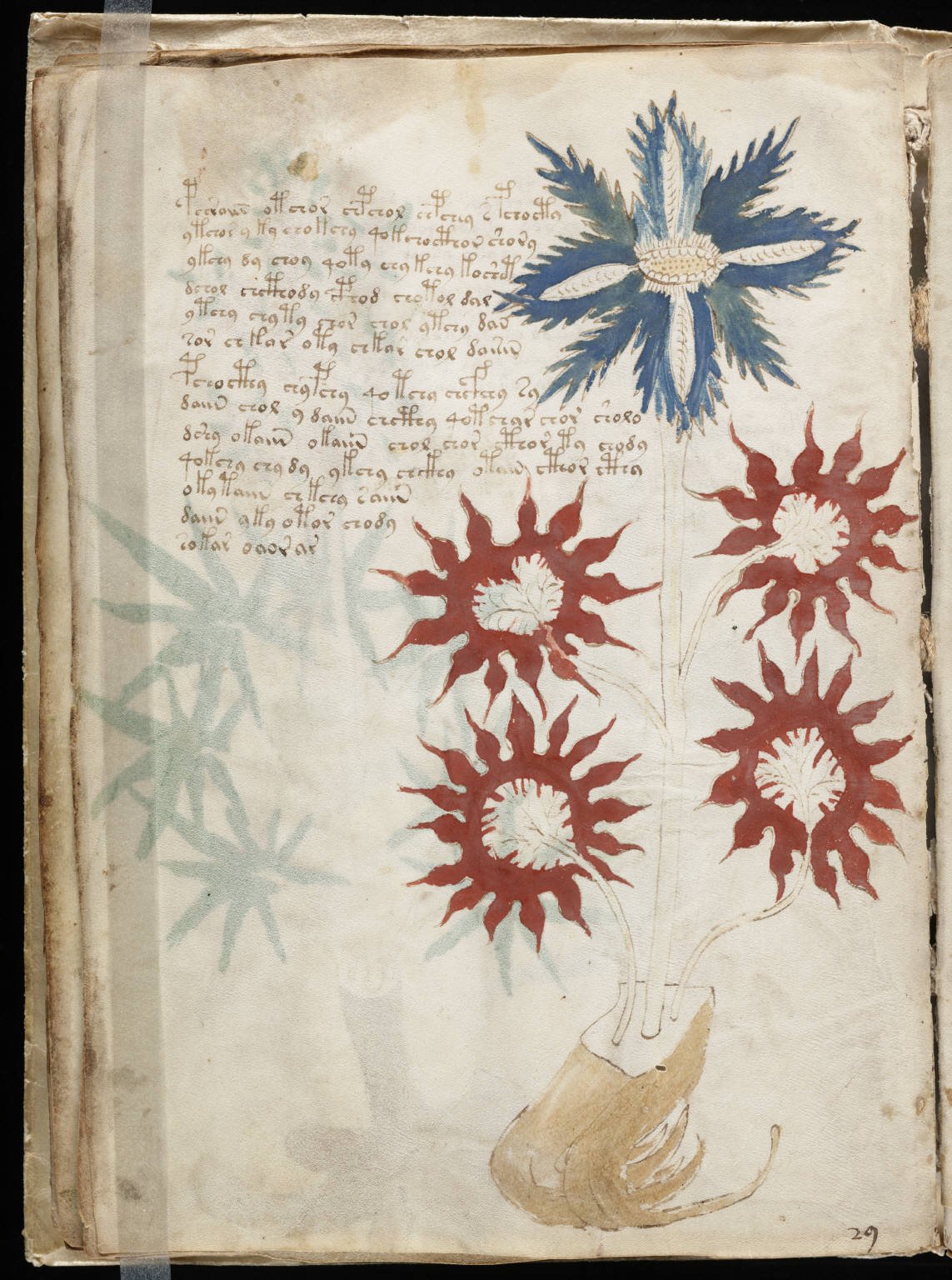
Picture a book you can open, page through and photograph in detail. Every line is handwritten. The ink is clear. And yet nobody can tell you what a single sentence says. That is the Voynich Manuscript. It is an illustrated book written in an unknown script, filled with plant drawings and astronomical diagrams. Today it sits in a library vault in the United States. Its text remains untranslated.
What is the Voynich Manuscript?
The Voynich Manuscript is a handwritten, illustrated book in a writing system no one has identified. Its pages carry drawings of plants, star charts and other diagrams. Yale University, which owns it, groups the content into six sections based on the pictures: plants, astronomy and astrology, baths, cosmological medallions, medicinal herbs, and what may be recipe texts.
The book measures 225 by 160 millimetres, roughly the size of a paperback you might carry on a train. People often say it has about 240 pages. The exact count depends on how you number its unusual folding leaves. Yale’s detailed catalogue records 102 parchment leaves plus one paper leaf, with the fold-outs included.
The author is unknown. Yale’s own feature from 21 February 2025 still describes the writer as an unidentified person. Yale linguist Claire Bowern notes that paleographic study has separated the hands of five different people who worked on the writing. So this was not one lone scribe.
How old is it?
The parchment has been radiocarbon dated. A 2019 paper by Zelinka, Zmeskal and Windsor summarises the result: the animal skin falls between 1404 and 1438. One caution applies. That range dates the parchment, not the ink. It is not a firm date for when the text was written. Still, it anchors the book in a specific period.
One older theory tied the book to Roger Bacon. Yale treats that link as speculation without evidence.
Voynich manuscript: where was it found?
The book takes its name from Wilfrid Voynich, a rare-book dealer. In 1912 he bought it from a Jesuit college at Frascati, near Rome. That is the moment the manuscript entered modern public life.
Its earlier trail runs through Prague. Johannes Marcus Marci wrote a letter about the book there, and that letter is preserved in Yale’s catalogue. It was written in Prague on 19 August, but the year reads as either 1665 or 1666. Marci’s letter also passes on a second-hand claim: Emperor Rudolf II once paid 600 ducats for the book.
Voynich manuscript: where is it now?
If you want to stand in front of it, you need to travel to New Haven, Connecticut. The manuscript is held at Yale University’s Beinecke Library under the number MS 408. Yale’s catalogue entry files it under the title Cipher manuscript.
It arrived there in 1969. The bookseller Hans Peter Kraus donated it to the Beinecke that year. Before that it had passed through private hands for more than half a century after Voynich’s purchase.
Voynich manuscript images: how to see every page
You do not need a plane ticket. Yale provides high-resolution images of the whole manuscript through its digital collections, and you can download the image files. This is the closest most people will get to the real thing, and it costs nothing.
There is also a physical option. In 2016 the Beinecke Library and Yale University Press published a photographic facsimile edition, with research essays explaining what is known. If you search for a Voynich manuscript book to buy, this facsimile is the official one.
Voynich manuscript PDF: what is real and what is not
Search results fill with offers of a Voynich manuscript PDF, a Voynich manuscript book PDF, and even a Voynich manuscript solved PDF. Be careful with the last one. The text has not been deciphered in any independently verified way. That means any file labelled as a solved PDF or a complete translation cannot be treated as a confirmed reading. The same goes for files advertised as a Turkish PDF translation.
Image scans are a different matter. Since Yale releases the page images itself, a PDF of the pictures can be legitimate. A PDF of the meaning cannot, because no verified meaning exists.
Has the Voynich manuscript been decoded or solved?
No. Yale’s current description calls the text undeciphered. It goes further: it is not even settled whether the text is a cipher at all. That is the honest state of the field.
Several claims have made headlines. Here are three.
The Turkish claim. In 2018 Ahmet Ardıç argued that the text is in a language derived from Old Turkic. He submitted his work to the journal Digital Philology. It was rejected in 2019.
The proto-Romance claim. In 2019 Gerard Cheshire announced he had read the text as a proto-Romance language. Specialists in medieval documents objected to his interpretations. On 16 May 2019 the University of Bristol stated that it had removed its news story promoting the research, after experts in linguistics and medieval studies challenged its validity.
The natural-language view. Not every study claims a solution. Bowern and Lindemann’s 2021 linguistics survey weighs the idea that the book is a medieval hoax against the idea that it holds a real language. They offer statistical reasons to favour natural language. They also state plainly that the content has not been read.
Voynich manuscript AI: can a computer crack it?
Artificial intelligence has been tried. In 2018 Greg Kondrak and Bradley Hauer at the University of Alberta ran a computer analysis that compared the text against samples of 400 languages. Hebrew came out as the most likely candidate.
Kondrak himself called this only a first step toward a solution. The team also acknowledged that experts in medieval manuscripts who reviewed the work were not convinced. So AI has produced a hypothesis, not a translation.
Voynich manuscript Reddit: separating discussion from evidence
Online forums carry endless Voynich threads. If you read them, keep one filter in mind. Ask whether a claim has been checked by people who read medieval manuscripts for a living. The Turkish, Hebrew and proto-Romance proposals all reached the public before passing that check. Bristol’s withdrawal of its own news story shows how fast a confident claim can fall apart under expert review.
Timeline
- 1404–1438 Radiocarbon range for the parchment. Not a firm date for the text.
- 1665/1666 Johannes Marcus Marci writes his letter about the book in Prague on 19 August; the year is unclear.
- 1912 Wilfrid Voynich buys it from the Jesuits at Frascati, near Rome.
- 1930 Voynich dies in March. The manuscript goes into a bank vault, where it stays for about 30 years.
- 1961 Hans Peter Kraus acquires it for 24,500 dollars plus half of any future sale proceeds.
- 1969 Kraus donates it to Yale’s Beinecke Library.
- 2016 Beinecke and Yale University Press publish the photographic facsimile.
- 2018 The University of Alberta’s AI-based Hebrew hypothesis and Ahmet Ardıç’s Turkish claim reach the public.
- 16 May 2019 The University of Bristol withdraws its news story on a claimed decipherment.
- 2021 Bowern and Lindemann publish their linguistics survey of the text’s structure.
- 21 February 2025 Yale’s feature presents the author as unknown and the text as untranslated.
Details you won’t find in guidebooks
It took a small herd. Yale curator Raymond Clemens estimates that around 14 to 15 calf skins went into the parchment.
A hidden signature. The first leaf carries a faded ownership signature of Jacobus Horcicky de Tepenec. It stayed faint until 1914, when Voynich applied an unidentified chemical to make it visible.
Thirty years in a bank. After Voynich died in March 1930, the manuscript spent about 30 years in a bank vault.
No buyer at 160,000 dollars. Kraus acquired it in 1961 for 24,500 dollars plus half of any future sale proceeds. He priced it at 160,000 dollars. Nobody bought it, and in 1969 he gave it away.
Nine medallions. On the large fold-out leaf numbered 85r to 86v, Yale’s catalogue describes nine medallions joined to one another by fibrous shapes.
FAQ
Where is the Voynich Manuscript today?
At Yale University’s Beinecke Library in New Haven, Connecticut, catalogued as MS 408.
Has the Voynich Manuscript been translated?
No. Yale describes the text as undeciphered, and it is not even certain that the text is a cipher.
Can I see the Voynich Manuscript pages online?
Yes. Yale provides high-resolution images of the whole manuscript through its digital collections and allows you to download the image files.
Is there a Turkish translation of the Voynich Manuscript?
Ahmet Ardıç proposed in 2018 that the text is in a language derived from Old Turkic, but his submission to Digital Philology was rejected in 2019. No verified translation exists in any language.
Who wrote the Voynich Manuscript?
Unknown. Paleographic study cited by Yale linguist Claire Bowern distinguishes five different people who worked on the writing.
Sources
- Yale Library — The Beinecke Cipher (Voynich) Manuscript beinecke.library.yale.edu
- Yale Library — Cipher manuscript catalogue record search.library.yale.edu
- Yale Beinecke — MS 408 detailed catalogue and Marci letter pre1600ms.beinecke.library.yale.edu
- Yale News — Deciphering a mysterious manuscript (21 February 2025) news.yale.edu
- Yale News — Mysterious Voynich Manuscript reborn in facsimile edition (2016) news.yale.edu
- University of Memphis — Unconventional methods in Voynich manuscript analysis (Zelinka, Zmeskal, Windsor, 2019) digitalcommons.memphis.edu
- University of Alberta — Using AI to uncover ancient mysteries ualberta.ca
- University of Bristol — Statement re: Voynich research paper bristol.ac.uk
- Bowern and Lindemann — The Linguistics of the Voynich Manuscript (SSRN) papers.ssrn.com
- English Wikipedia — Voynich manuscript en.wikipedia.org
- Turkish Wikipedia — Voynich el yazması tr.wikipedia.org
Image: Voynich Manuscript (32).jpg — Unknown authorUnknown author, Public domain