Who lies in Westminster’s Roman sarcophagus?
Westminster Abbey’s Roman sarcophagus carries the name of Valerius Amandinus, a wealthy man who lived in London around AD 300–400. Yet the male skeleton inside belongs to the Middle Ages. Radiocarbon testing placed the remains within AD 987–1052. Warwick Rodwell considers the Westminster abbot Ælfwig the strongest candidate for this later burial. His identity remains uncertain.
If you follow the inscription alone, you reach the Roman owner. If you follow the bones, you reach a medieval man. A Latin cross on the lid supplies another clue. It dates to the tenth or eleventh century and shows that the Roman tomb was reused long after its original dedication.
Rodwell’s study, Westminster Abbey’s Roman Sarcophagus and its Afterlife, appeared online in the Journal of the British Archaeological Association on 20 October 2026. It draws on a detailed examination of the sarcophagus and skeleton undertaken in 2016. The findings connect the stone container, its altered lid and its later occupant.
What does the Roman inscription tell you?
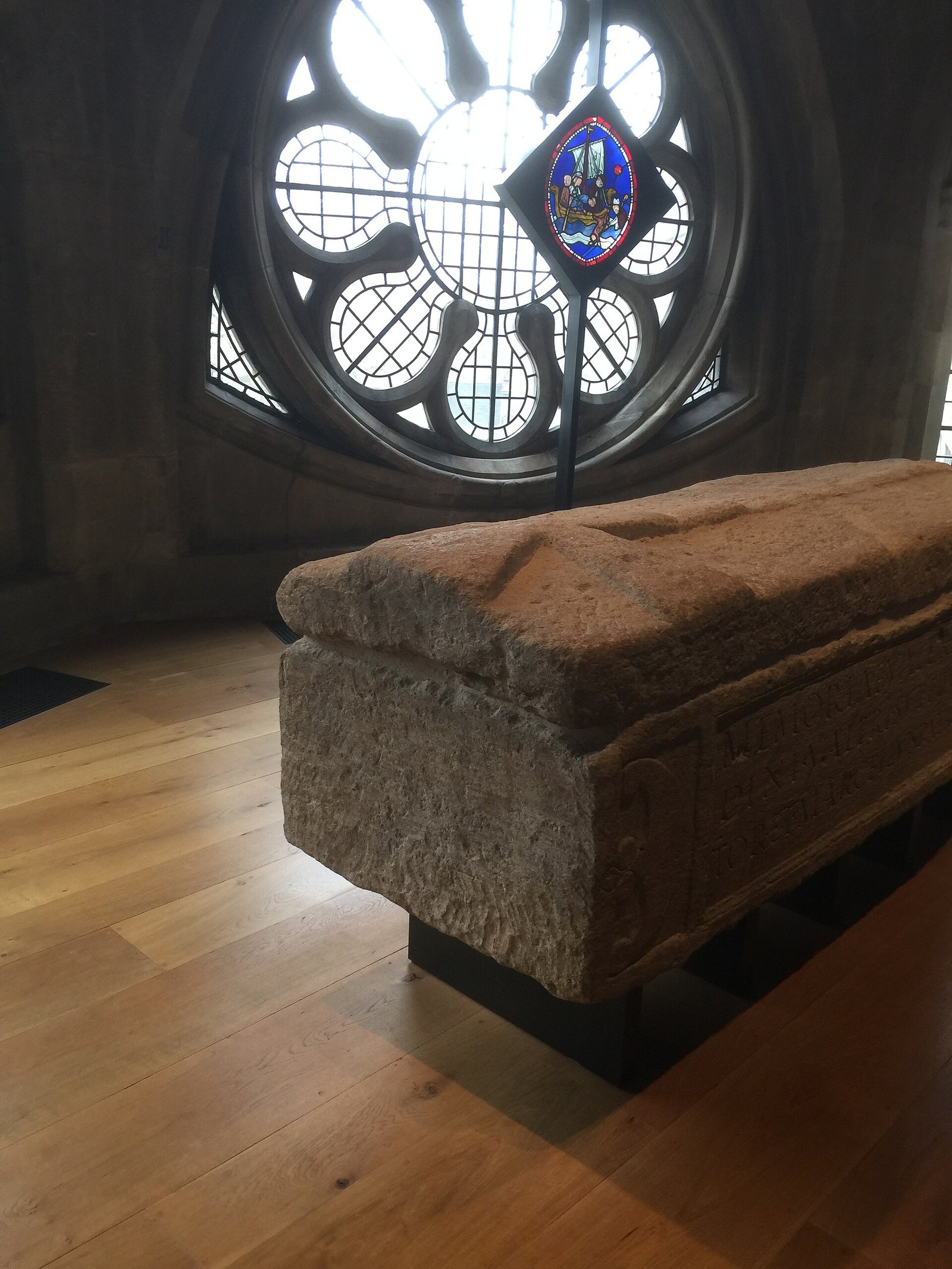
The limestone sarcophagus bears an inscription dedicated to Valerius Amandinus. He lived in London around AD 300–400. That dedication establishes a named connection for the ancient container. It does not identify the medieval skeleton recovered inside it.
The sarcophagus was carved from a single limestone block. It measures approximately two metres in length, with walls averaging ten centimetres thick. Those dimensions describe a substantial stone object. Its later movements around Westminster Abbey would reveal just how difficult it was to relocate.
Westminster Abbey stands in London’s Westminster district. Its official name is the Collegiate Church of Saint Peter at Westminster, and it is an Anglican church. Construction of the present church began in 1245 on the orders of Henry III. Both the Roman sarcophagus and the medieval man inside it therefore predate the beginning of that building campaign.
How did a Roman tomb become a medieval burial?
The Latin cross on the lid dates to the tenth or eleventh century. The bone sample, examined at the Scottish Universities Environmental Research Centre, produced a radiocarbon range of AD 987–1052. These findings place the lid’s medieval marking and the man’s remains within compatible periods. Together, they support the interpretation of a reused Roman burial container.
Rodwell argues that the valuable stone sarcophagus and its large cross suggest a high-ranking churchman. A Westminster abbot is his proposed explanation. This is an interpretation of the burial’s character. The cross and the stone container do not, by themselves, establish the occupant’s name.
There is an everyday connection here: you might keep using a valued possession long after its first owner. Rodwell gives the ancient container a more specific medieval context. According to him, stone coffin production had ceased in the late Anglo-Saxon period. Obtaining a secondhand Roman sarcophagus could therefore be a prestigious acquisition.
Simon Roffey, an archaeologist at the University of Winchester who did not participate in the research, urges further investigation into the reasons medieval Christians reused pagan graves. His caution concerns the motives behind reuse. The Westminster evidence establishes different periods for the Roman container and its surviving occupant, while the reasons for choosing it require interpretation.
Why is Abbot Ælfwig the leading candidate?
Ælfwig served as abbot of Westminster from 993 until his death around 1020. That death falls within the radiocarbon range of AD 987–1052. The chronological fit makes him a possible occupant of the reused sarcophagus. Rodwell places him ahead of the other proposed candidate.
Rodwell’s preference also rests on Ælfwig’s earlier connection with Westminster. Before becoming abbot, Ælfwig had been a monk there. Rodwell regards that history as a reason to favour him over his successor. It adds a biographical argument to the match between his death and the dated bones.
Wulnoth, Ælfwig’s successor, remains an alternative. He died in 1049, which also falls within the radiocarbon range. Rodwell notes that the birth dates of both men are unknown. Either could fit the skeleton’s estimated age at death. You can therefore distinguish a preferred candidate from a confirmed identification: Ælfwig is favoured, but Wulnoth remains possible.
What did the skeleton reveal?
James Young Langthorne, a human bone specialist at Pre-Construct Archaeology, identified the remains as those of a man who died between 35 and 49 years of age. He estimated the man’s height at approximately 1.75 metres. About 90 percent of the skeleton survived, according to the research reported by CNN.
These findings differ from the nineteenth-century assessment. That earlier examination described a person no older than 30 and approximately 1.70 metres tall. The modern assessment therefore changed both the estimated age and height of the occupant. The older description should not be used interchangeably with Langthorne’s findings.
The bones showed healed fractures, osteoarthritis and signs of gout. No evidence of a serious illness or injury explaining the death was identified. The skeleton preserves signs of injuries and joint disease, but those observations do not establish why this man died.
Timeline
- Around AD 300–400: Valerius Amandinus, named in the Roman sarcophagus’s dedicatory inscription, lives in London.
- AD 987–1052: Radiocarbon testing places the male skeleton within this date range.
- 993–around 1020: Ælfwig serves as abbot of Westminster until his death.
- 1049: Wulnoth, Ælfwig’s successor and another proposed occupant, dies.
- 1245: Construction of the present Westminster Abbey church begins on Henry III’s orders.
- 1820: Workers discover the sarcophagus, break its lid and rebury it.
- 1869: The sarcophagus is formally excavated in North Green. The damaged lid is repaired that year.
- 2016: Conservation work allows a detailed examination of the sarcophagus and skeleton.
- 20 October 2026: Rodwell’s study is published online.
How was the sarcophagus rediscovered?
Workers first found the sarcophagus in 1820. It was subsequently reburied without detailed documentation of its contents. This early encounter left an incomplete record of what had been inside the stone container when it was opened.
The formal excavation followed in 1869, in Westminster Abbey’s North Green. Afterwards, the sarcophagus was moved to the East Cloister. It later went to the base of the northwest tower. These movements form part of the object’s history after excavation, alongside the much earlier change from Roman tomb to medieval burial.
By the time of the 2016 investigation, the skeleton had been thought lost. Opening the sarcophagus in the conservation workshop revealed that the remains were still inside and nearly complete. Their survival made the detailed examination possible, including the assessment of age, height and skeletal conditions.
Details you won’t find in guidebooks
The damage from 1820 was extensive: workers broke the lid into six pieces. Repairs followed in 1869. The lid thus carries evidence of two very different interventions. Its Latin cross marks medieval reuse, while its repaired breaks belong to the history of its rediscovery.
Moving the sarcophagus to the base of the northwest tower took more than 36 hours because of its weight. Remember its construction when you picture that operation. The container was cut from one limestone block, approximately two metres long, with substantial stone walls.
A rectangular deposit of white lime was found on the bottom of the sarcophagus in 2016. It was interpreted as the trace of a wooden coffin that had completely decayed. This detail adds another element to the burial arrangement: a wooden coffin appears to have occupied the interior of the stone container.
The skeleton’s supposed disappearance also proved misleading. Nearly complete remains survived inside the sarcophagus when it was opened in the workshop. The contrast between that belief and the actual contents helps explain the importance of the 2016 examination. The bones were available for direct assessment after all.
Where can you see the sarcophagus?
The sarcophagus is on permanent display in The Queen’s Diamond Jubilee Galleries at Westminster Abbey. When you encounter it, keep its separate dates in mind. The inscription belongs to its Roman dedication. The cross indicates medieval reuse. The skeleton was dated to AD 987–1052.
Those distinctions make the object easier to understand. Valerius Amandinus is the man named on the Roman container. Ælfwig and Wulnoth are proposed identities for its medieval occupant. The surviving evidence supports reuse and a medieval burial, while Rodwell’s preferred identification remains a theory.
FAQ
Who lies in Westminster’s Roman sarcophagus?
The skeleton belongs to a medieval man whose identity remains uncertain. Warwick Rodwell considers Abbot Ælfwig the strongest candidate, while Ælfwig’s successor Wulnoth is another possibility.
Who was Valerius Amandinus?
Valerius Amandinus was a wealthy man who lived in London around AD 300–400. The Roman limestone sarcophagus bears an inscription dedicated to him.
How was the medieval reuse established?
A bone sample produced a radiocarbon date range of AD 987–1052. A Latin cross on the lid dates to the tenth or eleventh century and also indicates medieval reuse.
Where is the sarcophagus displayed?
The sarcophagus is on permanent display in The Queen’s Diamond Jubilee Galleries at Westminster Abbey.
Sources
- Westminster Abbey — Mystery of Abbey’s Roman Sarcophagus Solved westminster-abbey.org
- Warwick Rodwell, Journal of the British Archaeological Association — Westminster Abbey’s Roman Sarcophagus and its Afterlife doi.org
- Taylor & Francis — Mystery Skeleton Found in Roman Sarcophagus at Westminster Abbey May Finally Have an Identity newsroom.taylorandfrancisgroup.com
- CNN / Local News 8 — A Mystery Skeleton Found in a Roman Sarcophagus at Westminster Abbey May Finally Have an Identity localnews8.com
- Wikipedia — Westminster Abbey en.wikipedia.org
Image: Stone coffin – Roman.jpg — maggie jones., Public domain