What is the Council of Higher Education in Turkey?
The founding of YÖK followed the military coup of 12 September 1980. Law No. 2547 established the present Council of Higher Education on 6 November 1981, while military rule continued. It brought higher education into a central structure that directed institutions and supervised their work. For you, that date is the starting point for understanding how university leadership and organization changed after the coup.
The law was adopted on 4 November 1981. It appeared two days later in the Official Gazette, issue 17506. These dates mark different steps: adoption of the legislation and its publication. İhsan Doğramacı became YÖK’s founding president and served from 1981 to 1992.
The system being reorganized contained 19 universities in the 1980–1981 academic year. It had 237,369 students and 20,816 academic staff. The changes therefore affected existing institutions, their employees and their students. They also altered which institutions belonged within the university system.
Why had a YÖK already appeared before 1981?
The name YÖK did not originate after the coup. The Universities Law, No. 1750, had provided for a council with the same name in 1973. The present institution dates from 1981, but the earlier law shows that a higher body above universities had already entered legislation.
In 1975, the Constitutional Court annulled the earlier YÖK arrangement. It found that members drawn from the government side outnumbered university representatives, contrary to university autonomy. The composition of a supervisory council was therefore already a constitutional issue before the military coup of 1980.
How did YÖK centralize university government?
Article 6 of the original 1981 law defined YÖK as a permanent body with autonomy and public legal personality. Its role included regulating higher education and directing institutional activities. The law thus gave autonomy to the council itself while placing universities within a structure that could guide their work.
The original council had 25 members. The head of state selected eight, the Council of Ministers six, the General Staff one, the Ministry of National Education two and the Interuniversity Council eight. Selections made by authorities other than the head of state required the head of state’s approval before becoming final.
That distribution helps you see how the new authority was assembled. University representation formed part of the council, alongside selections by state, government and military authorities. The approval requirement also gave the head of state a role beyond choosing eight members directly.
Article 131 of the 1982 Constitution made YÖK a constitutional institution. It assigned the council responsibility for planning, regulating, administering and supervising higher education. YÖK’s position consequently rested on both the 1981 law and the constitutional framework that followed it.
How were university rectors chosen after the coup?
The original Article 13 established a specific appointment procedure. YÖK proposed four people, and the head of state appointed a rector from that group for five years. The council controlled the proposed candidates, while the final choice belonged to the head of state.
This arrangement placed rector selection within the central system created by Law No. 2547. If you want to understand the autonomy debate, the appointment procedure is a concrete place to begin. The authority to propose and appoint university leaders lay with YÖK and the head of state under the original provision.
What changed for universities and students?
The restructuring converted academies into universities and reorganized education institutes. Conservatories and vocational higher schools became attached to universities. These measures changed institutional relationships across higher education, bringing different types of teaching establishments into the university framework.
As academies and higher schools attached to ministries entered the system, the number of state universities rose from 19 in 1981 to 27 in 1982. That increase must be read alongside the institutional transfers. The numerical expansion included the reorganization of establishments that already existed.
The Student Selection and Placement Centre also became attached to YÖK when the council was established. Central oversight therefore extended to the body responsible for student selection and placement, as well as to university organization and leadership.
Marmara University offers a specific example of the restructuring. It was established on 20 July 1982 through Decree-Law No. 41, which reorganized higher education institutions. Its founding belongs to the same institutional transformation that increased the number of state universities.
Article 130 of the 1982 Constitution opened another route for higher education. It allowed foundations to establish higher education institutions under state supervision and control, provided they did not operate for profit. Alongside the reorganization of state institutions, the constitutional framework thus permitted foundation higher education.
How did open education enter everyday life?
Decree-Law No. 41, dated 20 July 1982, assigned Anadolu University responsibility for open education across the country. Its system began teaching in the 1982–1983 academic year through two distance education programs: Economics and Business Administration. The first year brought 29,500 registrations.
Here the institutional story connects with an everyday activity: watching television. Anadolu’s first televised lessons began on TRT 1 on 15 January 1983. You can connect the founding period to something as familiar as switching on a television, because broadcasting became a channel for university lessons. The programs made the restructuring visible beyond university administration.
Did YÖK remove university autonomy?
Autonomy was disputed during the creation of the system. In 1981, Ankara University’s Faculty of Political Sciences argued that the proposed legislation abolished autonomy. Supportive views from the same period argued that YÖK would address shortages of academic staff at universities in Anatolia. These positions attached different priorities to central coordination.
The legal distinction matters. Article 130 of the 1982 Constitution recognized scientific autonomy for universities. That guarantee should be considered separately from the power to choose university leaders. Scientific autonomy and the original system of centrally appointed rectors existed within the same constitutional and legislative setting.
What happened to academics who left?
Academic departures formed another disputed part of the period. Aziz Kılıç’s research describes resignation, retirement and departure abroad as responses to YÖK and the implementation of Law No. 1402. It also records Doğramacı’s position in 1982: he rejected the claim of a purge and explained departures through employment opportunities and working preferences.
Kılıç reports a list of 1,255 people who left or were removed. Of these, 73 were directly classified under Law No. 1402. The remaining 1,182 belonged to other categories, including resignation, retirement and nonrenewal of appointments. The total therefore combines several kinds of departure; it cannot be treated as a single category of dismissal.
Details you won’t find in guidebooks
The original text of Law No. 2547 reached into the curriculum. Alongside Atatürk’s Principles and History of the Revolution, Turkish language and a foreign language, it required either physical education or a branch of fine arts. The founding legislation addressed what students studied as well as how institutions were governed.
Marmara’s establishment also changed a specific institution’s status. The Istanbul Higher Islamic Institute, previously attached to the Ministry of National Education, became the university’s Faculty of Theology in 1982. This example shows how a transfer into the university system could involve a change in institutional form.
Changes also reached below university and faculty level. According to the institutional history of Ankara University’s Field Crops Department, Law No. 2547 abolished its chair structure. The unit took the name Field Crops Main Scientific Branch. The department’s history records the reform through an internal academic reorganization.
Timeline
- 1973: Law No. 1750 provided for an initial Council of Higher Education.
- 1975: The Constitutional Court annulled that YÖK arrangement.
- 12 September 1980: The military coup took place.
- 4 November 1981: Law No. 2547 was adopted.
- 6 November 1981: The law was published, establishing the present YÖK.
- 1981–1992: İhsan Doğramacı served as founding president.
- 20 July 1982: Decree-Law No. 41 reorganized higher education institutions.
- 1982: State universities numbered 27, and YÖK gained constitutional status.
- 1982–1983: Anadolu began its Economics and Business Administration distance programs.
- 15 January 1983: Anadolu’s first television lessons began on TRT 1.
- 1992: YÖK launched an overseas scholarship program.
- 2004: A constitutional amendment ended the General Staff’s selection of a YÖK member.
How did the system develop after its founding?
YÖK’s overseas scholarship program began in 1992. Supported students were required to serve in Turkish universities after returning for twice the duration of their scholarships. The program connected study abroad with a subsequent service obligation within Turkey’s university system.
In 2004, a constitutional amendment removed the General Staff’s role in selecting a YÖK member. That change altered a military role included in the original council’s composition. It marks a later change to the structure established after the 1980 coup.
FAQ
When was YÖK founded?
The present YÖK was founded on 6 November 1981, when Law No. 2547 was published. The law had been adopted on 4 November.
How did the original YÖK system appoint rectors?
Under the original Article 13 of Law No. 2547, YÖK proposed four candidates. The head of state appointed one for a five-year term.
Did the 1982 Constitution recognize university autonomy?
Article 130 recognized scientific autonomy. That guarantee must be distinguished from universities’ authority to choose their own leaders.
Where is Turkey’s Council of Higher Education based?
YÖK is based in the Çankaya district of Ankara.
Sources
- Türk Maarif Ansiklopedisi — Yükseköğretim Kurulu turkmaarifansiklopedisi.org.tr
- Official Gazette — Original text of Law No. 2547 static.bianet.org
- Anadolu Agency — Founding president of Turkey’s Higher Education Board passes away aa.com.tr
- TÜBİTAK Encyclopedia — YÖK ansiklopedi.tubitak.gov.tr
- TOBB — 2011 Turkish Higher Education Sector Report tobb.org.tr
- Marmara University — Institutional history oidb.marmara.edu.tr
- Anadolu University — Open Education Faculty general information anadolu.edu.tr
- Anadolu University — Açıköğretim ile 40 Yıl cdn.anadolu.edu.tr
- Constitutional Court — Journal of Decisions, Issue 26 anayasa.gov.tr
- Karavar and Efilti Atay — Representation of Law No. 2547 and YÖK in the contemporary press dergipark.org.tr
- Atatürk Research Center — Aziz Kılıç, Türkiye’de Askerî Darbelerin Eğitim ve Kültür Hayatı Üzerindeki Etkileri atam.gov.tr
- Ankara University — Field Crops Department history tarla.agri.ankara.edu.tr
- Wikipedia — Council of Higher Education (Turkey), including its reference to Julie Mathews’s 2007 research) en.wikipedia.org
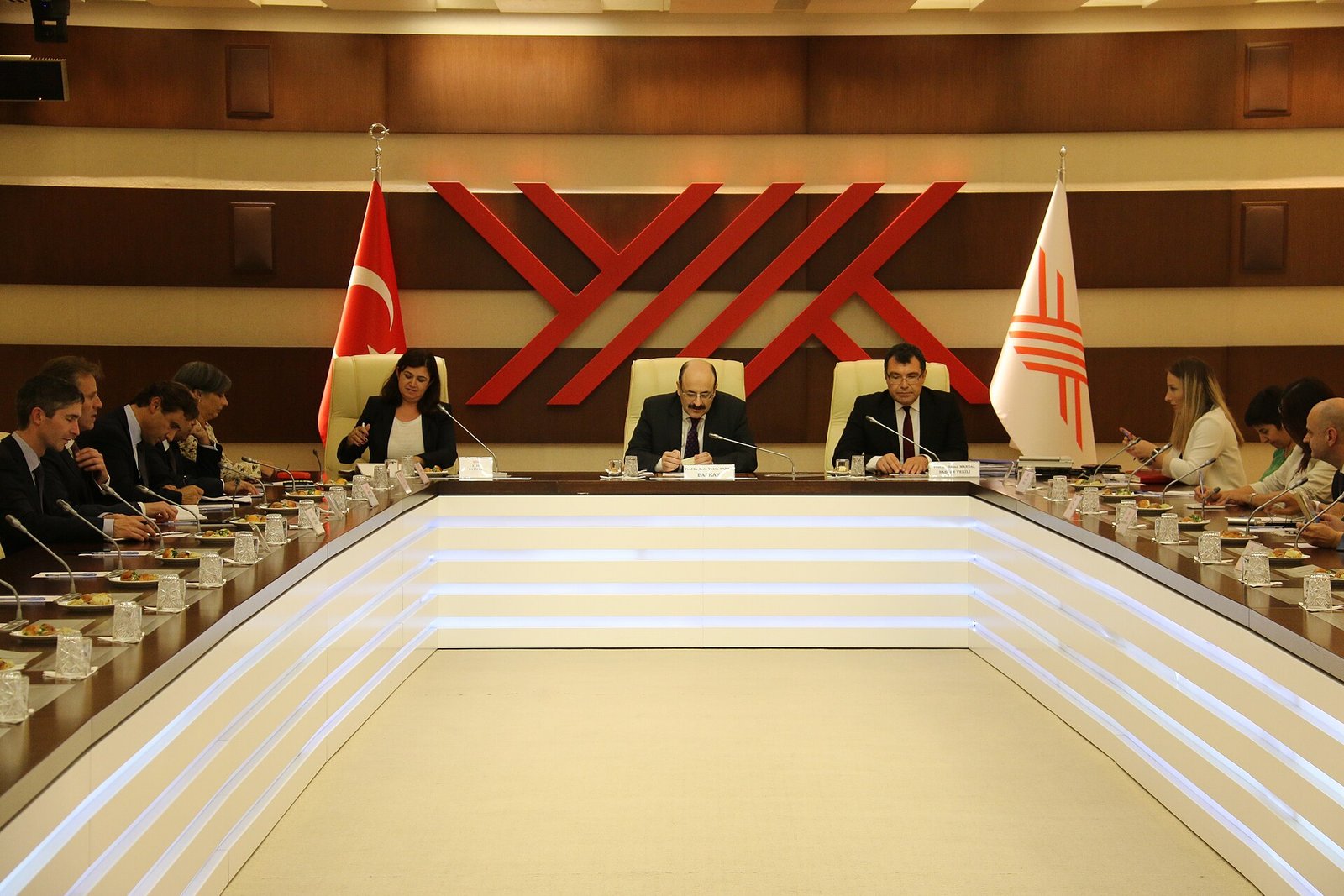
Image: The OSCE PA delegation meets with the Council of Higher Education, Ankara, 17 August 2016 (29061636485).jpg — OSCE Parliamentary Assembly from Copenhagen, Denmark, CC BY-SA 2.0