Dolmabahçe Palace stands in Istanbul’s Beşiktaş district, on the strip of land between Dolmabahçe Caddesi and the Bosphorus. Six sultans and the last caliph lived here. Mustafa Kemal Atatürk spent about four years of his later life in it and died in one of its rooms. This guide covers the history, the famous room, and the practical details you need before you go.
Dolmabahçe Palace History: How a Bay Became a Garden
The name explains the site. Dolma means filled, and bahçe means garden. From the 17th century, a bay used by the Ottoman navy was gradually filled in. The new land became a private garden of the sultans.
Sultan Abdülmecid later had the old Beşiktaş Shore Palace demolished. He built Dolmabahçe Palace in its place. The Atatürk Encyclopedia gives the construction period as 1843 to 1856. The TDV Islamic Encyclopedia says the palace opened on 7 June 1856.
The Directorate of National Palaces names four people in the building process: Karabet Balyan, Ohannes Serveryan, Nikoğos Balyan and James William Smith.
The style is mixed. Baroque, Rococo and Neoclassical elements are combined with traditional Ottoman architecture.
Is Dolmabahçe the Last Ottoman Palace?
The popular label says yes. The official description is more careful. The Directorate of National Palaces calls Yıldız Palace the last large palace built in Istanbul. So “the last Ottoman palace” is misleading if you take it literally.
What is true is still striking. Six Ottoman sultans lived at Dolmabahçe. So did Abdülmecid Efendi, the last caliph.
Who Lived There
The palace served the Ottoman court in its final decades. After the sultanate ended, the last caliph, Abdülmecid Efendi, also lived here. In 1923 he had a bathroom built next to what is now called the Pink Hall.
The Republic then used the building too. Atatürk stayed here at intervals between 1927 and 1938, about four years in total. Under İsmet İnönü, the palace served as the presidential office until 1949.
How the Palace Is Laid Out
The main building has three functional parts:
- Selamlık: the section for administration.
- Harem: the private living quarters of the dynasty.
- Muayede Hall: the hall for state ceremonies.
The inventory of the National Palaces lists 285 rooms, 44 halls, 68 toilets and 6 baths. You will not see all of them on a visit, but the numbers show the scale.
The Muayede Hall holds a British-made crystal chandelier. It weighs about 4.5 tons and burns 750 lights. Think of a normal living room with one ceiling lamp. Here, a single fixture carries 750.
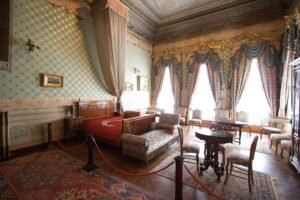
Atatürk’s Room: Room 71
Atatürk died on 10 November 1938 at 09.05. The place was his bedroom in the Harem section. It is room 71, between the Blue Hall and the Pink Hall.
The clock in the room shows 09.05. It was a gift to Atatürk from Nuri Conker.
Most visitors read this as a memorial detail, and it is one. It is also a simple reminder of how precise the record is. The date, the hour and the room number are all known.
Details You Won’t Find in Guidebooks
Some small facts that rarely reach the guidebooks make the rooms feel lived in.
- The study next door. Atatürk used room 69, right beside his bedroom, as his study.
- The lift. In June 1937, an elevator was installed for him in the bright section of the Blue Hall.
- The caliph’s bathroom. Atatürk used the bathroom that Abdülmecid Efendi had built in 1923 next to the Pink Hall.
- The medicines. The Culture Portal notes that the medicines used in his treatment are displayed in a glass cabinet at the bathroom entrance.
Timeline
- 17th century: The bay is filled in and becomes the Dolmabahçe private garden.
- 1843–1856: Construction of the palace, according to the Atatürk Encyclopedia.
- 7 June 1856: The palace opens, according to the TDV Islamic Encyclopedia.
- 1927: Atatürk begins to stay at the palace; his stays continue until 1938.
- June 1937: An elevator is built for Atatürk in the Blue Hall.
- 10 November 1938: Atatürk dies at 09.05 in room 71.
- 1949: The palace stops serving as the presidential office.
- 1984: The palace opens to visitors as a museum-palace.
Dolmabahçe Palace Opening Hours
The palace is closed on Mondays. This was checked on the official page on 24 October 2026.
The ticket office opens at 09.00 and closes at 17.00. The visit plan at the top of the same page shows 09.00 to 17.30. The detailed section gives the ticket office closing time as 17.00. Plan to be in the queue before 17.00.
Dolmabahçe Palace Ticket Price and Entrance Fee
On 24 October 2026, the official tariff for the combined Selamlık, Harem and Painting Museum ticket was:
- Turkish visitors: 250 TL
- Foreign visitors: 2,000 TL
- Discounted visitors: 150 TL
One rule matters if you travel with a Museum Card. According to the official rules checked that day, the Museum Card is not valid in the Selamlık section.
Dolmabahçe Palace Tickets: Official Website
Use the National Palaces ticket page: millisaraylar.gov.tr/Bilet/BiletAl. It offers a link for Turkish citizens and a separate e-ticket form for foreign visitors.
Where Is Dolmabahçe Palace and How to Get There
The palace is in Beşiktaş, Istanbul, on the Bosphorus shore. Its map coordinates are about 41.03944 N and 29.00167 E. The Culture Portal lists the Bağcılar–Kabataş tram line among the ways to reach it.
The Treasury Gate is the monumental gate of the palace. It is near the Clock Tower. Look for both when you arrive.
Photos
The Culture Portal page for Dolmabahçe Palace carries palace photographs credited to Hamit Yalçın and Gülcan Acar. They are a good way to preview the interiors before you decide which rooms matter most to you.
FAQ
Is Dolmabahçe the last Ottoman palace?
Not strictly. The Directorate of National Palaces describes Yıldız Palace as the last large palace built in Istanbul. Dolmabahçe was the home of six sultans and the last caliph, Abdülmecid Efendi.
Which day is Dolmabahçe Palace closed?
Mondays. This was the information on the official palace page when it was checked on 24 October 2026.
How much is a Dolmabahçe Palace ticket for foreign visitors?
On 24 October 2026 the official price for the combined Selamlık, Harem and Painting Museum ticket was 2,000 TL for foreign visitors. Prices can change, so check the official site before you go.
Where did Atatürk die in Dolmabahçe Palace?
He died in the bedroom in the Harem section, room 71. It lies between the Blue Hall and the Pink Hall. The date was 10 November 1938, at 09.05.
Does the Museum Card work at Dolmabahçe Palace?
Not in the Selamlık section, according to the official rules checked on 24 October 2026.
Sources
- Millî Saraylar — Dolmabahçe Sarayı millisaraylar.gov.tr
- Millî Saraylar — Yıldız Sarayı millisaraylar.gov.tr
- Kültür Portalı — Dolmabahçe Sarayı kulturportali.gov.tr
- TDV İslâm Ansiklopedisi — Dolmabahçe Sarayı islamansiklopedisi.org.tr
- Atatürk Ansiklopedisi — Atatürk ve Dolmabahçe Sarayı ataturkansiklopedisi.gov.tr
Image: Dolmabahçe Palace and Sultans gate april 19 2014.jpg — This Photo was taken by Wolfgang Moroder.
Feel free to us, CC BY-SA 3.0