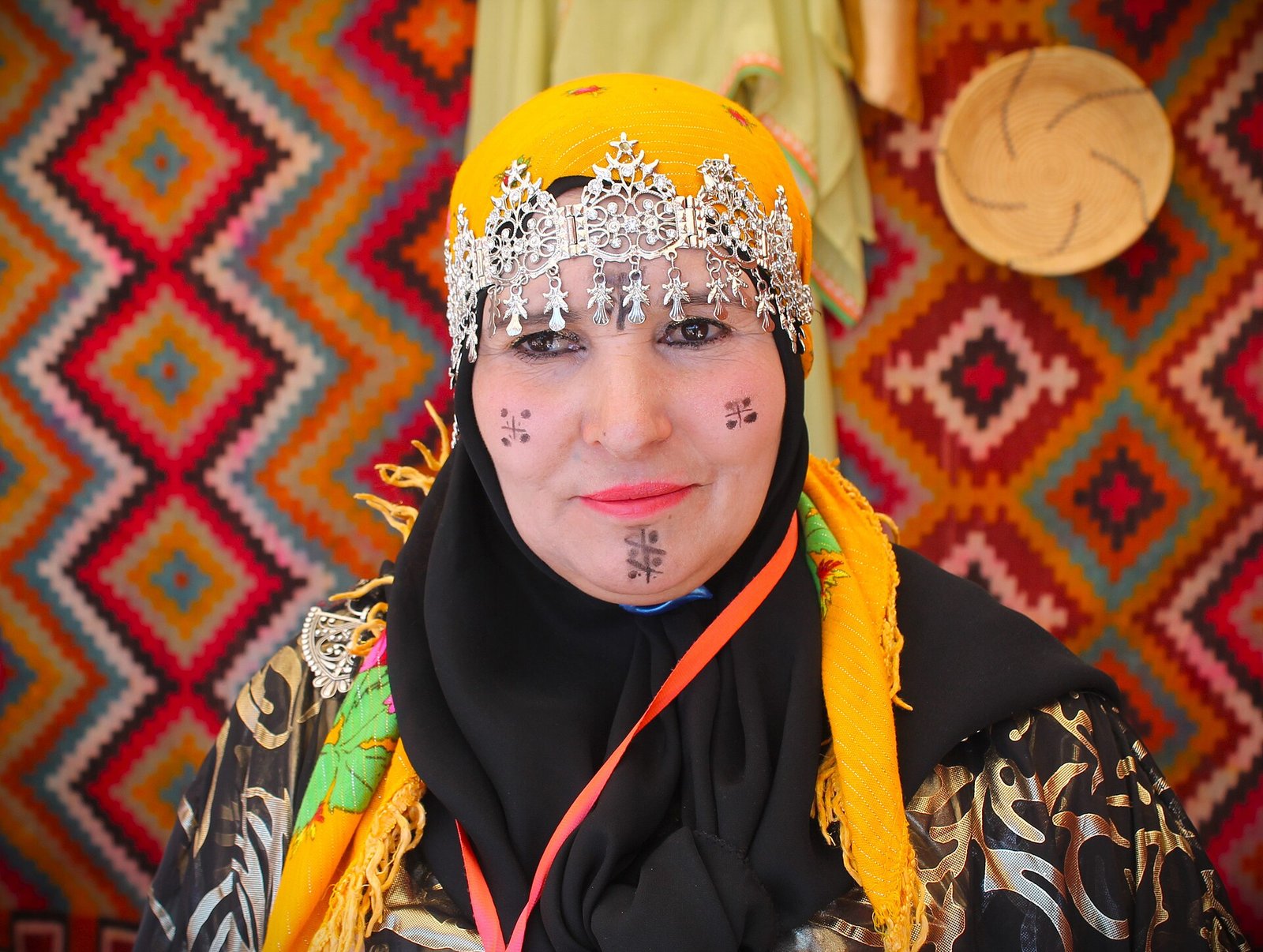
The Amazigh are Indigenous peoples of North Africa whose roots precede the Arab conquests. Often called Berbers, they comprise several ethnic communities. Morocco and Algeria are major centers of Amazigh life, but their communities extend across North Africa and into the Sahara and Sahel.
If you are trying to understand the difference between Amazigh and Arabs, start with identity and language. Amazigh communities have their own ethnic designations and speak languages belonging to a different Afroasiatic branch from Arabic. Most are Muslim, but their gradual adoption of Islam did not require abandoning Berber languages.
What does Berber mean, and who are the Berber people?
Berber is an established name for the Indigenous Amazigh peoples of North Africa. The name is connected to barbarus, a term Romans used for peoples who did not speak Latin. Its linguistic history therefore differs from that of the communities’ own names.
Amazigh is singular; Imazighen is plural. Many community members now prefer this self-designation or a regional name over Berber.
The familiar explanation that Amazigh means “free person” is disputed. Stéphane Gsell’s interpretation associated the word with nobility or freedom. Other researchers consider that explanation an excessive extension of its meaning. Treating it as a settled dictionary definition conceals that disagreement.
Where did the Berbers come from?
Amazigh origins are rooted in North Africa’s Indigenous populations before the Arab conquests. Their history therefore reaches further back than the seventh-century expansion that began the region’s gradual Islamization. The term describes communities with longstanding regional roots, rather than a population introduced by those conquests.
The Numidian kingdom belongs to this earlier history. According to the TDV İslâm Ansiklopedisi, it united Berbers in territories within present-day Algeria and Tunisia. It fell in 46 BCE.
Shared Indigenous roots do not make Amazigh communities a genetically uniform population. A 2017 genomic study compared five Berber and six Arab populations. Its findings do not support treating Berber groups as wholly isolated or genetically homogeneous. Historical identity and biological uniformity are different claims.
Where are the Berbers of North Africa today?
Amazigh communities live chiefly in Morocco and Algeria. They also live in Tunisia, Libya, Egypt, Mauritania, Mali, Niger and Burkina Faso. Their geography includes mountain regions, desert oases and the Sahara–Sahel belt. Communities also live in cities and rural areas, with diasporas in Europe and North America.
In Algeria, Kabyle communities are concentrated in mountainous Kabylia, between Algiers and Constantine. Shawiya communities are associated with the Aurès Mountains in eastern Algeria. These regional names help explain why a single broad label can conceal important differences in local identity.
Egypt’s Siwa Oasis, in the western desert, is an eastern center of Amazigh settlement. Tuareg communities belong to the Amazigh world of the Sahara and Sahel, particularly in Mali and Niger. Amazigh geography thus extends well beyond the Moroccan and Algerian mountain regions.
Where do Berbers live in Morocco?
Morocco’s principal Amazigh settlement areas include the Rif Mountains in the north, the Middle Atlas, the High Atlas, the Anti-Atlas and the Sus Valley. These places provide a more precise geographical picture than treating all Moroccan Amazigh communities as one mountain population.
If you encounter Amazigh culture through a visit to Morocco, museums provide concrete regional connections. The Aït Bougmez Ecomuseum presents everyday life in the High Atlas. In Marrakech, the Pierre Bergé Museum of Berber Arts displays objects collected across regions stretching from the Rif to the Sahara.
Morocco recognized Amazigh as an official language through its 2011 constitutional reform. This modern legal status sits alongside the language’s longstanding place in Amazigh communities. Algeria later elevated Tamazight from national-language status to official-language status in 2016.
What languages do the Amazigh speak?
Berber languages, also called Tamazight, form a branch of the Afroasiatic language family. Oxford’s linguistic reference classifies this branch as approximately forty languages. The name Tamazight therefore needs to be understood alongside the diversity contained within the wider Berber language group.
Arabic and Berber languages belong to separate branches of Afroasiatic. Their membership in the same language family does not make Berber a form of Arabic. This distinction is central to understanding how Amazigh linguistic identity differs from Arab linguistic identity in North Africa.
Berber languages also use more than one writing system. Tifinagh was preserved and developed by Tuareg communities. Latin and Arabic letters are used as well. If you see a Berber language written in Arabic letters, the script alone does not establish that the language is Arabic.
Berbers vs Arabs: what are the differences?
Amazigh and Arab are different ethnic designations. Language provides another distinction: Berber languages and Arabic represent separate Afroasiatic branches. These differences remain relevant even though Islam became the majority religion among Amazigh communities after the Arab conquests.
Islamization began gradually following the conquests that started in the seventh century. Adopting Islam did not require every Amazigh community to abandon its language. Religious affiliation therefore cannot, by itself, tell you whether a North African community identifies as Amazigh or Arab.
Most Amazigh are Sunni Muslims. The Mozabite Amazigh of the Mzab Valley around Ghardaia in Algeria follow the Ibadi tradition instead. This religious difference is another reason to avoid presenting all Amazigh communities as identical in their beliefs and practices.
For readers familiar with the history of Turkey, another distinction matters: Berber refers to North Africa’s Indigenous Amazigh peoples, not the Kurds. The geographical and ethnic designation concerns communities extending across countries such as Morocco, Algeria, Tunisia, Libya and Egypt.
Berbers vs Moors: are the names interchangeable?
Equating Berbers with Moors requires care. Some researchers identify the Mauri of Late Antiquity with Berbers. Historian Ramzi Rouighi challenges the direct equation of categories such as Moor and Berber across different historical periods.
The disagreement concerns how historical labels are applied. A reference to Mauri or Moors should not automatically become a precise statement about Amazigh identity. Rouighi’s argument makes the period and use of the name part of the historical question itself.
Timeline
- 46 BCE: The Numidian kingdom falls.
- Seventh century: Arab conquests begin a period of gradual Islamization among Amazigh communities.
- 702: According to the TDV chronology, Kâhine dies fighting the forces of Hassân b. Nu‘mân after leading resistance among the Aurès Berbers.
- 1056–1147: The Berber Almoravids rule from Marrakech across large parts of North Africa and al-Andalus.
- 1130–1269: The Berber Almohad dynasty rules. It grows from the movement begun by Ibn Tûmert of the Masmuda Berbers.
- 2011: Morocco recognizes Amazigh as an official language. The Pierre Bergé Museum of Berber Arts opens in Marrakech.
- 2016: Algeria makes Tamazight an official language.
- 2017: UNESCO places Taskiwin on its List of Intangible Cultural Heritage in Need of Urgent Safeguarding.
Details you won’t find in guidebooks
A Tuareg takuba sword from the Algerian Sahara in Harvard’s Peabody Museum carries a steel blade manufactured in Europe in the sixteenth century. The object combines a Tuareg sword with a European-made component. It offers a concrete example of why material culture cannot always be assigned to a single place of manufacture.
Everyday life offers another useful connection. At the Aït Bougmez Ecomuseum, information about Amazigh daily life is shared over mint tea. That documented practice provides a direct counterexample to the sweeping claim that Berbers do not drink mint tea.
The Pierre Bergé Museum of Berber Arts occupies Jacques Majorelle’s former painting studio in Marrakech. Opened in 2011, it displays more than 600 objects from regions between the Rif and the Sahara. Its collection gives the broad term Berber a range of material examples.
Taskiwin is a dance associated with Morocco’s western High Atlas. Its name comes from the decorated Tiskt horn carried by dancers. UNESCO added it to the urgent safeguarding list in 2017, connecting a specific regional practice with an identified need for protection.
FAQ
Who are the Berber people?
Berbers, also called Amazigh or Imazighen, are a collection of ethnic communities connected to North Africa’s Indigenous peoples before the Arab conquests.
Where are the Amazigh from?
The Amazigh are Indigenous to North Africa. Their communities live especially in Morocco and Algeria, with others across North Africa and the Sahara–Sahel region.
Are Berbers and Arabs the same people?
Amazigh and Arab are different ethnic designations. Berber languages and Arabic also belong to separate branches of the Afroasiatic language family.
What language do the Amazigh speak?
They speak Berber languages, also called Tamazight. Oxford’s linguistic reference classifies this branch of the Afroasiatic family as approximately forty languages.
Are the Amazigh Muslim?
Most Amazigh are Sunni Muslims. The Mozabites of Algeria’s Mzab Valley follow the Ibadi tradition of Islam.
Sources
- Wikipedia — Berbers en.wikipedia.org
- Bruce Maddy-Weitzman — Berbers (Amazigh) dayan.org
- Oxford Bibliographies — Berber Languages and Linguistics academic.oup.com
- Arauna and colleagues — Recent Historical Migrations pmc.ncbi.nlm.nih.gov
- Vikipedi — Berberiler tr.wikipedia.org
- TDV İslâm Ansiklopedisi — Berberîler islamansiklopedisi.org.tr
- Ramzi Rouighi — The Berbers of the Arabs brill.com
- Harvard Peabody Museum — The Tuareg: Nomads of the Sahara peabody.harvard.edu
- Aït Bougmez Valley Ecomuseum — Museum introduction touda.fr
- Jardin Majorelle — Pierre Bergé Museum of Berber Arts jardinmajorelle.com
- UNESCO — Taskiwin, martial dance of the western High Atlas ich.unesco.org
Image: The Radiant Smile of Amazigh Heritage.jpg — Muhammed amine benloulou, CC BY-SA 4.0