Who was Blackbeard, the real pirate of the Caribbean?
Blackbeard was a real English pirate who operated in the Caribbean and along North America’s Atlantic coast in the early eighteenth century. Records call him Edward Teach or Edward Thatch. His best-known ship was Queen Anne’s Revenge, a captured French slave ship that he turned into a heavily armed pirate vessel.
If you want to understand Blackbeard, start with that ship and his short, documented career. The earliest primary document naming him identified in archaeologist David Moore’s research dates to the summer of 1717. By 22 November 1718, he was dead after a fight at Ocracoke.
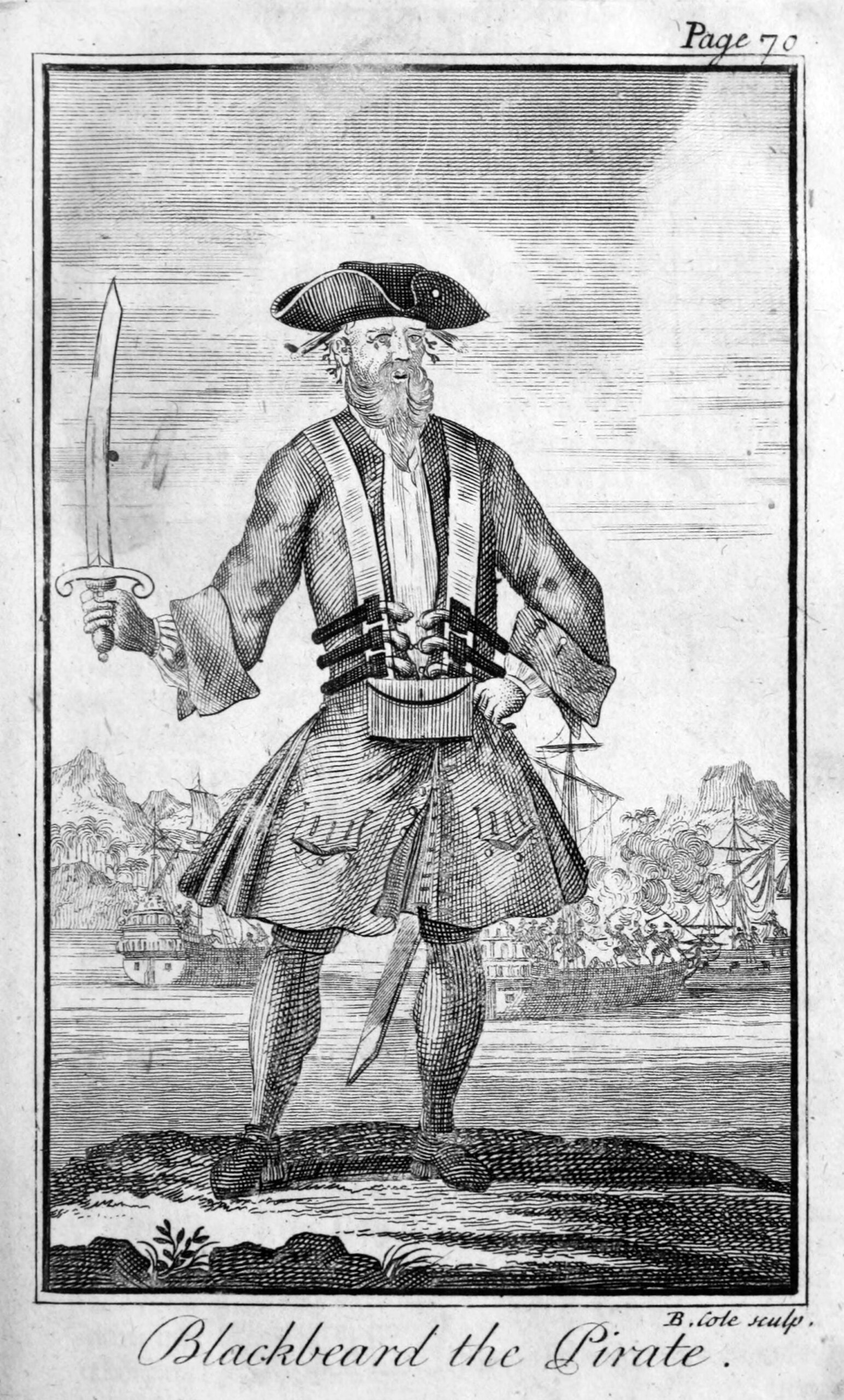
His thick black beard supplied his nickname. Smoke strengthened the effect. The South Carolina Encyclopedia describes him boarding ships with burning fuses in his beard and hair. His frightening appearance was something he deliberately intensified.
Where was Blackbeard from?
Blackbeard was English, but the familiar account of his birth needs care. A birth in Bristol around 1680 is a theory. The Oxford Dictionary of National Biography states that his original name and birthplace are not firmly established.
His early pirate career becomes clearer in the Bahamas. Around 1716, he is generally understood to have joined Benjamin Hornigold’s crew on New Providence. This places him in a specific pirate company before his own name appears in the surviving document identified by Moore.
In autumn 1717, Blackbeard commanded Revenge, a sailing vessel belonging to the pirate Stede Bonnet. He captured 11 ships along the North American coast. These captures preceded his acquisition of the larger vessel that became Queen Anne’s Revenge.
What was Blackbeard’s pirate ship?
In November 1717, Blackbeard captured La Concorde off Martinique. The vessel was a French slave ship. He renamed it Queen Anne’s Revenge and equipped it with 40 guns. Under his command, it carried more than 300 people.
The ship’s earlier identity matters. Queen Anne’s Revenge entered Blackbeard’s career through the capture of a vessel already engaged in the slave trade. Archaeological evidence later helped connect the wreck near Beaufort Inlet with this French ship.
Blackbeard used Queen Anne’s Revenge with three smaller sailing vessels to blockade Charleston in May 1718. The blockade lasted about a week. His demand for releasing hostages was a chest of medicines. When the medicines arrived, he released them.
In June 1718, Queen Anne’s Revenge and Adventure ran aground on a sandbar at the passage now called Beaufort Inlet in North Carolina. Both were abandoned. Witness David Herriot claimed the grounding was deliberate. The Queen Anne’s Revenge Project does not establish whether that accusation was correct.
Who belonged to Blackbeard’s crew?
Blackbeard’s men included Black and white sailors. According to the National Park Service, they also included former privateers and people taken from captured ships. The crew therefore drew together men with different backgrounds and different routes into piracy.
Capture could mean forced service. When La Concorde fell to Blackbeard, 10 French crew members were compelled to join the pirates. Among them were three surgeons, two carpenters and a cook. Their occupations show some of the practical skills aboard the captured vessel.
The size of Blackbeard’s following changed. Queen Anne’s Revenge carried more than 300 people under his command. In June 1718, about 30 men accompanied him to Bath, then North Carolina’s capital. There, he swore allegiance to the Crown and received a royal pardon.
What did Blackbeard’s flag look like?
A newspaper report from 1718 describes black flags bearing skulls and red flags in Blackbeard’s fleet during an attack on Protestant Caesar. This is contemporary evidence for flags associated with his pirates.
The familiar image of a horned skeleton stabbing a bleeding heart has a different history. That design appeared in 1912 as a general pirate flag. Contemporary records do not confirm its connection with Blackbeard.
If you recognize Blackbeard through the skeleton-and-heart design, the distinction matters. The reported skull flags belong to an account from 1718. The familiar horned figure belongs to a later published design whose attribution to him remains unverified.
Where did Blackbeard die?
Blackbeard spent much of his final five months around Ocracoke. He anchored Adventure in the area now called Teach’s Hole Channel. Ocracoke also became the site of his final battle.
Virginia governor Alexander Spotswood sent a force against him. About 60 Royal Navy men, commanded by Lieutenant Robert Maynard, attacked at Ocracoke on 22 November 1718. Maynard concealed most of his men below the deck of Jane.
Blackbeard and his men boarded Jane and entered Maynard’s trap. Close fighting followed. Blackbeard was killed. Naval men estimated that his body bore five pistol wounds and about 20 wounds from edged weapons.
His severed head was hung from the bowsprit of Maynard’s boat. It was later displayed on a pole in Virginia to intimidate other pirates. The display extended the punishment beyond the battle itself.
Defiant words attributed to Blackbeard appear in Charles Johnson’s account of 1724. They lack independent confirmation and may be literary embellishment. His death at Ocracoke is established; the dialogue attached to it deserves greater caution.
Has Blackbeard’s treasure been found?
Searches along the eastern coast of the United States have not identified a buried cache securely connected to Blackbeard. Stories about hidden gold and silver therefore remain separate from a demonstrated discovery.
The wreck offers physical evidence you can distinguish from a buried-treasure claim. An Intersal research team found the remains identified as Queen Anne’s Revenge near Beaufort Inlet on 21 November 1996. The location, early eighteenth-century weapons and a bronze bell dated 1705 supported that identification.
By 2015, 24 cannon had been recovered from the wreck. These weapons provide substantial material evidence from the vessel. They also connect the archaeological site with the heavily armed ship described in Blackbeard’s career.
Gold was recovered too, but its scale matters. An East Carolina University report published in 2019 described about 14,000 gold grains with a combined weight of roughly one ounce. Those tiny grains are a documented find, rather than evidence of a buried chest.
Details you won’t find in guidebooks
The medicine demanded at Charleston gives Blackbeard’s piracy an everyday connection. In May 1718, access to those supplies became the condition for releasing hostages.
Marks on the wreck’s sternpost helped establish the ship’s identity. They recorded draught using the French measurement system. These markings supported the acceptance in 2011 that the remains belonged to the former French slave ship La Concorde.
Paper fragments survived inside a cannon chamber. They were identified as pieces of the first edition of Edward Cooke’s 1712 book, A Voyage to the South Sea, and Round the World.
One useful clue was the word “Hilo.” In this text, it referred to Ilo on the Peruvian coast, rather than Hawaii. A small place-name helped identify printed pages recovered from a pirate ship’s gun.
What does the wreck reveal about Blackbeard and writing?
The paper from the cannon was printed material from Cooke’s book. Its identification connects a specific publication with the wreck of Queen Anne’s Revenge. It does not establish that Blackbeard wrote the words or personally read those pages.
Blackbeard’s supposed final speech presents a different problem involving written evidence. Johnson’s 1724 narrative preserves the attributed words, but independent confirmation is absent. The printed fragments and the later speech account support different kinds of historical claims.
Timeline
- Around 1680: Blackbeard’s proposed birth date, part of the theory that he was born in Bristol. His original name and birthplace remain uncertain.
- Around 1716: He is generally understood to have joined Benjamin Hornigold on New Providence.
- Summer 1717: The earliest primary document naming him identified in David Moore’s research dates to this period.
- November 1717: He captures La Concorde and renames it Queen Anne’s Revenge.
- May 1718: His fleet blockades Charleston for about a week.
- June 1718: Queen Anne’s Revenge and Adventure run aground at Beaufort Inlet. Blackbeard also receives a royal pardon at Bath that month.
- 22 November 1718: He dies fighting Maynard’s force at Ocracoke.
- 21 November 1996: The wreck identified as Queen Anne’s Revenge is discovered near Beaufort Inlet.
- 2011: French draught markings support acceptance of the wreck’s identity.
FAQ
Was Blackbeard a real pirate?
Yes. Blackbeard was an English pirate recorded as Edward Teach or Edward Thatch. He operated in the Caribbean and along North America’s Atlantic coast in the early eighteenth century.
Where was Blackbeard from?
Blackbeard was English. Bristol and a birth around 1680 have been proposed, but his birthplace and original name are not firmly established.
What did Blackbeard’s flag look like?
A newspaper report from 1718 describes black flags with skulls and red flags in his fleet. The familiar horned skeleton stabbing a bleeding heart has no confirmed contemporary connection to him.
Has Blackbeard’s buried treasure been found?
No buried cache discovered along the eastern coast of the United States has been securely linked to Blackbeard. Tiny gold grains recovered from his shipwreck are a separate archaeological find.
Where and when did Blackbeard die?
Blackbeard died at Ocracoke on 22 November 1718, fighting Royal Navy men commanded by Lieutenant Robert Maynard.
Sources
- Oxford Dictionary of National Biography — Teach, Edward academic.oup.com
- Queen Anne’s Revenge Project — The Story of Blackbeard qaronline.org
- South Carolina Encyclopedia — Blackbeard scencyclopedia.org
- National Park Service — Blackbeard (Edward Teach) nps.gov
- Wikipedia — Blackbeard en.wikipedia.org
- Wikipedia — Flag of Blackbeard en.wikipedia.org
- Queen Anne’s Revenge Project — Blackbeard’s Shipwreck Discovered qaronline.org
- East Carolina University — A history of piracy east.ecu.edu
- National Geographic — Chance Blackbeard Discovery Reveals Pirate Reading Habits nationalgeographic.com
Image: Blackbeard the Pirate.jpg — Engraved by Benjamin Cole[1] (1695–1766), Public domain