Who was Cybele?
Cybele was a mother goddess from Anatolia, closely linked with Phrygia. The Oxford Classical Dictionary describes her as a goddess who gave fertility. She also protected the well-being of the community and guarded it in war.
Her name is a puzzle. A Phrygian rock sanctuary from the first half of the 6th century BC carries the phrase Matar Kubileya or Kubeleya. Scholars usually read it as ‘Mother of the Mountain’. That reading is common, but it is not a settled etymology.
By about the 6th century BC her cult was spreading. Greek colonies in Anatolia carried it to Greece and to Greek settlements further west.
Where does the Anatolian story begin?
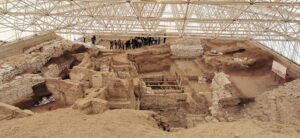
It is tempting to trace her back to Neolithic times. You may have read that the figurines of Çatalhöyük show a prehistoric mother goddess. Be careful with that claim. The Çatalhöyük research project says James Mellaart’s theory was questioned after later excavations found male and animal figurines too. The firmly documented Cybele belongs to Phrygia and the periods after it.
Why did Rome want a foreign goddess?
The answer is war. Rome adopted the cult in 204 BC, during the Second Punic War against Carthage.
According to the ancient summary of Livy, the Sibylline books held a prophecy. If the Idaean Mother were brought to Rome, the foreign invader could be driven out of Italy. So the Senate looked east.
The goddess travelled as a sacred stone. In Livy’s account, King Attalos I of Pergamon handed it over to the Romans.
Where did the stone come from?
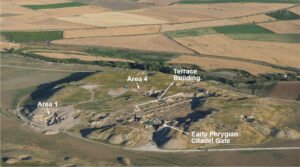
The Oxford Classical Dictionary names Pessinus in Phrygia as the origin of the stone taken to Rome in 204 BC. Pessinus was an important centre of her worship. Today it lies at Ballıhisar, about 13 kilometres from Sivrihisar in Eskişehir province.
Not everyone agrees. Helmut Berneder points to Ovid’s story of Mount Ida and to the closeness of that region to Pergamon. He argues that the cult came to Rome from the Ida region. So the stone’s exact origin remains an open question.
How was the goddess welcomed in Rome?
The traditional Roman story is vivid. The Senate chose ‘the best man’ to receive the goddess. Livy’s summary says this was Scipio Nasica, a young Roman who had not yet become a quaestor.
He met the goddess at Ostia. Roman women then carried the sacred object to the Temple of Victory on the Palatine Hill.
Berneder suggests that parts of this tale may be later political stories. The link between the prophecy and the cult’s arrival could be one. The welcoming roles of Scipio Nasica and Claudia Quinta could be others. The core fact stands, though. In 204 BC Rome brought the cult in.
Think of how a town today welcomes a trophy at the station. The ceremony matters as much as the object. Rome did the same with a stone.
What did Romans call her?
In Rome she was known as Magna Mater. That is Latin for ‘Great Mother’.
The stone first stayed in the Temple of Victory. A new Magna Mater temple on the Palatine Hill was dedicated in 191 BC. It gave the sacred object a permanent home after years in the Victory temple.
The building did not last untouched. It burned in 111 BC and was rebuilt later.
What did she look like in art?
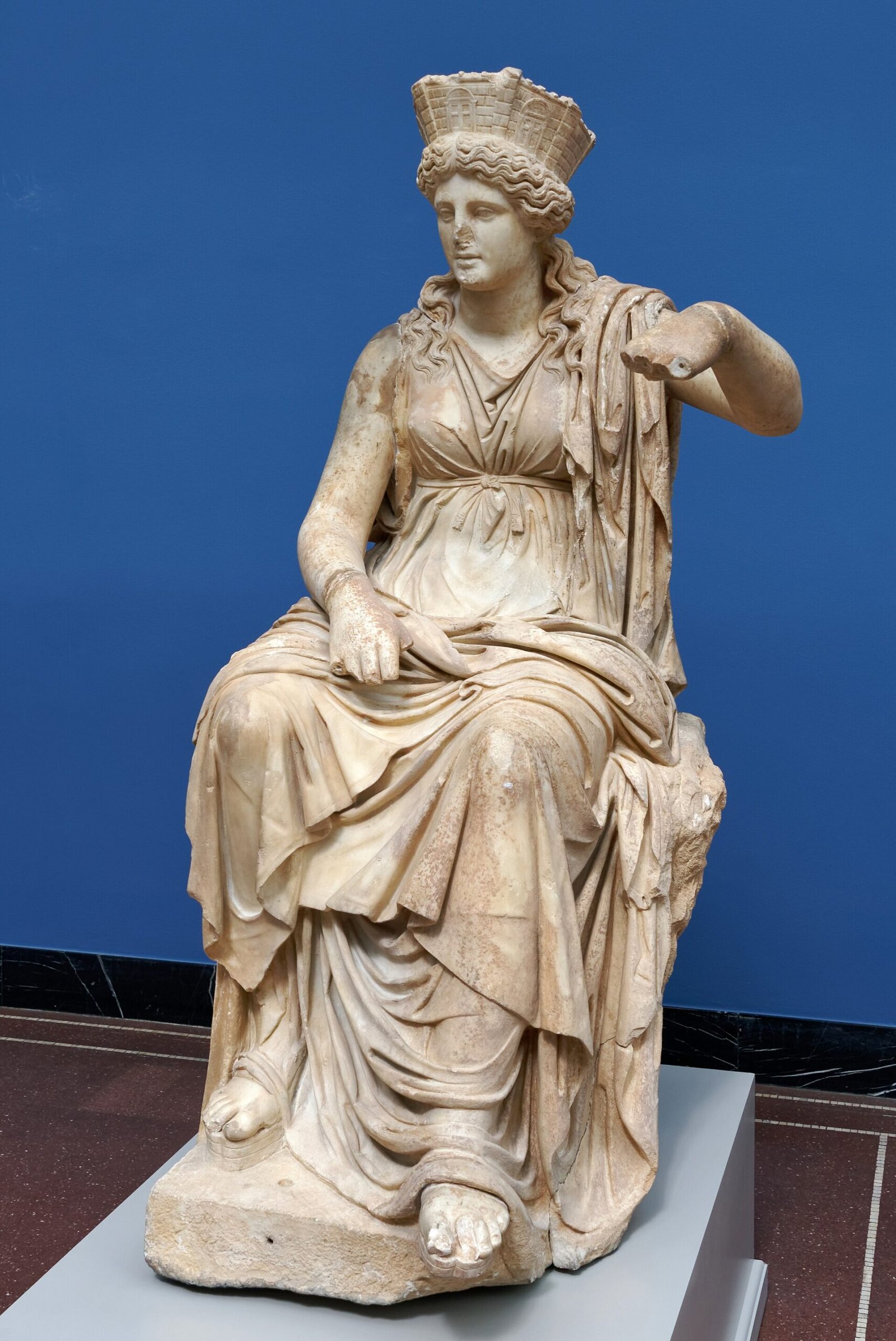
Roman-era statues show how the goddess was imagined. A marble statue in the San Antonio Museum of Art dates to the 1st or 2nd century AD. It is 90.4 centimetres tall. Each part of its imagery has a meaning:
- The crown shaped like city walls stands for the protection of cities.
- The lions stand for her power over wild animals.
- The tympanum, a hand drum, recalls the dancing in her rituals.
The statue’s eye sockets are empty now. They once held inlays of glass or coloured stone.
Who were her priests?
The tradition of priests who castrated themselves for Cybele is Phrygian in origin. Lynn E. Roller’s research shows, however, that it is documented most strongly in Greek and Roman sources. Much of what we read about these priests was written by outsiders.
Timeline
- First half of the 6th century BC: the phrase Matar Kubileya or Kubeleya is recorded at a Phrygian rock sanctuary.
- About 6th century BC: the cult spreads into the Greek world.
- 204 BC: the cult and its sacred stone are brought to Rome.
- 191 BC: the Magna Mater Temple on the Palatine is dedicated.
- 111 BC: the temple burns.
- About AD 50: the seated Cybele statue now in the Getty collection is made.
- 3rd century AD: the votive statue later returned to Türkiye is dated to this period.
- AD 362: Emperor Julian visits Pessinus and tries to revive the cult.
- 1967: systematic excavations begin at Pessinus under Pierre Lambrechts.
- 12 December 2020: the Cybele statue returned from the USA arrives in Türkiye.
Details you won’t find in guidebooks
- A priestess with a Roman face. The Getty dates a seated Cybele statue to about AD 50. Its head is not an ideal goddess face. It is the portrait of an older Roman woman, and the museum says she may be a priestess.
- Secret letters. Among the inscriptions known from Pessinus are eight private and confidential letters. In the 2nd century BC the Attalid kings sent them to Cybele’s high priest.
- A young greeter. The man chosen as ‘the best’ to greet the goddess had not even held the office of quaestor yet.
- Gems for eyes. The San Antonio statue once had glass or coloured stone in its eyes. Today you see only empty hollows.
- A dedication in three lines. The base of the votive statue from Afyonkarahisar carries a three-line Ancient Greek inscription. It says that Asklepiades of Sideropolis, son of Hermeios, offered the statue to the Mother of the Twelve Gods.
Is the main temple of Cybele found at Pessinus?
Not yet. Excavations at Pessinus aimed to find her famous temple. They began in 1967 under Pierre Lambrechts of Ghent University. According to the Oxford Classical Dictionary, her main sanctuary has still not been located. The temple that was uncovered is linked to the imperial cult of Tiberius’s time.
The site stayed important later. In AD 362 the Roman emperor Julian visited the sanctuary and tried to revive Cybele’s cult.
A statue that came home
You can also see Cybele in a museum in Türkiye. A votive statue dated by experts to the 3rd century AD was found in 1960 during road works in Çavdarlı village, Afyonkarahisar. That is the Ministry’s finding.
It later left the country and was returned from the USA. It arrived in Türkiye on 12 December 2020. According to the Ministry’s records, it is displayed in the Afyonkarahisar Museum.
If you travel in Anatolia, this is a simple stop. See the statue in Afyonkarahisar. Then visit Pessinus near Sivrihisar to stand where the cult flourished.
Why does the story matter?
The journey of Cybele shows how religion moved with politics. A Phrygian mother goddess became Rome’s Magna Mater in 204 BC, in the middle of a war. Rome did not just borrow a god. It built a temple, set a date and made her official.
The story also shows how to read ancient sources. Livy’s account is rich, yet modern scholars question the origin of the stone and the welcome ceremony. You can hold both ideas at once. The adoption is firmly dated, and the details are debated.
FAQ
When did Rome adopt the cult of Cybele?
Rome officially adopted the cult in 204 BC, during the Second Punic War against Carthage. A permanent temple on the Palatine Hill was dedicated in 191 BC.
What does the name Magna Mater mean?
Magna Mater is Latin for ‘Great Mother’. It is the name under which Romans knew Cybele.
Where did the sacred stone come from?
The Oxford Classical Dictionary gives Pessinus in Phrygia as its place of origin. Helmut Berneder argues instead that it came from the Mount Ida region, so the question is still debated.
Can you visit Pessinus today?
Yes. Pessinus lies at Ballıhisar, about 13 kilometres from Sivrihisar in Eskişehir province. Be aware that Cybele’s main sanctuary has not been found. The temple excavated there is linked to the imperial cult of Tiberius’s time.
Was Cybele worshipped at Çatalhöyük?
Not clearly. The Çatalhöyük research project says James Mellaart’s idea of a mother goddess was questioned once male and animal figurines were also taken into account.
Sources
- Oxford Classical Dictionary — Cybele academic.oup.com
- Oxford Classical Dictionary — Pessinus academic.oup.com
- Wikipedia — Cybele en.wikipedia.org
- Wikipedia — Temple of Cybele (Palatine) en.wikipedia.org
- Livius.org — Livy, Periochae 26–30 livius.org
- Bryn Mawr Classical Review — review of Magna Mater-Kult und Sibyllinen bmcr.brynmawr.edu
- Çatalhöyük Research Project — Was there a belief in the Mother Goddess at Çatalhöyük? catalhoyuk.com
- Kültür ve Turizm Bakanlığı — Pessinus Örenyeri muze.gov.tr
- Eskişehir İl Kültür ve Turizm Müdürlüğü — Pessinus Kazıları eskisehir.ktb.gov.tr
- Gender & History — The Ideology of the Eunuch Priest onlinelibrary.wiley.com
- San Antonio Museum of Art — Statue of Cybele sanantonio.emuseum.com
- Getty Museum — Statue of a Seated Cybele with the Portrait Head of her Priestess getty.edu
- Kültür Varlıkları ve Müzeler Genel Müdürlüğü — ABD’den iade edilen Kybele kvmgm.ktb.gov.tr
Image: Cybele, from Formale in Campania c. 60 BC, marble – Ny Carlsberg Glyptotek, Copenhagen, 20220618 1056 7035.jpg — Jakub Hałun, CC BY-SA 4.0