Urartu was an Iron Age kingdom that grew around Lake Van. It appeared in the middle of the 9th century BC and was a strong power in eastern Anatolia in the 8th and 7th centuries BC. If you stand on the rock of Van Castle today, you are standing in its old capital.
This article explains where Urartu was, who ruled it, what you can still see, and why historians still argue about its people and its end.
Urartu Kingdom: Where and When
The kingdom was centered on the Lake Van basin. Its lands spread across the borders of today’s Turkey, Armenia, Iran and Iraq.
The state did not arrive ready-made. Tribal unions around Lake Van and in the valley of the Upper Zab formed its political unity in the mid-9th century BC.
The name needs a note. Assyrian sources call the country Urartu. Its own inscriptions use the name Biainili. So “Urartu” is, strictly speaking, the neighbors’ word for it.
Urartu History in Brief
Urartian history is mostly read from stone. Kings had inscriptions cut into rock faces and onto steles, and those texts are the backbone of the story.
The earliest royal inscriptions were written in the Neo-Assyrian language and script. About a generation later, most inscriptions used Urartian instead of Assyrian. The kings had started writing in their own tongue.
The kingdom ran through fortified centers. These were used to collect taxes and to supervise the surrounding regions. Appointed governors lived there, along with military and civil officials.
Everyday link. Think of the local tax office or district governor’s building in a modern town. A fortress with a governor, clerks and soldiers did that same job 2,800 years ago.
Tushpa and Van Castle
Urartu’s capital was Tushpa. It stood on the rocky outcrop where Van Castle is today, and on the land around it, on the eastern shore of Lake Van.
The Ministry of Culture and Tourism inventory says King Sarduri I founded Van Castle between 840 and 825 BC.
Immediately north of the castle runs a mound about 750 meters long, east to west. Researchers have studied Urartian houses there, along with older settlement layers beneath them. The rock is only part of the site.
On 13 April 2016, Tushpa/Van Castle, its mound and the Old City of Van were added to UNESCO’s World Heritage Tentative List.
What you can see on the rock
The south face of the castle holds eight rock tombs. UNESCO’s nomination file describes four of them as multi-chamber tombs of the Urartian period.
On the southeast slope is the Analı Kız sanctuary, measuring 40 by 15 meters. It has two rock niches where basalt steles were set up. These steles recorded the campaigns of Sarduri II.
The annals of Argishti I are carved on a tomb facade at the castle. UNESCO’s file calls them the longest Urartian inscription.
Urartian Language
Urartian was used in written documents from the late 9th century BC to the 7th century BC. Its only known relative is Hurrian.
The scholar Gernot Wilhelm says its geographic origin cannot be fixed with certainty. The language is thought to have been common around Lake Van and in the mountains of the Upper Zab.
Urartu, Armenia and Yerevan
People often search for Urartu together with Armenia and Yerevan. There is a real historical link, and a second one that is disputed.
The real link is Erebuni. Argishti I founded it in 782 BC, and that founding is accepted as the beginning of the history of present-day Yerevan.
The annals of Argishti I say that 6,600 prisoners of war from the lands of Hate and Tsupani were settled in Erebuni. The fortress was built with people moved there by force.
The disputed link is language and identity. One view holds that the Urartian people and dynasty spoke Proto-Armenian. This is a theory. The opposing view says Urartian was simply the language spoken around Van. Defining the whole population with one language and one identity is therefore contested.
Turkish and Kurdish claims
Two other claims circulate online, and the evidence does not support either as stated.
Kemal Balkan’s 1984 article builds the similarity between Urartian and Turkish on agglutinative structure. It explains the close language relationship through Hurrian. A typological likeness alone does not prove a Turkish identity.
Urartian cannot be offered as linguistic evidence that the Urartians were Kurds. Iranica classifies Urartian as related to Hurrian. That does not support the idea that Urartian was an old form of Kurdish.
Gods, Water and Metal
The main gods of Urartian religion were Haldi, Teisheba and Shivini. Teisheba was the god of storm and thunder. Shivini was the sun god.
The Urartians built water channels, dams, embankments, aqueducts and cisterns. The Minua/Shamram Canal near Van reaches about 55 kilometers including its reservoir area.
Everyday link, again. When you turn on a tap, you rely on a chain of channels and storage that someone planned and maintained. Urartian engineers did a version of this around Van.
Metalwork was another strength. Surviving products include hundreds of bronze belts, plus shields, helmets, quivers, bells and horse harness.
Timeline
- Mid-9th century BC: Political union of the Lake Van basin communities gives rise to the Kingdom of Urartu.
- 840–825 BC: According to the Ministry of Culture inventory, Sarduri I founds Van Castle.
- Late 9th century BC: Use of Urartian in royal inscriptions spreads.
- 782 BC: Argishti I founds Erebuni, in present-day Yerevan.
- 8th–7th centuries BC: Urartu remains a strong kingdom in eastern Anatolia and its surroundings.
- Second half of the 7th century BC: Several Urartian centers suffer destructions whose perpetrators and exact dates are debated.
- 6th century BC: Urartu’s political existence ends. Scholars differ between a Median conquest and a Persian conquest in 547 BC.
- 13 April 2016: Tushpa/Van Castle, its mound and the Old City of Van join UNESCO’s Tentative List.
- 2023: Rescue excavations at Körzüt Castle uncover three cuneiform inscriptions linked to the Minua period.
Details you won’t find in guidebooks
- On the Sardur Tower, west of Van Castle, the same text that Sarduri I had written in the Assyrian language and script is repeated six times.
- Some rock tomb chambers at Van Castle reach 9 meters in height and 200 square meters in area.
- A rock chamber on the north slope is called Menua’s Stable, based on the inscription at its entrance.
- The Meher Gate inscription in Van lists 79 gods and the animal sacrifices owed to them.
- Rescue excavations at Körzüt Castle in 2023 produced three new cuneiform inscriptions. They connect the building of the fortress with the reign of King Minua, dated 810–786 BC.
How Did Urartu End?
There is no single accepted answer. Some views blame Scythians or Medes for the destruction of Urartian centers. The Metropolitan Museum of Art treats these as proposed explanations. It says the exact dating and the perpetrators of the destructions in the second half of the 7th century BC are still under research.
For the end of the kingdom itself, one view points to a Median conquest in the early 6th century BC. Another holds that the kingdom lasted until the campaign of Cyrus II in 547 BC.
FAQ
Where was the Urartian capital?
The capital was Tushpa, on and around the rock where Van Castle stands today, on the eastern shore of Lake Van.
What did the Urartians call their own country?
Assyrian sources call it Urartu. The kingdom’s own inscriptions use the name Biainili.
Who founded Van Castle?
The Ministry of Culture and Tourism inventory says King Sarduri I founded it between 840 and 825 BC.
Is Urartian related to Armenian, Turkish or Kurdish?
Its only known relative is Hurrian. Similarities with Turkish are typological, based on agglutinative structure. Urartian cannot serve as linguistic evidence for Kurdish. Whether the dynasty spoke Proto-Armenian is a theory, and it is disputed.
What is the link between Urartu and Yerevan?
King Argishti I founded Erebuni in 782 BC. That date is accepted as the beginning of the history of present-day Yerevan.
Sources
- Vikipedi — Urartular tr.wikipedia.org
- Encyclopaedia Iranica — Urartu in Iran iranicaonline.org
- Encyclopaedia Iranica — Urartian iranicaonline.org
- History Museum of Armenia — Urartu: The Kingdom of Van historymuseum.am
- Cambridge University Press — Urartian cambridge.org
- Belleten — Urartuluların Kökeni ve Dilleri belleten.gov.tr
- Wikipedia — Urartu en.wikipedia.org
- The Metropolitan Museum of Art — Urartu metmuseum.org
- Kültür Portalı — Van Kalesi kulturportali.gov.tr
- Kültür ve Turizm Bakanlığı — Van Kalesi turkishmuseums.kprod.kultur.gov.tr
- UNESCO World Heritage Centre — Tushpa/Van Fortress whc.unesco.org
- Troy Museum Journal — Minua/Şamram Kanalı Yazıtlarının Güncel Durumu ve Kanalın Yeniden Değerlendirilmesi dergipark.org.tr
- Van Yüzüncü Yıl Üniversitesi — Recently Discovered Urartian Cuneiform Inscriptions in the Temple of the Körzüt Fortress avesis.yyu.edu.tr
- Colloquium Anatolicum — Excavations at the Mound of Van Fortress – 2011 dergipark.org.tr
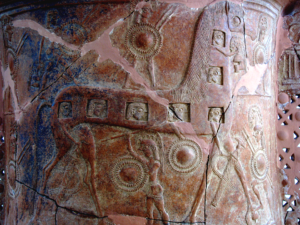
Image: An Urartu Hieroglyph from Mezopotamia.jpg — Knslmn, CC BY 4.0