Where is Kibyra ancient city in Turkey?
Kibyra lies in Horzum neighbourhood, within Gölhisar district in Turkey’s Burdur province. The ancient city occupies three hills separated by deep ravines. Its setting matters when you picture the site: this was a settlement spread across distinct rises, with substantial public buildings among its surviving remains.
The UNESCO submission places Kibyra approximately 110 kilometres southwest of Burdur city, on hills west of modern Gölhisar. That gives you two useful geographical anchors: Burdur identifies the province and regional reference point, while Gölhisar identifies the nearby modern town.
You may encounter several versions of the name. Turkish Wikipedia uses Kibira, while English Wikipedia uses Cibyra. Cibyra Magna is another name for the same ancient city. These spellings refer to the Burdur settlement discussed here.
Kibyra Antik Kenti: location and directions
If you are searching for “Kibyra Antik Kenti yol tarifi,” use the full location: Horzum, Gölhisar, Burdur. The ancient remains stand west of modern Gölhisar. Keeping both the district and province attached to the name helps distinguish this inland city from another ancient settlement called Cibyra Minor.
Kibyra’s location also helps explain its historical importance. It stood on trading routes where the cultural regions of Lycia, Caria, Pisidia and Phrygia met. Its position connected several regional worlds, while its later role as a judicial centre drew surrounding communities into its administrative orbit.
Kibyra Medusa: where is the mosaic?
The Medusa pavement occupies the centre of the orchestra inside Kibyra’s Odeion. This precise location is useful when you look at photographs or identify the remains. The Medusa belongs to the interior floor of a major public building, separate from the large mosaic outside it.
Although often called a mosaic, the pavement was made using opus sectile. Thin coloured marble pieces were cut into different shapes and sizes, then fitted beside one another. Here, the individual pieces form the image through their cut outlines as well as their colour.
Excavation director Şükrü Özüdoğru describes the work as the only known Medusa pavement made using opus sectile. The claim concerns a particular subject and technique together. It is the combination of the Medusa image and this method of cut-stone construction that gives the pavement its particular archaeological significance.
A 2023 study by Özüdoğru and Tarkan interprets the composition as Athena’s aegis. In their reading, the central Medusa head and the surrounding, radiating wing scales belong to one larger design. Looking beyond the face therefore changes how you understand the whole floor.
Kibyra Odeon: a building with several public roles
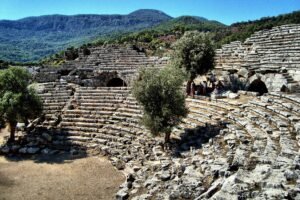
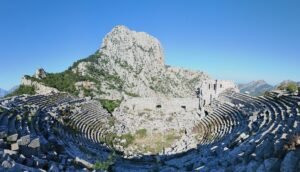
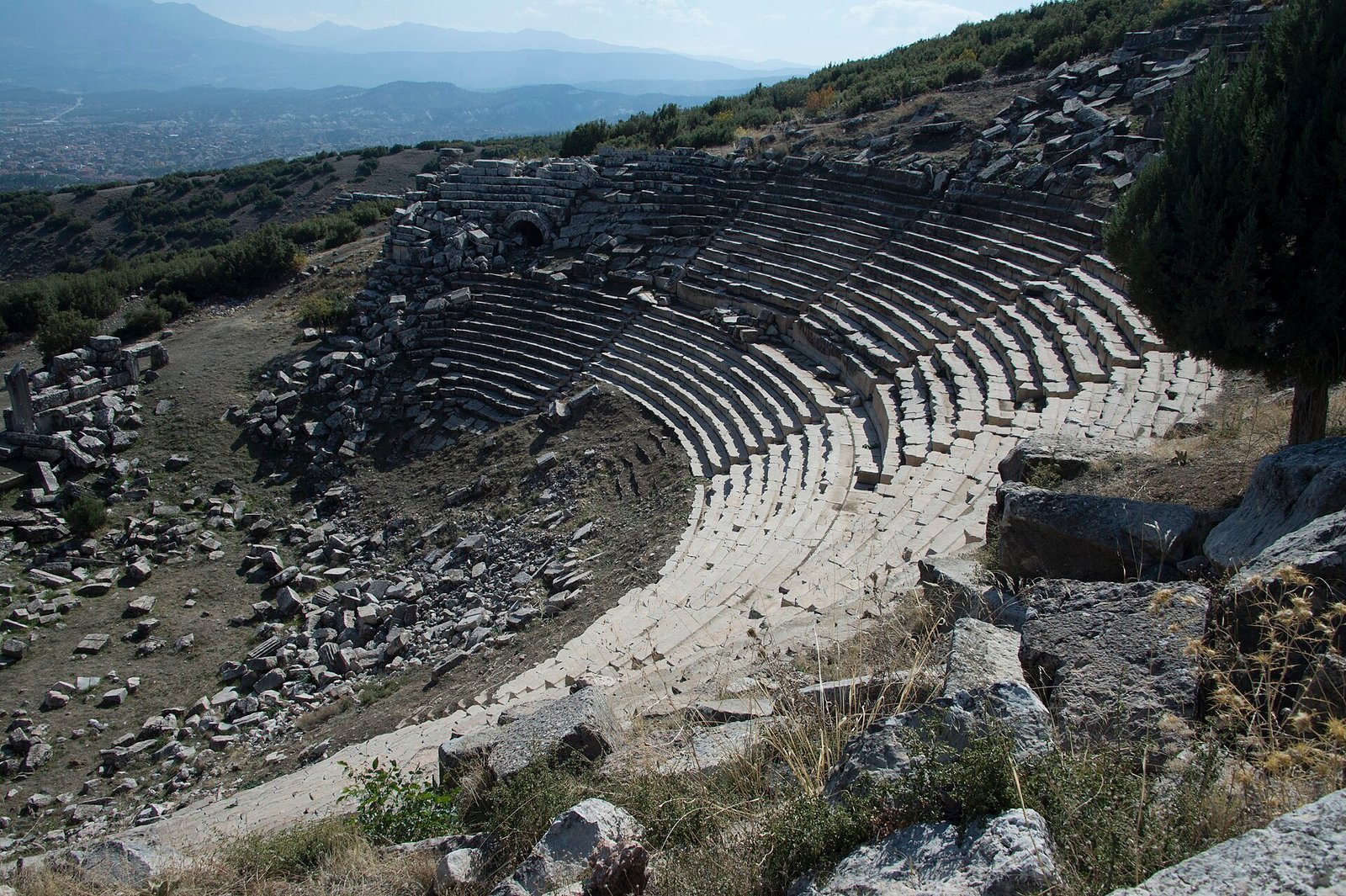
The Odeion reached its final architectural form in the second century AD. It had 31 seating rows and a capacity of 3,600 people. Its scale makes the Medusa pavement part of a substantial gathering place, with a large seated audience arranged around the building’s performance and assembly spaces.
Behind the 52.5-metre-long façade was a stage measuring 12.80 by 4.35 metres. These dimensions help you separate the building’s components: the façade and stage formed part of its architectural arrangement, while the Medusa pavement occupied the orchestra.
The Odeion served concerts, city council meetings, court proceedings and theatrical performances. For an everyday-life connection, imagine a room in your own routine that hosts several different activities. Kibyra’s building brings that idea to a civic scale, combining cultural, political and judicial functions within one structure.
Its judicial use also belongs to a wider story. During the Roman Imperial period, Kibyra was the judicial centre of the Kibyra Conventus, which included approximately 25 cities. The Odeion’s court function should be understood alongside that broader administrative importance.
The stoa mosaic, monumental fountain and museum
The mosaic in the stoa in front of the Odeion is a separate work from the Medusa pavement. Discovered in 2011, it covers approximately 540 square metres. Its position outside the building and its stated area give you clear ways to distinguish the two floors.
Another sight is the Round-Plan Monumental Fountain. In a statement reported on 1 April 2026, the excavation director said water was flowing through it again from its original source. The fountain therefore adds a water structure to a visit otherwise strongly associated with seating, stone architecture and decorated floors.
Portable archaeological objects excavated at Kibyra are displayed in Burdur Museum. The museum provides another setting in which to encounter the city’s material remains. The ancient site contains the public buildings and pavements, while the museum displays objects recovered from the settlement.
Kibyra ancient city photos: what to look for
When viewing Kibyra photos, start by locating the Medusa within the Odeion’s orchestra. Then compare those images with photographs of the stoa pavement in front of the building. Both are decorated floors associated with the Odeion, but they occupy different spaces and are separate archaeological works.
Close views of Medusa reveal an extended tongue, visible teeth, a winged headdress and snakes around the neck. Wider views are useful for seeing the radiating elements discussed in the interpretation of Athena’s aegis. The face and its surroundings should be read together.
Photographs of the seating offer another point of comparison. The Odeion was built with 31 rows for 3,600 people. Keeping those figures in mind helps you relate a close photograph of the pavement to the much larger public building that contained it.
From trading crossroads to Roman judicial centre
Strabo’s foundation account describes the Kibyrans as a community that migrated from Lydia to Kabalis and later moved its settlement. This is an ancient account of the city’s origins. It sits alongside the geographical evidence of a city positioned where several cultural regions met.
Kibyra appears under the rule of the Kingdom of Pergamon during the reign of Eumenes II, between 197 and 159 BC. In the Hellenistic period, it also belonged to the Tetrapolis, a political association with Boubon, Balboura and Oinoanda.
The Roman general Murena dissolved this association. The date varies between accounts: the UNESCO submission places the event in 84–83 BC, while the Culture Portal gives 82 BC. Preserving that distinction is more accurate than presenting one date as undisputed.
An earthquake severely damaged Kibyra in AD 23. Tax exemption granted by Emperor Tiberius helped its rebuilding. The city’s most prosperous period falls between the first and third centuries AD, when it was known for ironworking, leatherworking, pottery and horse breeding.
A further earthquake struck in AD 417. Kibyra was not restored on its former scale afterward. The settlement gradually contracted, and its abandonment is generally placed in the eighth century.
Timeline
- 197–159 BC: Kibyra appears under Pergamene rule during the reign of Eumenes II.
- Hellenistic period: Kibyra belongs to the Tetrapolis with Boubon, Balboura and Oinoanda.
- 84–83 BC or 82 BC: Murena dissolves the association; accounts differ between 84–83 BC and 82 BC.
- AD 23: An earthquake causes severe damage; Tiberius supports recovery through tax exemption.
- First–third centuries AD: Kibyra experiences its most prosperous Roman Imperial phase.
- Second century AD: The Odeion reaches its final architectural form.
- AD 417: Another earthquake damages the city; rebuilding does not restore its former scale.
- Eighth century: The city’s abandonment is generally placed in this period.
- 2006: Scientific excavations begin under Burdur Museum, with archaeologists from Akdeniz University.
- 2011: The approximately 540-square-metre stoa mosaic is discovered.
- 13 April 2016: Kibyra is submitted to the UNESCO World Heritage Tentative List.
- 1 April 2026: The reopening of the Medusa and Odeion Stoa mosaics is announced after winter protection.
Details you won’t find in guidebooks
Strabo reports four languages at Kibyra: Lydian, Solymian, Pisidian and Greek. This gives the city’s cultural crossroads a concrete linguistic dimension. The ancient account describes several languages being spoken within the same city.
The Tetrapolis also had an uneven voting arrangement. Kibyra held two votes, while Boubon, Balboura and Oinoanda held one each. Four member cities therefore did not mean equal voting strength for every participant.
The Odeion’s decorative materials extended well beyond its immediate surroundings. Özüdoğru and Tarkan identify marble, limestone, porphyry, granite, breccia and alabaster from Greece, Egypt, Tunisia and Anatolia in its opus sectile floors and revetments. These materials concern the building’s decorative programme as a whole.
FAQ
Where is Kibyra ancient city?
Kibyra lies within Horzum neighbourhood in Gölhisar district, Burdur province, Turkey. It occupies three hills west of modern Gölhisar, approximately 110 kilometres southwest of Burdur city.
What makes the Kibyra Medusa pavement significant?
It uses opus sectile, a technique that joins thin pieces of coloured stone cut into different shapes and sizes. Excavation director Şükrü Özüdoğru describes it as the only known Medusa pavement made with this technique.
What was the Kibyra Odeion used for?
The Odeion hosted concerts, city council meetings, court proceedings and theatrical performances. It had 31 seating rows and a capacity of 3,600.
When can you see the Medusa mosaic in 2026?
An Anadolu Agency report dated 1 April 2026 announced that the Medusa and Odeion Stoa mosaics had reopened after winter protection. The announced viewing period runs until the end of November.
Sources
- Ministry of Culture and Tourism, Culture Portal — Kibyra Antik Kenti kulturportali.gov.tr
- UNESCO World Heritage Centre — Ancient city of Kibyra whc.unesco.org
- Anadolu Agency — Kibyra Medusa mosaic reopened, 1 April 2026 mobile.aa.com.tr
- OLBA, Özüdoğru and Tarkan — Kibyra Olympeion Odeionu ve Aigis/Medusa Döşemesi dergipark.org.tr
- Turkish Wikipedia — Kibira tr.wikipedia.org
- English Wikipedia — Cibyra en.wikipedia.org
Image: Kibyra Theatre 9919.jpg — Dosseman, CC BY-SA 4.0