Rüstem Pasha Caravanserai: Erzurum’s Taşhan
Erzurum’s Taşhan brings an Ottoman courtyard building and an Oltu stone market into the same space. Craftspeople now produce and sell their work inside the Rüstem Pasha Caravanserai. Its earlier uses included a prison and an electricity plant. Those changes give the building a history that extends well beyond its original role.
You will find Taşhan on Menderes Caddesi in Erzurum’s Yakutiye district. The cultural inventory places its address in Ayazpaşa Mahallesi. The building stands between Pervizoğlu Mosque and Boyahane Hamam. These street and neighbourhood details help identify the Erzurum monument when searching by its formal name.
Taşhan also appears as Taş Han and Rüstem Paşa Bedesteni. Its patron was Rüstem Pasha, grand vizier to Sultan Süleyman the Magnificent. The surviving building has two storeys, with rooms arranged around a central courtyard. Today, its shops sell Oltu stone prayer beads, rings, and necklaces.
Who built the Rüstem Pasha Caravanserai, and when?
Rüstem Pasha commissioned the caravanserai, but its precise construction date remains disputed. The Ministry of Culture and Tourism’s visitor page gives 1561. The same institution’s cultural inventory gives 1535. Both dates therefore appear in official descriptions of Taşhan.
Zerrin Köşklü’s 2010 study explains a physical obstacle to dating the building. The date section of its inscription is broken. The study discusses 1544–1560 as an estimated range. It also states that 1534–1535 could apply if M. Nusret’s published reading of the inscription is correct.
The distinction between these dates matters. The 1544–1560 range is an estimate discussed in the study. The possible 1534–1535 date depends on the accuracy of an earlier inscription publication. The Ministry’s 1561 date is another stated dating. None should be presented as an uncontested construction year.
For you as a visitor, the secure starting point is the sixteenth century and Rüstem Pasha’s patronage. The finer dating requires keeping the different claims separate. Taşhan’s damaged inscription is part of that discussion, alongside the official inventory and the visitor description.
Reading the courtyard and its architecture
Taşhan is a two-storey Ottoman caravanserai arranged around a central courtyard. Descriptions identify a rectangular courtyard plan, while Köşklü’s architectural study measures the open courtyard at 20 × 20 metres. Rooms line the courtyard, making this central space the clearest place to begin reading the building.
Arcades surround the courtyard. They rise on thick rectangular piers, which form a repeated structural frame around the open space. If you look from the courtyard towards the surrounding rooms, these piers and covered passages help explain how the building’s different parts connect.
Different materials were used in the walls and vaults. Rubble stone was used in the room walls. Brick was used in the vaults of both the arcades and the rooms. The building’s fabric therefore includes both stone and brick, even though Taşhan is the name by which it is commonly known.
Its historical service spaces included an imaret, or soup kitchen, a prayer room, rest areas, merchants’ shops, and sections where animals were tethered. Food, prayer, rest, trade, and accommodation for animals were all represented in the caravanserai’s recorded functions. Some of these original service spaces have not survived.
That loss matters when interpreting the present building. The surviving courtyard and rooms belong to a caravanserai whose recorded services extended beyond shops. Its current market use preserves a commercial function, but the historical complex also provided spaces for other practical needs.
The Oltu stone market today
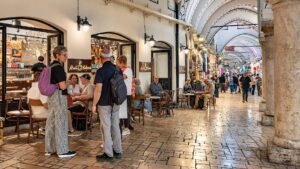
Taşhan now operates as a historical market where Oltu stone craftspeople both produce and sell goods. Making and selling are therefore part of the same building’s current use. Prayer beads, rings, and necklaces are among the objects available in its shops.
This gives you an everyday connection to the caravanserai’s history. A ring worn on a hand or a necklace worn around the neck links the market to ordinary personal use. At Taşhan, such objects are part of the documented Oltu stone trade within an Ottoman commercial building.
The prayer beads, rings, and necklaces also give a concrete focus to a visit. Taşhan’s present activity centres on craftspeople and their goods, while its courtyard and arcades retain the architectural setting. You can consider the objects and the building together: production and sales take place inside a structure originally equipped with merchants’ shops.
Commerce is one thread connecting the caravanserai’s earlier and present functions. Its history also includes uses far removed from selling goods. Municipal prison records and its later service as an electricity plant show how substantially the purpose of the same building could change.
Details you won’t find in guidebooks
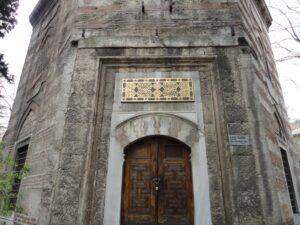
A surviving marble inscription at the western entrance names Rüstem Pasha. It is written in thuluth script. The remaining text also includes the word ribat, with the meaning of a frontier post. This is a specific detail preserved in the inscription despite the broken date section.
Erzurum municipal records from 1868–1869 document the caravanserai’s use as a prison. That evidence adds an institutional use to the history of a building associated with merchants. The prison episode belongs to the documented life of Taşhan, alongside its commercial functions.
During the Republican period, Taşhan served for a long time as an electricity plant. The courtyard building therefore passed through an industrial use as well as a prison use. Its present Oltu stone market is another stage in this sequence of changing functions.
A further detail concerns the northern side. During repairs around 1965, the section adjoining the north wall was rebuilt from its foundations. It means that the building seen today includes a substantial reconstructed section, as well as its surviving historical fabric.
Restoration and protection
Taşhan underwent a comprehensive restoration in 1965. The rebuilding beside the north wall belongs to the repair activity around that time. Reading these two facts together gives a more precise picture of the intervention than the restoration date alone.
The building’s registration record is decision A-188, dated 13 November 1976. The cultural inventory names the General Directorate of Foundations as the institution responsible for its care. The registration and the assigned responsibility are separate details in the monument’s administrative record.
A later restoration took place in 2007. This work was carried out by the Erzurum Regional Directorate of Foundations. Taşhan’s present form should therefore be understood alongside both the comprehensive work of 1965 and this later restoration.
Timeline
- Sixteenth century: Rüstem Pasha commissioned the caravanserai. Proposed dates include 1534–1535, an estimated 1544–1560 range, and 1561; the cultural inventory gives 1535.
- 1868–1869: Erzurum municipal records documented its use as a prison.
- Republican period: The building served for a long time as an electricity plant.
- 1965: A comprehensive restoration took place. Repairs around this date included rebuilding the section adjoining the north wall from its foundations.
- 13 November 1976: Registration decision A-188 was issued.
- 2007: The Erzurum Regional Directorate of Foundations restored Taşhan again.
- Today: Craftspeople use the building to produce and sell Oltu stone goods.
FAQ
Where is the Rüstem Pasha Caravanserai in Erzurum?
Taşhan stands on Menderes Caddesi in Erzurum’s Yakutiye district. The cultural inventory places it in Ayazpaşa Mahallesi, between Pervizoğlu Mosque and Boyahane Hamam.
When was Erzurum’s Taşhan built?
Its exact construction date is disputed. The Ministry’s visitor page gives 1561, while its cultural inventory gives 1535. Zerrin Köşklü’s study discusses an estimated 1544–1560 range and a conditional 1534–1535 dating.
Who commissioned the caravanserai?
Rüstem Pasha, grand vizier to Sultan Süleyman the Magnificent, commissioned the building.
What is sold at Taşhan today?
Craftspeople produce and sell Oltu stone goods at Taşhan. Products include prayer beads, rings, and necklaces.
Was Taşhan used for anything besides trade?
Municipal records from 1868–1869 document its use as a prison. During the Republican period, it also served for a long time as an electricity plant.
Sources
- Ministry of Culture and Tourism — Rüstem Paşa Kervansarayı (Taşhan) kulturportali.gov.tr
- Ministry of Culture and Tourism — Cultural Inventory: Rüstem Paşa Kervansarayı kulturportali.gov.tr
- Zerrin Köşklü — Erzurum’da Osmanlı Dönemi Hanları, 2010 yeni.kafkas.edu.tr
- Turkish Wikipedia — Rüstem Paşa Kervansarayı (Erzurum)) tr.wikipedia.org
Image: Taşhan – Rüstem Paşa Caravanserai 04.jpg — Zeynel Cebeci, CC BY-SA 4.0