Linear A remains undeciphered because the language it records is unidentified, its surviving inscriptions are often short or damaged, and no bilingual inscription provides a secure comparison with a known language. Linear B supplies approximate sound values for some signs, but these do not establish what the resulting words mean.
Yet the Cretan tablets are far from silent. Their numbers, materials, and archaeological settings reveal how writing served the Minoan palace economy. If you follow those clues, you can separate what the documents show from what a full translation would require. The distinction also explains why deciphering Linear B did not automatically unlock Linear A.
What is the Linear A script?
Linear A is a writing system associated with Minoan Crete. Its main period of use was approximately 1800–1450 BCE. It combines signs representing syllables with logograms representing objects or concepts. The technical description is a logo-syllabic script: its signs do not all perform the same job.
Arthur Evans gave the script its “Linear” name to distinguish its incised clay signs from the more pictorial forms of Cretan hieroglyphs. The name describes the writing’s appearance. It does not identify the language behind the marks.
Most Linear A writing runs from left to right. There are also examples written from right to left. Others use boustrophedon, with the direction changing between successive lines. When you examine an inscription, reading direction is therefore one concrete feature to establish before considering possible sounds or meanings.
What language does Linear A record?
The language recorded in Linear A is conventionally called Minoan. Its identity remains uncertain. “Linear A” names the script, while “Minoan” supplies a conventional label for the language represented by it. Treating those terms as interchangeable hides an important part of the decipherment problem.
Recognizing a sign and assigning it an approximate sound does not establish the meaning of a word. That is the difficulty with applying Linear B sound values to Linear A. The resulting sequences have not yielded a secure understanding of the language. Pronunciation proposals and reliable translation are different achievements.
Why is Linear A decipherment so difficult?
The surviving texts offer limited help with grammar. Many inscriptions are short, formulaic, and poorly preserved. Repeated administrative expressions can show patterns, but short sequences make it difficult to establish syntax and grammatical relationships. Damage further reduces the amount of usable text.
There is no known bilingual Linear A inscription that places its text alongside a securely understood language. A comparison of that kind, like the one associated with the Rosetta Stone, could provide direct anchors for interpretation. Linear A currently lacks that route into its vocabulary.
The surviving range of texts is another constraint. There is no evidence of historical narratives, literary works, diplomatic correspondence, or monumental inscriptions written in Linear A. Its administrative documents record transactions within the palace economy. They do not supply the extended passages that might expose a wider range of sentence structures.
Ester Salgarella’s academic assessment, published in 2025, still describes Linear A as undeciphered and its Minoan language as unidentified. The distinction matters when assessing a proposed reading: approximate sound values alone do not resolve the unknown meanings of the words.
Linear A vs Linear B: why did one yield to decipherment?
Linear B developed through the adaptation of Linear A to Greek. It records the earliest known form of Greek. The connection between the scripts provides a basis for comparing their signs, but it does not make the languages recorded by them identical.
Michael Ventris announced his identification of Linear B as Greek on BBC radio on 1 July 1952. In 1953, Ventris and John Chadwick published “Evidence for Greek Dialect in the Mycenaean Archives.” That decipherment established a linguistic interpretation for Linear B.
Chadwick later reported that he and Ventris tried applying the Linear B solution to Linear A without making easy progress. Their experience captures the central obstacle. A related script can supply useful comparisons while leaving the underlying language unexplained. For you as a reader, similar-looking signs should not imply interchangeable translations.
What do Linear A tablets tell us?
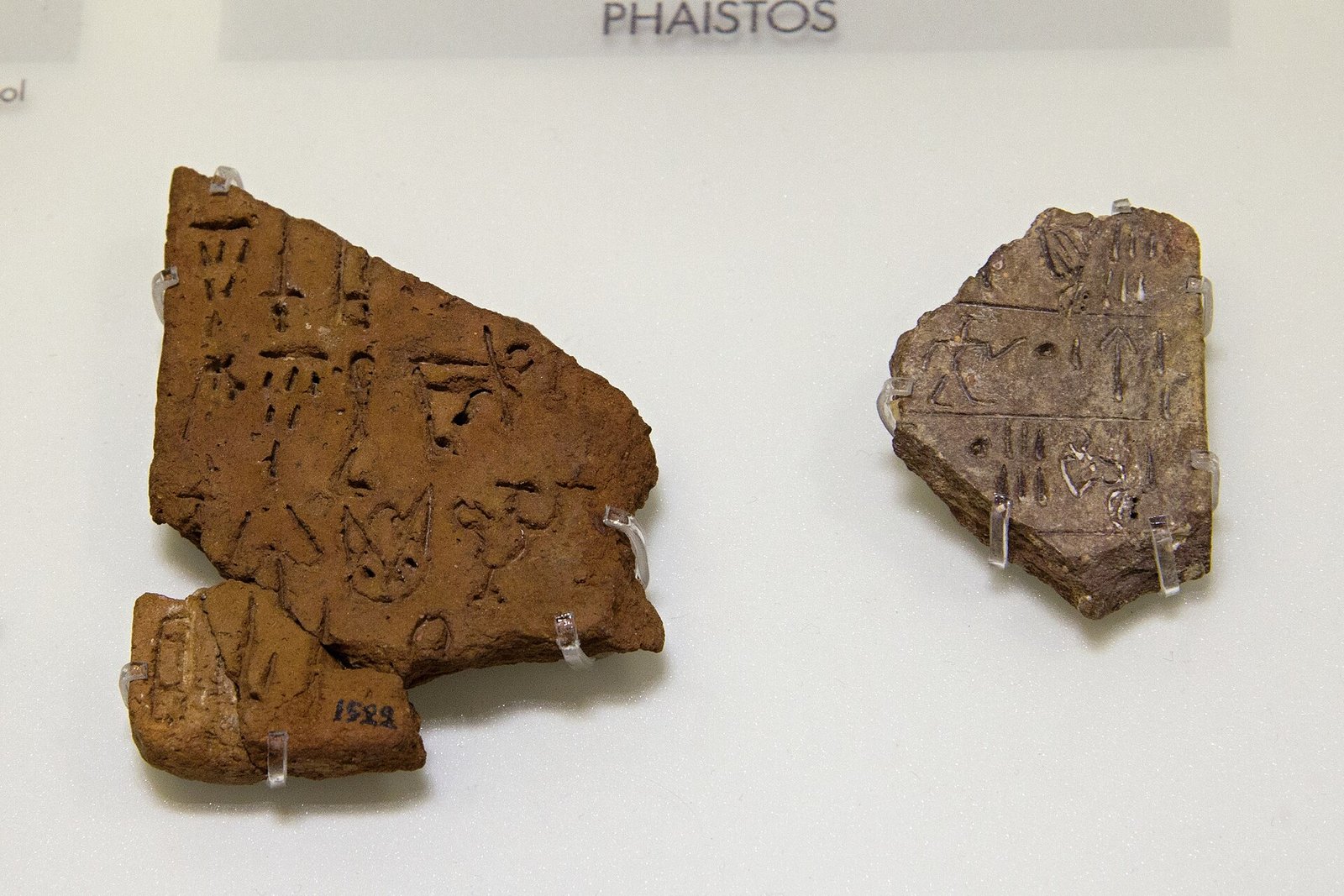
An April 2022 assessment in the Mnamon guide counted slightly more than 1,500 Linear A inscriptions. About 90 percent were on clay. Administrative records include tablets, round documents, and sealings. Their role was to document transactions within the palace economy.
The everyday-life connection is a shopping list. Quantities and repeated entries give a list a recognizable structure, even when its words remain unfamiliar. Linear A’s administrative setting and numerical notation likewise allow aspects of a record to be understood without a complete translation of its wording.
Its decimal number system is especially concrete. Vertical strokes represent units, horizontal strokes represent tens, circles represent hundreds, and circles with rays represent thousands. Identifying a quantity does not identify every item beside it, but it gives the document an interpretable numerical structure.
Hagia Triada is particularly associated with Linear A tablets. This Minoan settlement lies in Crete’s Mesara Plain, approximately three kilometres from the Palace of Phaistos. Those place names connect the writing to a specific administrative landscape rather than leaving it as an abstract collection of symbols.
Where was Linear A writing used?
During the First Palace period, Linear A finds were concentrated largely at Phaistos. During the Second Palace period, the script spread across Crete. Its distribution therefore changed over time, extending beyond its earlier concentration.
Linear A inscriptions have also been found on Kea, Milos, Santorini, and Samothrace, and at Miletus on the Anatolian coast. If you are exploring Turkey’s ancient connections, Miletus gives this Cretan writing system a direct geographical connection with Anatolia. The script’s surviving distribution reaches beyond Crete.
Other proposed identifications require caution. Finds from Tel Haror, Tel Lachish, and Drama in Bulgaria have been described as Linear A. Mnamon considers those identifications doubtful because of problems involving sign forms, geography, and dating. They should not be treated as equally secure additions to the distribution map.
Timeline
- Around 1800 BCE: Linear A’s principal period of use begins.
- Second Palace period: Linear A spreads across Crete.
- Around 1450 BCE: Destruction fires bake and preserve many clay documents.
- Around 1350 BCE: A painted figurine from Poros Herakleiou provides a late example of Linear A.
- 1 July 1952: Michael Ventris announces on BBC radio that Linear B records Greek.
- 1953: Ventris and Chadwick publish their joint explanation of the Linear B decipherment.
- 2021: A study proposes mathematical values for Linear A fraction signs.
- 2025: Ester Salgarella’s academic assessment describes Linear A as still undeciphered.
Details you won’t find in guidebooks
Destruction helped preserve many records. Fires around 1450 BCE baked clay tablets that could otherwise have been erased and reused. The documents survived through a change in their material condition. Their preservation does not mean that the tablets were originally intended as permanent records.
Clay was not necessarily the only surface used for documents. Mnamon points to impressions of bound sheets beneath some sealing fragments as possible evidence for lost papyrus or parchment records. This remains an interpretation of physical traces, rather than a surviving collection of readable documents on those materials.
A terracotta figurine from Poros Herakleiou carries painted Linear A writing and dates to approximately 1350 BCE. It provides a late example beyond the script’s principal administrative period.
A 2021 study proposed mathematical values for fraction signs, including J = 1/2, E = 1/4, and F = 1/8. Some other proposed values remained hypothetical. This is a specific area where numerical analysis can advance without producing a full decipherment of the language.
Linear A also has a digital presence. Unicode reserves the block U+10600–U+1077F for its signs. Digital encoding makes the characters representable as text; it does not assign meanings to the ancient words they form.
FAQ
Has Linear A been deciphered?
No. Ester Salgarella’s 2025 academic assessment describes Linear A as undeciphered and the Minoan language it records as unidentified.
What language does Linear A record?
The language is conventionally called Minoan, but its identity remains uncertain. Linear A names the writing system, rather than the language.
What is the difference between Linear A and Linear B?
Linear B adapted Linear A to record Greek. Linear B has been deciphered, but transferring approximate sound values to Linear A has not made its texts reliably translatable.
Can you translate a Linear A tablet?
A reliable full translation is not currently possible. Numerical notation and administrative context can reveal aspects of a document without establishing the meanings of its words.
Sources
- Oxford Classical Dictionary — Linear A doi.org
- Cambridge University Press — Writing in Bronze Age Crete cambridge.org
- Scuola Normale Superiore, Mnamon — Linear A mnamon.sns.it
- Wikipedia — Linear A en.wikipedia.org
- University of Cambridge — The Life of Michael Ventris classics.cam.ac.uk
- John Chadwick — Minoan Linear A: A Provisional Balance Sheet cambridge.org
- Corazza and colleagues — The mathematical values of fraction signs in the Linear A script cris.unibo.it
- Unicode Consortium — Linear A character chart unicode.org
- Wikipedia — Hagia Triada en.wikipedia.org
Image: Minoan inscriptions, Linear A script, Phaistos, 1850-1450 BC, AMH, 144886.jpg — Zde, CC BY-SA 4.0