Who was Mahmud II, sultan of the Ottoman Empire?
Mahmud II was the thirtieth Ottoman sultan. He ruled from 1808 to 1839. His reign brought changes to the army, official clothing and central government. The abolition of the Janissaries in 1826 was a major turning point. New ministries, a medical school and an official newspaper also belonged to his reign.
If you want to understand his reforms, begin with three connected subjects: soldiers, officials and institutions. Mahmud replaced the Janissary corps with a new army. His clothing regulations changed what officials wore. His administrative reforms reorganized foreign affairs and internal government into ministries.
Who was Mahmud II’s father, and how did he become sultan?
Mahmud was born on 20 July 1785. His father was Abdülhamid I, and his mother was Nakşidil Sultan. He became sultan on 28 July 1808, after Alemdar Mustafa Paşa removed Mustafa IV from the throne. His reign continued until his death in 1839.
These family names help you distinguish the people around his accession. Abdülhamid I was his father. Mustafa IV was the ruler removed immediately before Mahmud took the throne. Alemdar Mustafa Paşa carried out that removal. Mahmud’s own son Abdülmecid succeeded him in 1839.
Mahmud II and the Janissaries: what happened in 1826?
In 1826, Mahmud II abolished the Janissary corps. Ottoman histories call the event Vak‘a-i Hayriyye. The abolition involved armed intervention against the Janissaries and executions. It was a violent removal of an existing military institution, followed by the creation of a replacement army.
The new force was named Asâkir-i Mansûre-i Muhammediyye. Ağa Hüseyin Paşa became its first serasker, or military commander. The abolition and replacement belong together: Mahmud’s military reform included both dismantling the Janissary corps and establishing another organization to serve in its place.
The new army also needed physicians and surgeons. Tıbhâne-i Âmire was founded to meet that need. Teaching began on 14 March 1827 at the Tulumbacıbaşı Mansion in Istanbul’s Şehzadebaşı district. Military reform therefore included medical education as well as the organization of soldiers.
How did Mahmud II change Ottoman dress?
The army’s headwear changed in stages. Soldiers of the new force initially wore a headpiece called the şubara. They began wearing the fez in 1828. The fez therefore entered the new army’s dress before the 1829 decree regulating officials’ clothing.
That decree generally restricted permission to wear robes and turbans to the ulema, the religious scholarly class. Mahmud’s clothing arrangements promoted the fez, the setre coat and fitted trousers. These garments were intended to replace traditional clothes that indicated a person’s religion and rank.
Think of the everyday connection between clothing and a workplace role. Mahmud’s decree regulated what officials wore, while preserving a general exception for the ulema. If you follow the dress changes through dates and occupations, you can see that military headwear and civilian official clothing were related reforms with separate steps.
Changes also reached palace interiors. During Mahmud’s reign, palaces received European-style furniture as European diplomatic practices were adopted. Clothing and furnishings thus provide two concrete ways to approach changes in official life: what people wore and how palace rooms were equipped.
What were Mahmud II’s government reforms?
In 1834, Mahmud sent Mustafa Reşid Bey to Paris. This began the re-establishment of permanent Ottoman embassies in European capitals. The diplomatic changes were followed by a reorganization of the office responsible for foreign affairs.
In 1836, the reîsülküttâblık became the Hariciye Nezâreti, the foreign ministry. Mehmed Âkif Paşa became its first minister. In the same year, the Sadâret Kethüdâlığı became the Dahiliye Nezâreti. Internal administration was thereby organized in ministerial form alongside foreign affairs.
Mahmud also changed the highest government office. In 1838, he converted the grand vizierate into the başvekâlet. The terminology did not remain permanent. Abdülmecid restored the name of the grand vizierate in 1839, after succeeding his father.
A further institution received responsibility for planning reforms and supervising their implementation. The Meclis-i Vâlâ-yı Ahkâm-ı Adliyye was established on 24 March 1838. It began operating at Gülhane Pavilion on 31 March. Its assigned duties connected the preparation of reforms with oversight of their execution.
Mahmud’s reign also saw the first Turkish issue of Takvîm-i Vekāyi‘ on 1 November 1831. This was the Ottoman state’s first official newspaper. Alongside ministries and the reform council, the newspaper belongs among the institutional changes through which his reign can be studied.
Mahmud II’s portrait: where did his image appear?
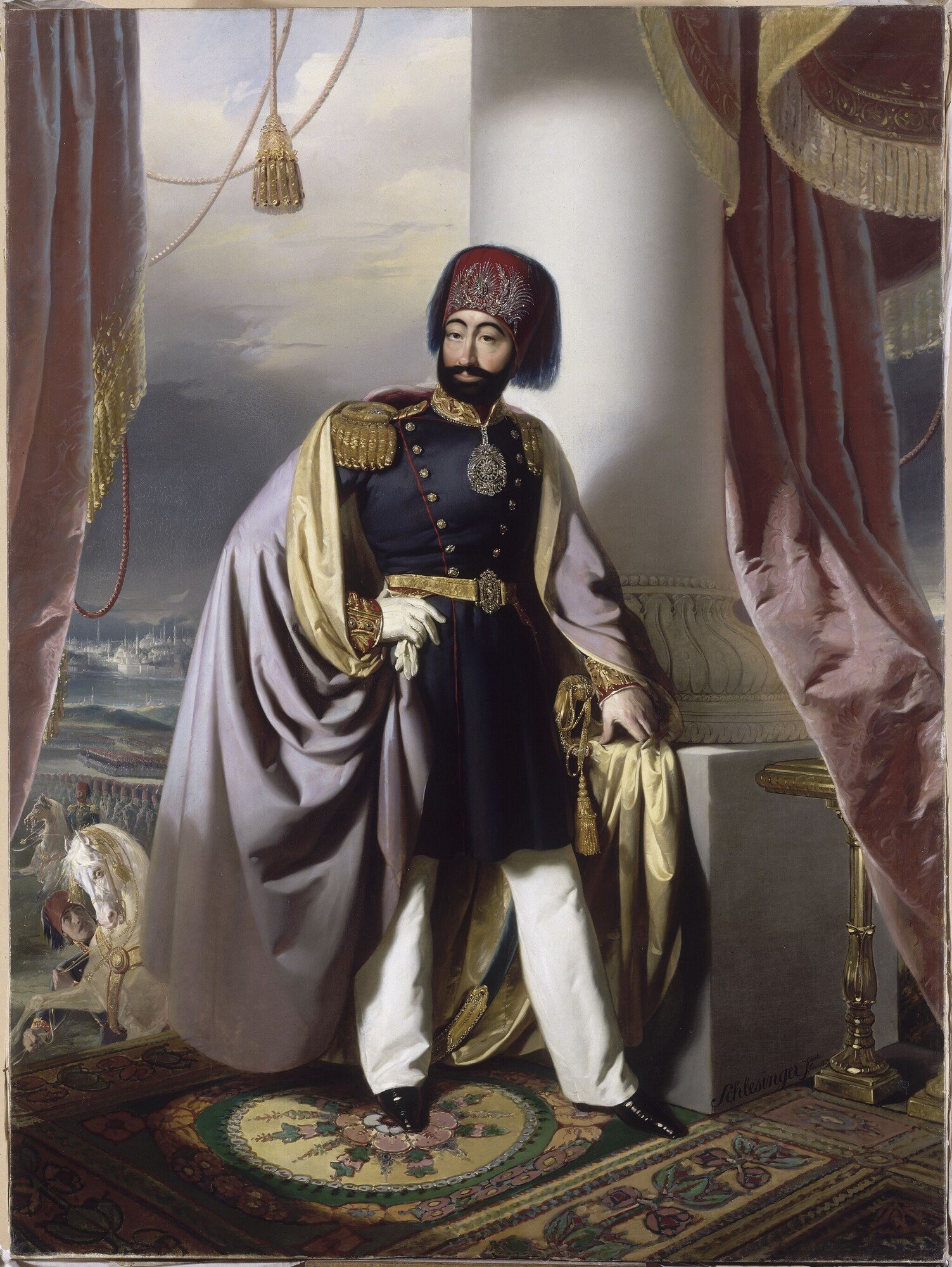
Mahmud’s portraits were known as tasvir-i hümâyûn. They hung in military and administrative buildings. They also served as diplomatic gifts and decorations. His image therefore appeared in several official settings, from buildings used by soldiers and administrators to exchanges involving diplomacy.
For a specific portrait, the Rijksmuseum holds an 1829 print bearing the name Meno Haas. Its inventory number is RP-P-1905-4979. If you are looking for a dated image of Mahmud II, this record gives you an artist’s name, a year and an identifiable museum object.
Who were Mahmud II’s wives and children?
Mahmud’s consorts included Bezmiâlem Kadın and Pertevniyal Kadın. Bezmiâlem was the mother of Abdülmecid. Pertevniyal was the mother of Abdülaziz. Both sons later became Ottoman sultans, although Abdülmecid was the son who succeeded Mahmud directly in 1839.
TDV İslâm Ansiklopedisi records that Mahmud had 36 children and lost most of them at young ages. His daughters included Saliha, Atiye, Mihrimah and Âdile Sultan. His family history thus includes both future rulers and the deaths of many children during childhood.
Mahmud II’s cause of death: why are there two dates?
English Wikipedia identifies Mahmud II’s cause of death as tuberculosis. It gives 1 July 1839 as his death date. TDV İslâm Ansiklopedisi instead dates his death to 28 June 1839 and provides an explanation involving the concealment of his death.
According to TDV, his death was kept secret for security reasons. His body was brought to Topkapı Palace on 1 July. The two accounts therefore assign different dates to his death, while TDV distinguishes the death itself from the later arrival of his body at the palace.
Timeline
- 20 July 1785: Mahmud II was born.
- 28 July 1808: He became sultan after Mustafa IV’s removal.
- 1826: The Janissary corps was abolished and Asâkir-i Mansûre-i Muhammediyye was established.
- 14 March 1827: Tıbhâne-i Âmire began teaching.
- 1828: The new army began wearing the fez.
- 1829: A decree regulated officials’ clothing.
- 1 November 1831: The first Turkish issue of Takvîm-i Vekāyi‘ appeared.
- 1834: Mustafa Reşid Bey was sent to Paris.
- 1836: The foreign and interior ministries were formed.
- 24 March 1838: The Meclis-i Vâlâ-yı Ahkâm-ı Adliyye was established.
- June–July 1839: Mahmud died; accounts give 28 June or 1 July.
- 1839: Abdülmecid succeeded him.
- 12 October 1840: Mahmud II’s tomb was completed.
Details you won’t find in guidebooks
The replacement army had duties beyond warfare. Its regulations assigned soldiers responsibility for Istanbul’s security. They also gave the force temporary firefighting duties. The same army established after the Janissaries’ abolition therefore had responsibilities connected to daily life in the city.
Mahmud’s tomb contains gifts from other rulers. Queen Victoria and Prince Albert gave a chandelier. Napoleon III gave gilded clocks. These objects add specific names and furnishings to the building’s history, alongside its role as a burial place.
Where is Mahmud II’s tomb in Istanbul?
Mahmud II’s tomb stands at Divanyolu Caddesi No. 74, in the Binbirdirek neighborhood of Istanbul’s Fatih district. Built during Abdülmecid’s reign, it was completed on 12 October 1840. The building has an octagonal plan, a dome and a Turkish Empire style.
Mahmud shares the tomb with his son Sultan Abdülaziz and his grandson Sultan Abdülhamid II. The surrounding burial ground contains approximately 140 graves. Those buried there include Ziya Gökalp, Abdülhak Molla and Sadullah Paşa. You can connect a visit to Mahmud’s own burial place with these other named figures.
FAQ
Who was Mahmud II in AP World History terms?
Mahmud II was the Ottoman sultan who ruled from 1808 to 1839 and strengthened central government through military and administrative reforms. His major changes included abolishing the Janissaries in 1826, establishing a replacement army and reorganizing government into ministries.
Who was Mahmud II’s father?
His father was Abdülhamid I. His mother was Nakşidil Sultan, and he was born on 20 July 1785.
Who was Mahmud II’s wife?
His consorts included Bezmiâlem Kadın, the mother of Abdülmecid, and Pertevniyal Kadın, the mother of Abdülaziz. Both sons later became sultans.
What caused Mahmud II’s death?
English Wikipedia identifies tuberculosis as his cause of death. It dates his death to 1 July 1839, while TDV gives 28 June and explains that his death was concealed for security reasons before his body reached Topkapı Palace on 1 July.
Sources
- Ministry of Culture and Tourism — İstanbul Türbeler Müze Müdürlüğü kvmgm.ktb.gov.tr
- TDV İslâm Ansiklopedisi — Mahmud II islamansiklopedisi.org.tr
- TDV İslâm Ansiklopedisi — Asâkir-i Mansûre-i Muhammediyye islamansiklopedisi.org.tr
- Wikipedia — Mahmud II en.wikipedia.org
- Atatürk Araştırma Merkezi Dergisi — Şapka İnkılabının Sosyo-Ekonomik Yönleri atamdergi.gov.tr
- The Metropolitan Museum of Art — The Later Ottomans and the Impact of Europe metmuseum.org
- Millî Saraylar — Osmanlı Padişah Portrelerine Dair Bir Değerlendirme dergipark.org.tr
- Rijksmuseum — Portret van sultan Mahmud II rijksmuseum.nl
- TDV İslâm Ansiklopedisi — Mekteb-i Tıbbiyye islamansiklopedisi.org.tr
- TDV İslâm Ansiklopedisi — Hariciye Nezâreti islamansiklopedisi.org.tr
- TDV İslâm Ansiklopedisi — Meclis-i Vâlâ-yı Ahkâm-ı Adliyye islamansiklopedisi.org.tr
- TDV İslâm Ansiklopedisi — Takvîm-i Vekāyi‘ islamansiklopedisi.org.tr
- TDV İslâm Ansiklopedisi — Mahmud II Türbesi, Sebili, Çeşmesi ve Hazîresi islamansiklopedisi.org.tr
- Ministry of Culture and Tourism — Istanbul Tomb Restoration Statement basin.ktb.gov.tr
Image: Mahmud II.jpg — Henry Guillaume Schlesinger, Public domain