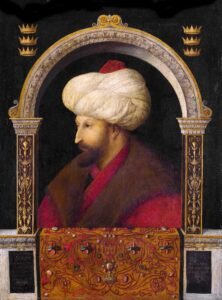
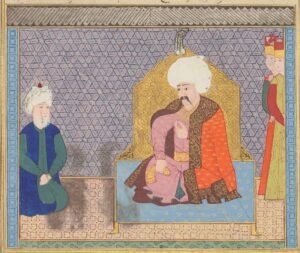
Cem Sultan was an Ottoman prince who lost a fight for the throne and spent the rest of his life as a bargaining chip in Christian Europe. His story mixes family rivalry, a knightly order, a pope and a French king. If you visit Bursa, you can still stand at his tomb.
Who Was Cem Sultan?
Cem Sultan was a son of Fatih Sultan Mehmed, known in English as Mehmed the Conqueror. He was born in Edirne in 1459. Sources disagree on the birthday. The TDV Islamic Encyclopedia gives 23 December. English Wikipedia gives 22 December.
He is the prince behind the phrase “the Cem Sultan affair.” It describes the struggle for the throne between Cem and his older brother, who became Bayezid II. That fight began after their father died in 1481.
Cem Sultan’s Real Name
English Wikipedia records his name in its Ottoman form as Cem bin Meḥemmed Ḫān. That reads as “Cem, son of Mehmed Khan.” So “Cem” is the name itself, and “Sultan” is the title that stuck to him in popular memory. Europeans of his time also knew him by the form “Zizim.” You can see that spelling today in the name of a tower in France, which we come to below.
Cem Sultan’s Mother and Father
His father was Fatih Sultan Mehmed. His mother was Çiçek Hatun. Bayezid II was his half-brother through their father.
That shared father is the heart of the conflict. Two sons of the same sultan each had a claim, and only one could rule.
What Religion Was Cem Sultan?
English Wikipedia’s biography box describes Cem as a Sunni Muslim. His life in exile fits that. While he was sheltered in Egypt, he went to Mecca and performed the pilgrimage, according to the TDV Islamic Encyclopedia.
This matters when you read about his later years. He spent them among Christian hosts, yet he was a Muslim prince from beginning to end.
A Prince Raised for Command
Ottoman princes learned to rule by governing provinces. Cem went to the Kastamonu governorship in 1469, when he was about ten years old. In 1474, after the death of his older brother Şehzade Mustafa, he was moved to the Karaman governorship, centered on Konya.
So by the time his father died, Cem had years of provincial experience. He also wrote poetry. We return to that in the details section.
The Cem Sultan Affair: A Throne Contested
Fatih died in 1481. Bayezid became sultan. Cem refused to accept it.
In 1481 Cem declared himself ruler in Bursa. He had the Friday sermon read in his own name and had coins struck. In the Ottoman world, those were the two classic marks of sovereignty. He was claiming the title, not just asking for a share.
The war was short. On 20 June 1481, Bayezid’s army defeated Cem on the Yenişehir Plain.
Cem crossed into Mamluk lands with his family. In Cairo, Sultan Kayıtbay received him. He also made the pilgrimage to Mecca during this period.
Rhodes: How a Refuge Became a Trap
Cem did not give up. In 1482 he and Karamanoğlu Kasım Bey tried to take Konya. They failed.
Cem then turned to the sea. On 29 July 1482 he reached Rhodes, where Pierre d’Aubusson, leader of the Hospitallers, welcomed him. Cem’s plan was to cross into Rumeli, the Ottoman lands in Europe. The knights had a different plan. They wanted to use him as a diplomatic tool against the Ottoman state.
Bayezid chose to pay rather than fight this out. He agreed to give the Rhodes knights 40,000 ducats a year in return for keeping Cem under watch.
Think of it like a yearly subscription fee. The sultan paid every year, and what he bought was a guest who stayed locked away.
Years in Europe
After Rhodes, Cem was moved from place to place. He was held in Nice and Bourganeuf, among other locations. In 1489 he passed into the care of the papacy in Rome.
The pope at the time, Innocent VIII, wanted to use Cem’s presence to organize a crusade against the Ottomans. For Cem, this meant that every host saw him as a tool. For Bayezid, it meant a brother who could become a rallying figure at any moment.
On 30 November 1490, the Ottoman envoy Mustafa Bey handed the pope 120,000 gold pieces in Rome. That payment covered three years of Cem’s custody.
Leaving Rome
In Cem’s last chapter, France entered Italy. King Charles VIII pressed Pope Alexander VI to hand Cem over during his Italian campaign. Cem left Rome in January 1495.
He did not go far. Charles took custody of him, and Cem died soon after in Naples.
Cem Sultan’s Cause of Death
Cem died on 25 February 1495 in Castel Capuana in Naples. The cause is debated.
The TDV Islamic Encyclopedia reports a rumor. It says the pope, forced to give up a valuable hostage, poisoned him. The encyclopedia presents this as hearsay.
Stanford Shaw tells it differently in his history of the Ottoman Empire. He writes that Cem fell ill on the road and died. Shaw adds that the idea of poisoning at Bayezid’s urging is unproven.
So you should treat “poisoned” as a claim, not a conclusion. The sources we have do not settle it.
Bayezid declared three days of mourning after hearing of his brother’s death.
The Cem Sultan Tomb in Bursa
Cem’s body was brought to Bursa in 1499. It was buried in the tomb at Muradiye. The Ministry of Culture and Tourism portal lists the Cem Sultan Tomb among Bursa’s sites to visit.
Bursa is also the city where Cem had declared himself ruler in 1481. His journey ended where his claim to the throne began.
Timeline
- 1459: Cem is born in Edirne.
- 1469: He is sent to the Kastamonu governorship.
- 1474: After Şehzade Mustafa’s death, he takes the Karaman governorship, centered on Konya.
- 1481: Fatih dies. Cem contests the throne with Bayezid II and declares himself ruler in Bursa.
- 20 June 1481: He is defeated on the Yenişehir Plain and takes refuge in Mamluk lands.
- 1482: His attempt on Konya fails. He reaches Rhodes on 29 July.
- 1484–1486: The Zizim Tower is built at Bourganeuf.
- 1489: He passes into papal custody in Rome.
- January 1495: Charles VIII takes him, and he leaves Rome.
- 25 February 1495: He dies in Naples.
- 1499: His body is buried in Bursa at Muradiye.
Details You Won’t Find in Guidebooks
A tower built for one prisoner. The town of Bourganeuf in France has a tower named Zizim. According to the town’s own page, it was built between 1484 and 1486 to hold Cem. Its roof peak stands 35 meters above the ground.
A price tag on a prince. On 30 November 1490, the Ottoman envoy Mustafa Bey paid the pope 120,000 gold pieces in Rome. The money covered three years of Cem’s custody.
A tomb with a prior owner. The building now called the Cem Sultan Tomb was first made for Şehzade Mustafa, Cem’s older brother. After Cem’s burial in 1499, it was named after him.
A rival who wrote poems. Cem left two divans, collections of verse: one in Turkish and one in Persian.
FAQ
Who was Cem Sultan’s father?
His father was Fatih Sultan Mehmed (Mehmed the Conqueror). His mother was Çiçek Hatun, and his half-brother was Bayezid II.
How did Cem Sultan die?
He died on 25 February 1495 in Castel Capuana in Naples. A rumor says the pope poisoned him. Stanford Shaw writes that he fell ill on the way and stresses that poisoning at Bayezid’s urging is unproven.
Where is Cem Sultan buried?
His body was brought to Bursa in 1499 and buried in the tomb at Muradiye. The building was first made for his brother Şehzade Mustafa.
What religion was Cem Sultan?
English Wikipedia lists him as a Sunni Muslim. During his refuge in Egypt he traveled to Mecca and performed the pilgrimage.
Why did the Knights of Rhodes keep Cem?
They wanted to use him as a diplomatic bargaining chip against the Ottoman state. Bayezid II agreed to pay them 40,000 ducats a year to keep Cem under watch.
Sources
- Vikipedi — Cem Sultan tr.wikipedia.org
- Wikipedia — Cem Sultan en.wikipedia.org
- TDV İslâm Ansiklopedisi — Cem Sultan islamansiklopedisi.org.tr
- TDV İslâm Ansiklopedisi — Cem Sultan Türbesi islamansiklopedisi.org.tr
- Kültür ve Turizm Bakanlığı Kültür Portalı — Cem Sultan Türbesi kulturportali.gov.tr
- Bourganeuf Belediyesi — La Tour Zizim bourganeuf.fr
- Stanford J. Shaw — History of the Ottoman Empire and Modern Turkey, Vol. 1 psi424.cankaya.edu.tr
Image: Cem Sultan, Pinturicchio, liberia piccolomini, 1502-07 circa, Pio II giunge ad Ancona per dare inizio alla crociata 07.jpg — Pinturicchio, 1502-07 circa, CC BY-SA 3.0