Who was Ibn Khaldun, and where was he from?
Ibn Khaldun was a historian, statesman, teacher, and Maliki judge who lived in the fourteenth century. Also known as Abdurrahman, he was born in Tunis on 27 May 1332. The city was then under Hafsid rule. His career took him through North Africa and Mediterranean centers, combining political service with historical writing.
His best-known work, the Muqaddimah, asks how society works and how historical reports should be judged. Its central concepts include umran, his science of civilization, and asabiyyah, the solidarity that enables groups to act together. If you want to understand his account of political power, these concepts belong together.
For readers interested in Turkey, his connection is also intellectual. Kâtib Çelebi, Naîmâ, and Ahmed Cevdet Paşa drew on Ibn Khaldun’s ideas when assessing Ottoman history. His arguments about society and government therefore became part of the work of these Ottoman historians.
Where did Ibn Khaldun live?
Ibn Khaldun’s life passed through Tunis, Fez, Tlemcen, Granada, Béjaïa, and Cairo. These places formed the geographical setting of a career spent in government, teaching, and law. Tunis was both his birthplace and a city to which he returned while working on his history.
Political employment brought danger. In 1357, Ibn Khaldun was imprisoned in Fez during the reign of the Marinid ruler Abu Inan. He was released after the ruler died in 1358. His experience of government thus included confinement as well as service.
Cairo became another major center of his life. In 1384, the Mamluk sultan Barquq appointed him chief Maliki judge there. He died in Cairo on 17 March 1406 and was buried in the Sufiyya cemetery opposite Bab al-Nasr. The exact location of his grave is unknown today.
Timeline
- 1332: Born in Tunis under Hafsid rule.
- 1357–1358: Imprisoned in Fez, then released after Abu Inan’s death.
- 1364: Sent as an envoy to King Pedro of Castile.
- 1377: Completed drafts of the Muqaddimah at Ibn Salama Castle.
- 1378: Returned to Tunis to consult sources for his history.
- 1384: Appointed chief Maliki judge in Cairo.
- 1401: Met Timur in Damascus.
- 1406: Died in Cairo.
- 1958: Franz Rosenthal’s first complete English translation of the Muqaddimah appeared in three volumes.
Ibn Khaldun’s Muqaddimah: what is the book about?
The Muqaddimah was written as the introduction to Kitab al-Ibar, Ibn Khaldun’s world history. He completed its drafts in 1377 at Ibn Salama Castle, in present-day Algeria. Its relationship to the larger history matters: it sets out ways to assess the reports on which historical writing depends.
Ibn Khaldun designed his science of umran to test historical reports against the workings of social life. The reliability of a report was therefore connected to how societies functioned. His approach brought the study of civilization into the task of deciding whether an account deserved belief.
The book also discusses politics, economics, education, and the social conditions of knowledge. These subjects sit alongside historical method. When you read the Muqaddimah, questions about government appear within a wider examination of livelihoods, learning, and collective life.
Its second section connects differences between Bedouin and settled communities with ways of making a living. Agriculture and animal husbandry are among the activities considered. This gives the discussion a concrete basis: forms of social life are examined in relation to how people support themselves.
Ibn Khaldun returned to Tunis in 1378 to reach the sources he needed to complete his history. That return followed the completion of the Muqaddimah drafts. The sequence shows the introduction taking shape within a larger historical project that still required access to written materials.
Ibn Khaldun’s asabiyyah: what does it mean?
Asabiyyah means the solidarity and group consciousness that move members of a community to act together. In Ibn Khaldun’s account, it helps explain how a group acquires political power. It also helps explain how a ruling group maintains its position after establishing a state.
Blood relationships can support this solidarity, but his explanation also includes geographical, political, and religious ties. Kinship is therefore one basis of asabiyyah among several. People can share the bonds that sustain collective action through forms of closeness beyond descent.
For an everyday comparison, think of a shared task in which you depend on others to do their part. The useful connection is the ability to act together. Ibn Khaldun applied that question of solidarity to communities, rulers, and dynasties, where collective action could support the acquisition of power.
In his theory, rural or tribal communities with strong asabiyyah can defeat established dynasties. The strength of the ruling side is therefore not explained by its settled position alone. A challenger’s capacity to act as a group can become decisive in a struggle for rule.
Asabiyyah remains necessary after victory. Ibn Khaldun regarded it as a support for a ruler’s or dynasty’s continued dominance. Establishing a state does not end the need for the solidarity that helped make political authority possible.
His explanation also distinguishes between uses of solidarity. He viewed asabiyyah serving what is right positively. He separated that from the asabiyyah of Jahiliyya that supports injustice. Group loyalty, in this account, must also be considered through the purposes it serves.
How does asabiyyah explain the rise and fall of dynasties?
Ibn Khaldun’s dynastic cycle connects political change with changes in solidarity. A group with strong asabiyyah can seize power from a settled dynasty. The comforts of city life can then weaken the solidarity of the new ruling community over several generations.
A further group with stronger cohesion may eventually defeat it. The explanation connects the beginning and end of a dynasty through the same concept. Solidarity helps a community establish its rule; its weakening helps explain why that rule becomes vulnerable to a successor.
Read alongside his discussion of agriculture and animal husbandry, this argument places political power within social conditions. The Muqaddimah considers how people live and how they organize themselves. Its account of dynastic change belongs within that broader investigation of society.
Ibn Khaldun’s books: where should you begin?
The relationship between Kitab al-Ibar and the Muqaddimah provides a starting point. Kitab al-Ibar is the world history. The Muqaddimah is its introduction, containing the discussions of historical method, society, and asabiyyah addressed here.
His autobiography, al-Ta’rif, was appended to the end of Kitab al-Ibar. It adds an autobiographical work to this group of connected writings. The history, its introduction, and the autobiography have different roles within Ibn Khaldun’s written work.
The attribution of Shifa al-Sa’il is disputed. Abdurrahman Badawi assigned it to Ibn Khaldun. Ali Abd al-Wahid Wafi attributed it to Abdurrahman, his father’s uncle. That disagreement should remain visible when the work appears in a list of his books.
Ibn Khaldun books PDF: where can you read the Muqaddimah?
Franz Rosenthal’s first complete English translation of the Muqaddimah appeared in 1958 in three volumes. It provides an English route into the work’s discussions of history, political authority, livelihoods, education, and knowledge.
The Indira Gandhi National Centre for the Arts in India hosts a PDF containing text from Rosenthal’s translation. If you are looking for an English Muqaddimah PDF, this gives you a direct place to begin reading.
Ibn Khaldun quotes: ideas in plain English
The Muqaddimah connects the assessment of historical reports with the workings of society. Put as a paraphrase, its method asks whether an account fits the conditions of social life. This is a statement of the argument, rather than a direct quotation.
His explanation of political change can likewise be paraphrased: solidarity helps groups gain and retain power, while weakened solidarity leaves dynasties exposed to stronger rivals. The full argument also includes livelihoods, settled life, and the changing condition of ruling communities.
Details you won’t find in guidebooks
In 1364, Ibn Khaldun met King Pedro of Castile as an envoy. Pedro offered to restore his family’s properties in Spain. Ibn Khaldun refused the offer. The encounter was therefore both a diplomatic mission and an occasion involving his family’s property.
In 1384, the ship carrying Ibn Khaldun’s family sank off Alexandria. This happened in the same year that he became chief Maliki judge in Cairo. The two events place a family catastrophe alongside a major appointment in his public career.
In 1401, Ibn Khaldun was lowered by ropes from the walls of besieged Damascus to meet Timur. He also reported writing a twelve-page account of North Africa at Timur’s request. According to his account, the text was translated into the Tatar language.
FAQ
Where was Ibn Khaldun from?
Ibn Khaldun was born in Tunis on 27 May 1332, when the city was under Hafsid rule.
What is the Muqaddimah?
The Muqaddimah was written as the introduction to Ibn Khaldun’s world history, Kitab al-Ibar. It examines historical method, politics, economics, education, and the social conditions of knowledge.
What does asabiyyah mean?
Asabiyyah means solidarity and group consciousness that lead people to act together. Ibn Khaldun connected it with the establishment and survival of political power.
Where can you find an English Muqaddimah PDF?
The Indira Gandhi National Centre for the Arts hosts a PDF containing text from Franz Rosenthal’s English translation: https://ignca.gov.in/Asi_data/16173.pdf.
Sources
- TDV İslâm Ansiklopedisi — İbn Haldûn islamansiklopedisi.org.tr
- TDV İslâm Ansiklopedisi — Mukaddime islamansiklopedisi.org.tr
- TDV İslâm Ansiklopedisi — Asabiyet islamansiklopedisi.org.tr
- Oxford Bibliographies — Ibn Khaldun academic.oup.com
- Princeton University Press / JSTOR — The Muqaddimah jstor.org
- Indira Gandhi National Centre for the Arts — The Muqaddimah PDF ignca.gov.in
- Wikipedia — Ibn Khaldun en.wikipedia.org
- Vikipedi — İbn Haldun tr.wikipedia.org
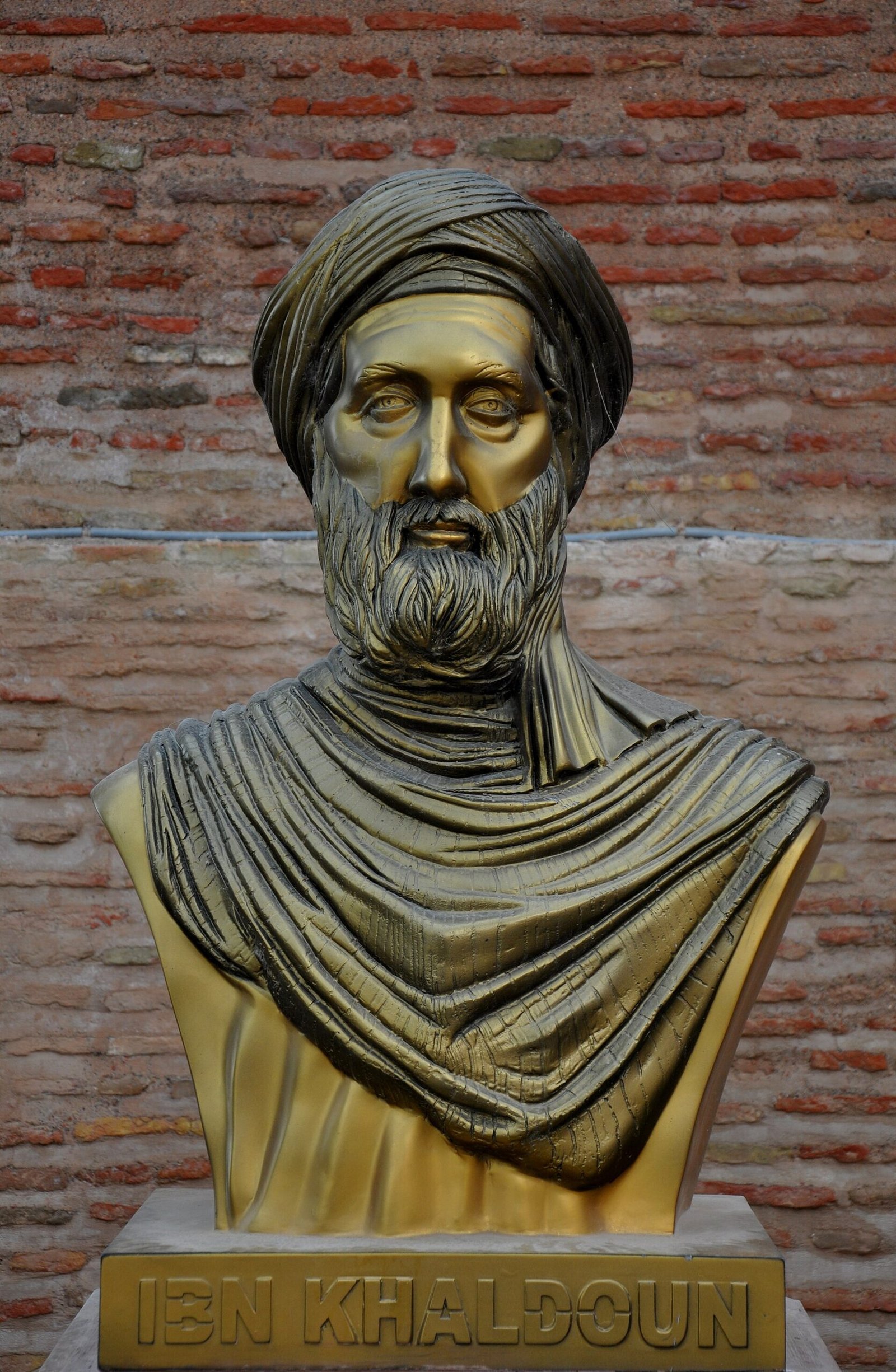
Image: Bust of Ibn Khaldun (Casbah of Bejaia, Algeria).jpg — Reda Kerbush, CC BY-SA 4.0