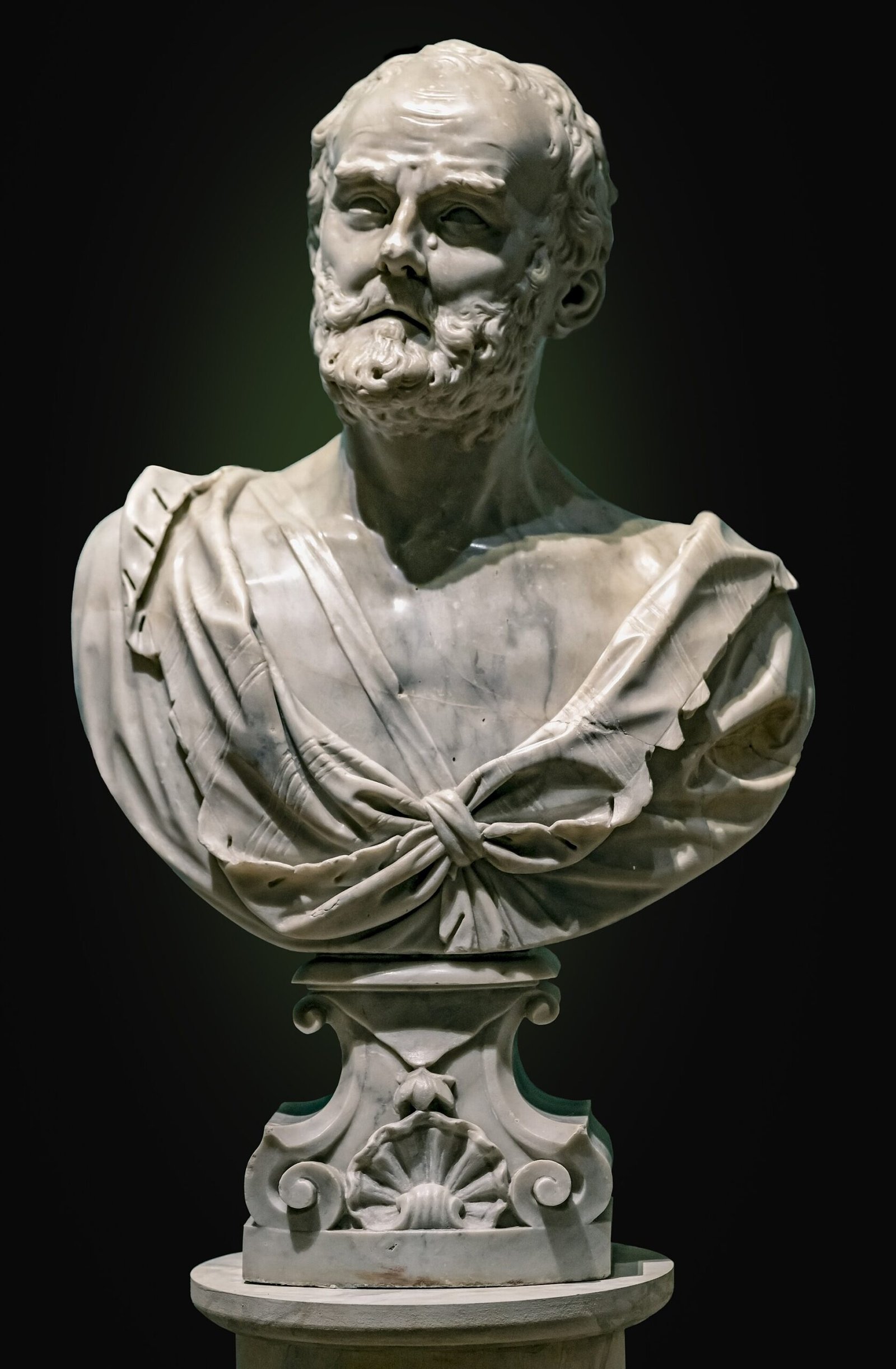
Heraclitus was a Greek philosopher from Ephesus, active around 500 BCE, who explored change, unity, and the shared order called logos. The saying that you cannot step into the same river twice comes through Plato’s account of his thought. A more securely preserved fragment describes fresh waters flowing upon people entering the same rivers, connecting change with continuity.
That difference changes how you read the famous river saying. Does the river lose its identity whenever its waters change, or does flowing water help it remain a river? Heraclitus’s fragments bring that question together with fire, opposing tensions, and the difficulty of understanding a common order.
Heraclitus of Ephesus: where did he live?
Heraclitus came from Ephesus, an Ionian city under Persian rule during his lifetime. He belongs to the Greek philosophers described as pre-Socratic. His intellectual activity is generally placed around 500 BCE, although his biography remains uncertain.
For travelers to Turkey, Ephesus provides the geographical connection. The ancient city stands in modern Selçuk, in İzmir province. When you connect Heraclitus with Ephesus, you place his philosophy in a specific city of ancient Ionia.
His dates require care. Turkish Wikipedia gives 535–475 BCE, while the Stanford Encyclopedia of Philosophy emphasizes the uncertainty of his life story. Around 500 BCE is therefore the more cautious anchor for introducing his activity.
Heraclitus pronunciation and the meaning of his name forms
The English pronunciation of Heraclitus is /ˌhɛrəˈklaɪtəs/. The stressed syllable sounds approximately like “klay.” If you are saying the name aloud, that is the syllable to emphasize.
Heraklitos, Herakleitos, and Heraclitus identify the same Ephesian philosopher. These forms correspond to the Greek name Ἡράκλειτος. Recognizing them helps when moving between English discussions and Turkish material about Ephesus.
The Heraclitus river quote: what survives?
The familiar statement that you cannot step into the same river twice appears in Plato’s Cratylus, at 402a, as an account of Heraclitus’s thought. Its connection with Plato matters. The popular wording should be distinguished from the wording of the surviving river fragment identified as B12.
B12 says that different waters flow upon those entering the same rivers. Its phrasing preserves both parts of the puzzle: the rivers are called the same, while their waters keep changing. That combination gives the passage more to say than a simple declaration that everything disappears.
The surviving river material also includes passages labeled B49a and B91a. Stanford treats B12 as a reliable direct quotation. It treats Plutarch’s B91a account as a paraphrase. These distinctions matter when you encounter several versions presented as a single quotation.
Heraclitus meaning: how can a changing river remain the same?
A Platonic reading takes the river image as an expression of continual change. On this reading, returning to the river cannot reproduce the earlier encounter, because different waters are flowing. This is the interpretation most closely associated with the familiar saying about entering twice.
Graham’s interpretation of B12 places more weight on continuity. The river persists as the same river because its waters change. Flow is part of what sustains it. Change and identity therefore belong in the same explanation, rather than forcing a choice between them.
An everyday connection appears in another of Heraclitus’s examples: a drink separates when it is left unstirred. Think of stirring that mixture. Its movement helps preserve its unity. The example makes the river’s problem concrete: keeping something together can depend on continuing activity.
Heraclitus philosophy: opposites and fire
Heraclitus uses the bow and the lyre to explain how opposing tensions can produce harmony. Their tension belongs to their working arrangement. The example connects opposition with unity, rather than treating the two as mutually exclusive conditions.
Fire provides another major image. In fragment DK B30, the cosmos is described as ever-living fire, kindling and going out according to measure. Neither gods nor humans created it. The reference to measure links transformation with an ordered process.
How to understand this fire remains debated. A traditional reading treats it as the world’s fundamental substance. The Internet Encyclopedia of Philosophy offers another approach through DK B90, where exchanges between gold and goods help explain fire as a standard of process and transformation.
Read alongside the river, these examples share a concern with relationships. Waters change within the continuing river. Opposing tensions form harmony in the bow and lyre. Fire kindles and subsides according to measure. Heraclitus’s philosophy connects movement with an intelligible order.
Heraclitus logos: what does it mean?
In DK B1, logos is presented as a common account or order according to which events occur. The term therefore belongs at the center of his philosophy. The river and fire concern change, while logos directs attention to how events share an underlying order.
DK B50 asks listeners to attend to logos rather than to Heraclitus’s personal authority. Its purpose is to lead them toward understanding the unity of all things. For you as a reader, the distinction is useful: the philosopher directs attention beyond the person speaking to the account being offered.
Heraclitus books and fragments: what can you read?
Heraclitus wrote one work, but it has not survived as a complete book. More than a hundred fragments remain through quotations in later writers. Reading him therefore means working with passages preserved separately, rather than following an intact sequence of chapters.
Turkish sources call the work Doğa Üzerine. Diogenes Laertius reports that it had three divisions, concerning the universe, politics, and theology. This is a later account of the work’s organization, distinct from the fragmentary text available to readers.
A tradition says Heraclitus deposited his book in the Temple of Artemis at Ephesus. Stanford regards the story as compatible with the storage functions of temples at the time, but unconfirmed. It should be read as a reported tradition about the book.
Heraclitus quotes: why wording matters
“Panta rhei,” meaning “everything flows,” often serves as a summary of Heraclitus’s thought. Yet Jonathan Barnes notes that most modern scholars do not accept this exact expression as his. A memorable summary and a securely attributed fragment are different kinds of evidence.
His difficult style also matters. Paradoxes and wordplay helped earn Heraclitus the ancient designation “the Obscure.” A short passage may require careful reading because its language carries a tension, as B12 does with the same rivers and different waters.
Details you won’t find in guidebooks
Aristotle used Heraclitus’s opening sentence as an example of a punctuation problem in the Rhetoric. The difficulty concerns which expression the word “always” belongs with. Even the placement of that word affects how the statement is understood.
One fragment describes gold seekers digging much earth and finding little gold. The image gives Heraclitus a concrete example of extensive effort yielding a small return. Gold appears here as something difficult to find, alongside its different role in the exchange comparison of B90.
Another fragment considers seawater. The same water is beneficial to fish but undrinkable and harmful to humans. The example makes a distinction through a specific relationship: what the water does depends on the living beings involved.
Heraclitus: where to start
Start with B12, then read DK B1 and DK B50 on logos. Follow these with the bow and lyre example and DK B30 on fire. This sequence brings together the river’s changing waters, a shared order, opposing tensions, and measured transformation.
For an accessible historical edition, the Library of Congress provides George Thomas White Patrick’s study of the fragments, published in Baltimore in 1889, with a PDF option. Turkish readers can also identify Cengiz Çakmak’s Fragmanlar translation, first published by Kabalcı in Istanbul in October 2005.
Heraclitus’s influence extended to Plato, Aristotle, the Stoics, Hegel, Nietzsche, and Heidegger. The river remains a useful starting point because its competing readings reveal a central question: how can something continue through change?
Timeline
- 535–475 BCE: The dates given by Turkish Wikipedia; his biography remains uncertain.
- Around 500 BCE: The period generally assigned to his intellectual activity.
- 1889: George Thomas White Patrick’s study of the fragments appeared in Baltimore.
- 2005: Kabalcı published the first edition of Cengiz Çakmak’s Turkish Fragmanlar translation.
FAQ
What does the Heraclitus river quote mean?
It connects the river’s continuing identity with its changing waters. Plato’s version stresses that you cannot enter the same river twice, while an interpretation of fragment B12 explains how the river continues through change.
Where did Heraclitus live?
Heraclitus came from Ephesus in Ionia. The ancient city is in modern Selçuk, in Turkey’s İzmir province.
Did Heraclitus write a book?
Heraclitus wrote one work, known in Turkish as Doğa Üzerine. More than a hundred fragments survive through quotations by later writers, rather than as a complete book.
Did Heraclitus say “everything flows”?
Panta rhei, meaning “everything flows,” commonly summarizes his thought. Jonathan Barnes notes that most modern scholars do not accept those exact words as his.
Sources
- Stanford Encyclopedia of Philosophy — Heraclitus plato.stanford.edu
- Internet Encyclopedia of Philosophy — Heraclitus iep.utm.edu
- Fordham University — The Fragments of Heraclitus sourcebooks.fordham.edu
- Library of Congress — The Fragments of the Work of Heraclitus of Ephesus on Nature loc.gov
- Wikipedia — Heraclitus en.wikipedia.org
- Wikipedia — Ephesus en.wikipedia.org
- Vikipedi — Heraklitos tr.wikipedia.org
Image: Ca' Rezzonico – Eraclito 1705 – Giuseppe Torretti.jpg — Didier Descouens, CC BY-SA 4.0