Chandragupta Maurya founded the Mauryan Empire, centred on Magadha, and ruled approximately from 322 to 298 BCE. He replaced Nanda rule by capturing its capital, Pataliputra, and later reached an agreement with Seleucus I. His childhood, the details of his campaigns, and the circumstances of his final years remain disputed.
The capture of Pataliputra provides a firm starting point, but the stories surrounding it are harder to untangle. If you follow Chandragupta from the Nanda capital to his agreement with Seleucus, you encounter different kinds of evidence: later religious narratives, accounts preserved through other writers, and retrospective inscriptions. Their differences explain why the empire’s foundation is clearer than many episodes in its founder’s life.
How did Chandragupta replace Nanda rule?
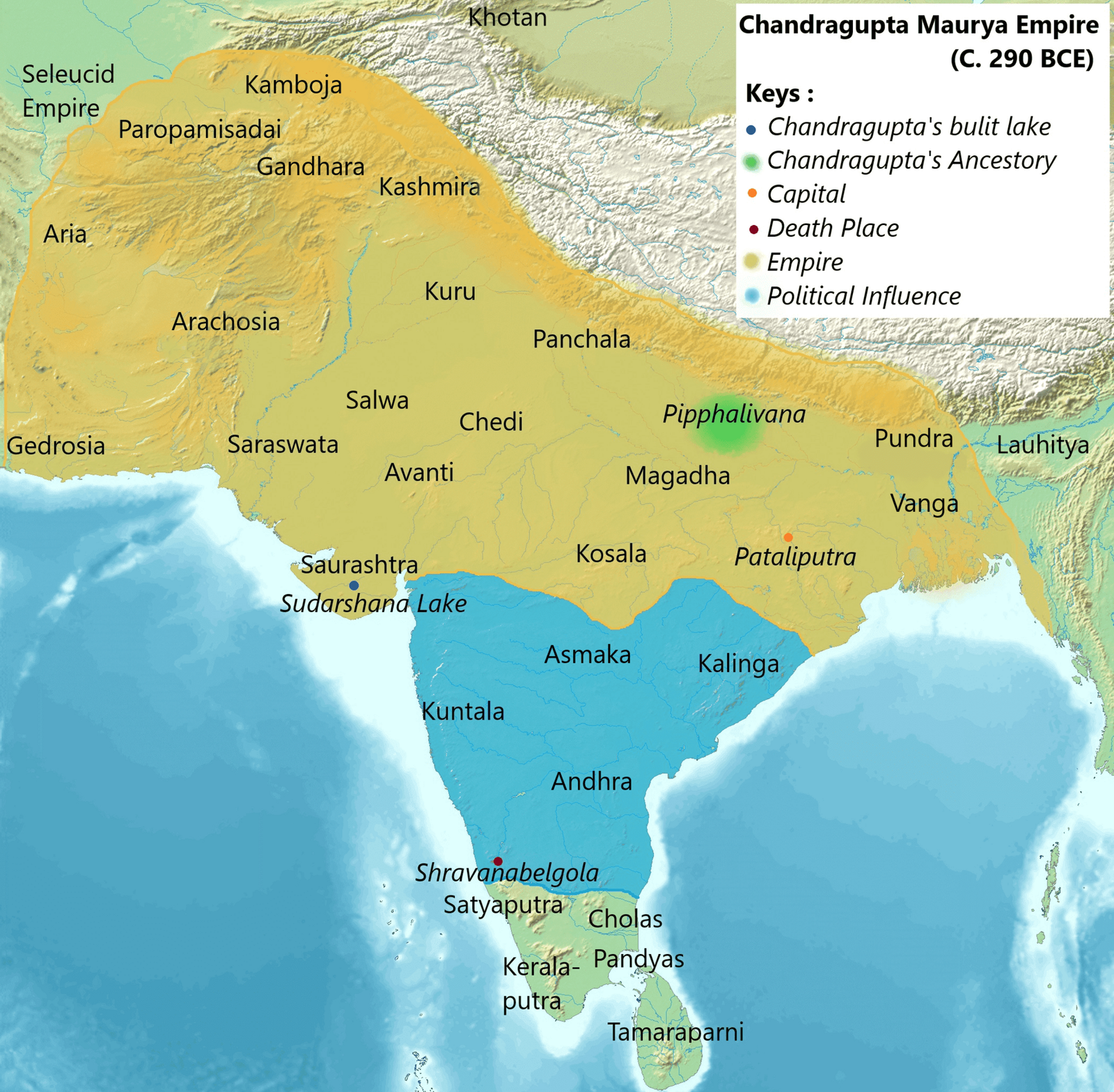
Chandragupta took Pataliputra, the capital of the last Nanda ruler, Dhanananda. His own dynasty then replaced Nanda government. Pataliputra corresponds to present-day Patna in India’s Bihar state, giving the political centre of his empire a location you can identify on a modern map.
His reign is dated approximately to 322–298 BCE. The order of the campaigns that brought Chandragupta to power remains disputed. Different reconstructions place his consolidation in Punjab either before or after the overthrow of the Nandas. A smooth account of uninterrupted advance would conceal that disagreement.
The Mahavamsa Tika and Parishishtaparvan describe an unsuccessful first attack on the capital. In these accounts, Chandragupta and his supporters then turn to the border regions before securing the centre. This offers a clear explanation of their strategy, but contemporary records do not confirm that sequence.
His family background is also unsettled. Brahmanical tradition presents him as the son of Nanda and Mura, while Jain tradition gives him a different origin. These competing accounts cannot establish a secure childhood biography. The replacement of the Nanda dynasty is more firmly grounded than the family stories attached to its conqueror.
What sources underpin accounts of his relationship with Chanakya?
Chanakya’s assistance appears in Vishakhadatta’s play Mudrarakshasa, Buddhist chronicles, and Jain texts. These works were written centuries after Chandragupta’s lifetime. They preserve accounts of the relationship, but their distance from the events limits how confidently individual episodes can be reconstructed.
Hemachandra’s twelfth-century Parishishtaparvan gives a detailed account in its eighth chapter. Its narrative helps explain the place of Chandragupta and Chanakya in Jain tradition. Yet narrative detail does not remove the chronological gap between an event and the surviving work that describes it.
The Arthashastra presents a different problem. Traditionally attributed to Chanakya, also called Kautilya, it is a Sanskrit text on principles of government. UCLA’s assessment points to differences in language and style that prevent the entire surviving text from being confidently assigned to one author.
If you read the Arthashastra to understand Chandragupta, distinguish prescriptions for government from records of government in action. The work cannot serve as a direct historical account of his administration. Its traditional association with Chanakya does not establish that every policy it describes operated under Chandragupta.
Why are details of his conflict and treaty with Seleucus disputed?
Chandragupta’s encounter with Seleucus I, a former commander of Alexander, and their peace agreement are generally dated to around 305–303 BCE. The settlement involved territorial transfer, a marriage arrangement, and elephants. Its broad outline is clearer than the military events that preceded it.
Sushma Jansari’s assessment challenges confident declarations that either ruler won a decisive military victory. The early sources do not establish an unambiguous winner. The existence of a settlement therefore cannot, by itself, tell you exactly how the fighting ended or which ruler dictated its terms.
Strabo and Plutarch report that Chandragupta gave Seleucus 500 elephants. Jansari cautions that these reports may derive from a shared source. Two surviving authors can therefore preserve one underlying account, rather than provide two independent confirmations of the number.
The marriage provision is another point of disagreement. Interpretations depend partly on the meanings of Appian’s word kēdos and Strabo’s epigamia. These have supported readings ranging from a personal dynastic marriage to a right of intermarriage between communities. A specific royal wedding should not be treated as settled fact.
Strabo also says that Seleucus ceded territory to Chandragupta. He does not clearly list the places transferred. The surviving wording does not permit the agreement’s borders to be drawn with precision.
What do accounts attributed to Megasthenes reveal about Mauryan government?
Seleucus sent Megasthenes as an envoy to Pataliputra. Megasthenes’ original account of India is lost. Its contents survive through later writers, including Strabo and Arrian. What can be read today therefore depends on the passages those writers transmitted.
The account attributed to Megasthenes describes Pataliputra as approximately nine miles long and two miles wide. A ditch and a wooden wall surrounded it. These details offer a concrete picture of the capital, although they reach us through the account’s later transmission.
Megasthenes’ description divides society into seven groups. Soldiers, government overseers, and royal advisers appear separately. This classification suggests distinctions between military and administrative work. It gives a view of specialised responsibilities within the kingdom, rather than simply a portrait of its ruler.
Thomas R. Trautmann’s 2021 reading places military resources at the centre of Chandragupta’s success. He interprets Megasthenes as describing royal monopolies over horses, elephants, and weapons. Control of those resources helps explain how the ruler could sustain organised military power.
Trautmann also reads the account as showing that soldiers received pay during both war and peace. Farmers were disarmed, and soldiers were separated from agricultural production. For an everyday-life connection, think about the difference between receiving regular pay for a dedicated job and producing your own food. In this interpretation, military service formed a distinct occupation supported beyond periods of fighting.
Timeline
- Around 322 BCE: Chandragupta’s reign began. His Mauryan dynasty replaced Nanda rule, but the campaign sequence remains disputed.
- Around 305–303 BCE: The encounter with Seleucus ended in an agreement involving territory, a marriage arrangement, and elephants.
- Around 298 BCE: Chandragupta’s reign ended, and his son Bindusara succeeded him.
- Second century CE: Rudradaman’s inscription retrospectively credited Chandragupta’s governor Pushyagupta with constructing Sudarshana Lake.
- Seventh century CE: An inscription at Shravanabelagola mentioned Prabhacandra. Its connection with Chandragupta remains disputed.
- Twelfth century CE: Hemachandra included a detailed account of Chandragupta and Chanakya in Parishishtaparvan.
Details you won’t find in guidebooks
The account attributed to Megasthenes says that Chandragupta sometimes changed where he slept because he feared conspiracies. This small detail places personal insecurity alongside the capital’s defences and the kingdom’s organised military resources. It remains a reported feature of court life, rather than a directly preserved statement by Chandragupta.
Trautmann connects Mauryan military strength with control over two different environments. The dry Indus basin supplied horse resources, while the humid Ganges basin supplied elephant resources. In his interpretation, commanding both helped bring these military animals under the same royal authority.
Rudradaman’s second-century inscription credits Pushyagupta, a governor under Chandragupta, with building Sudarshana Lake in Gujarat. The attribution was recorded retrospectively. It connects Chandragupta’s government with a named governor and a specific construction project, while preserving a clear gap between the work and the inscription.
Two other details show why dates and attribution matter. The Arthashastra was rediscovered in modern scholarship in 1905. Much later, an Indian Ministry of Culture reply dated 9 December 2024 confirmed the excavation of an 80-pillared hall at Kumrahar, but did not attribute that building to Chandragupta.
How securely can traditions about Jainism and his abdication be verified?
Bindusara succeeded his father on the Mauryan throne. Jain tradition adds that Chandragupta abdicated, accompanied Bhadrabahu to Shravanabelagola, and died through fasting. Vincent A. Smith accepted this account while acknowledging that its evidence was not conclusive.
The seventh-century inscription at Shravanabelagola is central to the debate over identification. Lewis Rice identified its Prabhacandra with Chandragupta Maurya. J. F. Fleet rejected that interpretation. The inscription’s relevance therefore depends on an identification that scholars have disputed.
Harisena’s Brhatkathakosa raises another difficulty. Its Chandragupta comes from Ujjain and is not identified as a Maurya. Those features have supported the view that the story concerns another person. The shared name alone cannot securely connect this narrative with the founder of the Mauryan Empire.
FAQ
Who was Chandragupta Maurya?
Chandragupta Maurya founded the Mauryan Empire, centred on Magadha, and ruled approximately from 322 to 298 BCE. He replaced Nanda rule after taking Pataliputra.
Did Chanakya help Chandragupta establish his rule?
Buddhist chronicles, Jain texts, and Vishakhadatta’s Mudrarakshasa describe Chanakya’s assistance. These works were written centuries after the events, so their detailed accounts require caution.
Did Chandragupta defeat Seleucus I?
Their encounter around 305–303 BCE ended in an agreement. The early sources do not establish a clear military winner, and the territorial and marriage provisions remain disputed.
Did Chandragupta become a Jain ascetic?
Jain tradition says he abdicated, travelled with Bhadrabahu to Shravanabelagola, and died through fasting. The identification of figures in related texts and inscriptions remains disputed.
Sources
- IGNCA, The Maurya Period ignca.gov.in
- INFLIBNET, The Mauryan Empire ebooks.inflibnet.ac.in
- Wikipedia, Pataliputra en.wikipedia.org
- Wikipedia, Chandragupta Maurya en.wikipedia.org
- Turkish Wikipedia, Chandragupta Maurya tr.wikipedia.org
- UCLA MANAS, Kautilya and Arthashastra southasia.ucla.edu
- Sushma Jansari, Chandragupta Maurya, UCL Press discovery.ucl.ac.uk
- Thomas R. Trautmann, Megasthenes on the Military Livestock of Chandragupta and the Making of the First Indian Empire cambridge.org
- Vincent A. Smith, The Oxford History of India, 1923 penelope.uchicago.edu
- Indian Ministry of Culture, Lok Sabha Question 2122 sansad.in
Image: Chandragupta Maurya Empire c.290 BCE.png — Levakpitam, CC0