The Persian Empire of Cyrus and Darius is known to historians as the Achaemenid Empire. It started in 550 BC, when Cyrus the Great ended Median rule. It ended in 330 BC, with the last reign of Darius III. On the common 550–330 BC dating, that is about 220 years. If you travel in western Turkey, you pass through its former provinces. This guide covers the founders, the map, the capitals, and the questions people search for most.
Where was the Persian Empire?
The core of the empire was the kingdom of Anshan. It lay in Persis, today called Fars, in south-western Iran. From there Cyrus and his successors expanded in every direction.
Maps of the empire at its largest extent show Achaemenid rule stretching from the Balkans and North Africa, through Anatolia, Mesopotamia and Iran, to the Indus basin. Around 500 BC the territory is estimated at about 5.5 million square kilometres. The British Museum describes the Persian Empire at this point, reaching from Libya to Pakistan, as the largest empire of its time.
So when you search for an Achaemenid Empire map, look for the line that runs through modern Turkey. Most of Anatolia sat inside the empire for two centuries.
One identity question comes up often. The Achaemenids are described in the sources as a Persian dynasty of the ancient Iranian world. They are not classified as a Turkish dynasty. Being Iranian also does not make them a Kurdish dynasty. Their historical identity is recorded as Persian.
How do you pronounce Achaemenid?
The common English pronunciation is /əˈkiːmənɪd/. The stress falls on the second syllable. Say it with a long ‘kee’ sound in the middle and you will be understood.
The name also appears in other scripts. Hindi Wikipedia writes the empire as हख़ामनी साम्राज्य. Urdu Wikipedia writes it as ہخامنشی سلطنت. In Arabic, the journal of history and archaeology at the University of Baghdad uses الإمبراطورية الأخمينية.
Cyrus: from Anshan to Babylon
Cyrus the Great ruled first. Behind him came Cambyses II, then Bardiya, who reigned briefly in 522 BC, and then Darius I, who ruled from 522 to 486 BC.
Cyrus took Sardis in western Anatolia. The exact year is disputed. The Metropolitan Museum places the capture in 546 BC. The Sardis excavation team argues for 547 BC. The problem is a Babylonian chronicle with a broken country name, and scholars do not agree on how to read it.
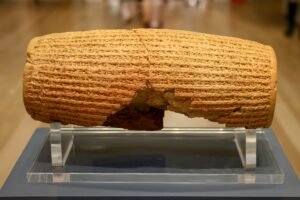
In 539 BC Cyrus captured Babylon. After this he had the Cyrus Cylinder prepared. The text describes the repair of temples and the return of exiled communities to their homelands. After Cyrus, Cambyses II took the throne.
Sardis and Daskyleion: the empire in Turkey
Two Achaemenid provincial centres sit in modern Turkey, and you can visit both.
Sardis was a major satrapal centre under Persian rule from 547 to 334 BC. It was the gathering point for the Greek campaigns of Darius and Xerxes. It was also the main western end of the great administrative road that began at Susa in Iran. A governor in Sardis was, in effect, at the far end of the imperial highway.
Daskyleion lies near Lake Manyas in Balıkesir province. During the Persian period, from 546 to 334 BC, it served as one of the satrapal centres of Anatolia.
Darius: revolts, taxes and gold
Darius I came to power in 522 BC. Between 521 and 520 BC he put down a series of revolts. He recorded this at Behistun in an inscription written in three languages: Old Persian, Elamite and Babylonian.
Darius also organised taxation. Herodotus describes a Darius arrangement with 20 tax districts. The king’s own Behistun inscription counts 23 countries. These two lists should not be treated as the same administrative classification.
Toward the end of the 6th century BC Darius introduced the gold daric. The coin weighed about 8.4 grams. Pick up a coin from your pocket and feel its weight. A daric was a small object carrying a large amount of gold, and it moved along the same roads that linked Susa to Sardis.
Darius built too. According to UNESCO, he founded Persepolis in 518 BC. It was a large palace complex on a terrace that was partly natural and partly artificial.
What was the capital of the Achaemenid Empire?
There is no single answer, and that is the real answer. The Achaemenids did not have one fixed, unchanging capital. Pasargadae was the dynastic centre. Susa and Babylon were the chief political and administrative centres. Persepolis, founded by Darius, added a monumental palace complex to this set. If you want one city to name, say Susa for administration and Pasargadae for the dynasty.
Did the Achaemenid Empire have a flag?
Online ‘flag map’ images place a modern design on the empire’s territory. The ancient evidence is thinner than those images suggest.
Xenophon describes the royal standard of Cyrus as a golden eagle set on a tall pole. He also notes that the different units of the Achaemenid army carried their own standards. So there was not one flag for everyone.
A later image adds a puzzle. The Alexander Mosaic shows a standard associated with Darius III. Some researchers identify the bird on it as a rooster, others as an eagle or a falcon. The debate is still open.
Achaemenid religion: what the evidence says
Darius worshipped Ahura Mazda. Whether that makes him a Zoroastrian is debated. Mary Boyce argued that the early Achaemenids were Zoroastrians. The counter-view stresses that worship of Ahura Mazda on its own does not prove a specifically Zoroastrian faith. When you read a confident claim either way, remember that specialists disagree.
How the empire ended
After Darius I the throne passed to Xerxes I, Artaxerxes I, Xerxes II, Sogdianus, Darius II, Artaxerxes II, Artaxerxes III, Artaxerxes IV and Darius III.
Alexander the Great defeated Persian armies at the Granicus in 334 BC, at Issus in 333 BC and at Gaugamela in 331 BC. The reign of Darius III ended in 330 BC. That year is the accepted end of the Achaemenid Empire. Persian rule at Sardis and Daskyleion ended in 334 BC, the year of the Granicus.
Timeline
- 550 BC Cyrus ends Median rule; traditional founding date of the Achaemenid Empire.
- 547/546 BC Cyrus takes Sardis; the exact year is disputed.
- 539 BC Cyrus captures Babylon.
- 522 BC Brief reign of Bardiya; Darius I comes to power.
- 521–520 BC Darius suppresses the revolts recorded at Behistun.
- 518 BC Darius founds Persepolis, according to UNESCO’s dating.
- c. 500 BC The empire reaches its largest extent.
- 486 BC The reign of Darius I ends; Xerxes I takes the throne.
- 334 BC Alexander wins at the Granicus; Persian rule in western Anatolia dissolves.
- 333 BC Alexander defeats the Persian army at Issus.
- 331 BC The Persian army is defeated at Gaugamela.
- 330 BC The reign of Darius III and the Achaemenid Empire end.
Details you won’t find in guidebooks
- Arrowheads in the wall. In the 2021 excavations at Sardis, archaeologists found more than 24 bronze arrowheads in a passage within the destruction layer linked to the Persian conquest.
- A soldier’s last coin. In 1987 a soldier was found at Sardis with his helmet. Near his head lay a Lydian silver coin worth one twenty-fourth of a stater.
- Phrygian words on Persian stones. At Daskyleion, grave stelae in Anatolian-Persian style carry Phrygian inscriptions. The local language stayed in use under Persian rule.
- A monument 60 metres up. The Darius monument at Behistun sits about 60 metres above the plain. It measures about 15 metres high and 25 metres wide.
- A missing piece found at Yale. A missing fragment of the Cyrus Cylinder was identified in 1971 in the Yale University collection. A cast of the piece was added to the main object.
FAQ
Where was the Persian Empire?
Its core was Anshan in Persis (Fars), south-western Iran. At its height around 500 BC it reached from Libya to Pakistan, and from the Balkans to the Indus basin.
Who founded the Achaemenid Empire?
Cyrus the Great. The founding is dated to 550 BC, when he ended Median rule.
What was the capital of the Achaemenid Empire?
There was no single fixed capital. Pasargadae was the dynastic centre; Susa and Babylon were the main political and administrative centres. Darius founded Persepolis in 518 BC.
Was the Achaemenid Empire Turkish or Kurdish?
No. The sources describe it as a Persian dynasty of the ancient Iranian world.
How long did the Achaemenid Empire last?
On the usual 550–330 BC dating, about 220 years.
Sources
- Wikipedia — Achaemenid Empire en.wikipedia.org
- Vikipedi — Ahameniş İmparatorluğu tr.wikipedia.org
- British Museum — Achaemenid Dynasty britishmuseum.org
- British Museum — Luxury and Power exhibition texts britishmuseum.org
- Encyclopaedia Iranica — Capital Cities iranicaonline.org
- UNESCO — Persepolis whc.unesco.org
- UNESCO — Bisotun whc.unesco.org
- Sardis Expedition — The Persian Sack of Sardis sardisexpedition.org
- Sardis Expedition — About Sardis sardisexpedition.org
- Sardis Expedition — Sardis, 2021 sardisexpedition.org
- Metropolitan Museum — Sardis metmuseum.org
- Metropolitan Museum — The Cyrus Cylinder and Ancient Persia metmuseum.org
- Nevşehir Hacı Bektaş Veli University — Daskyleion arkeoloji.nevsehir.edu.tr
- Encyclopaedia Iranica — Achaemenid Dynasty iranicaonline.org
- Encyclopaedia Iranica — Daric iranicaonline.org
- Encyclopaedia Iranica — Achaemenid Religion iranicaonline.org
- Encyclopaedia Iranica — Derafš iranicaonline.org
- Hindi Wikipedia — हख़ामनी साम्राज्य hi.wikipedia.org
- Urdu Wikipedia — ہخامنشی سلطنت ur.wikipedia.org
- University of Baghdad — الاخمينيون .. من القرية الى المدينة jcoart.uobaghdad.edu.iq
Image: Achaemenid Empire at its greatest extent according to Oxford Atlas of World History 2002-ar.png — Bassem Fleifel, CC BY-SA 4.0