Who was Boudica, the queen who fought Rome?
Boudica was the British queen of the Iceni who led an uprising against Roman rule in AD 60 or 61. Her forces attacked Camulodunum, Londinium and Verulamium, now Colchester, London and St Albans. A Roman army eventually defeated the rebels. Her story combines a royal inheritance dispute, violence against her family and the destruction of three towns.
If you know Boudica through her statue in London, the revolt gives that monument its historical setting. The bronze group shows her with her two daughters in a chariot. The ancient accounts describe a queen whose husband had been Rome’s ally, but whose family suffered under Roman rule after his death.
Where was Boudica from, and where did she live?
Boudica belonged to the Iceni. Their territory covered the area around present-day Norfolk, eastern Cambridgeshire and northern Suffolk. This was the region of her kingdom. Her connection with London comes from the rebellion: her forces attacked and burned Londinium.
Her husband, Prasutagus, was the Iceni king and an ally of Rome. Boudica therefore came to lead a revolt from within a kingdom that had maintained an alliance with Roman power. Prasutagus tried to protect his family through his will. What happened to that inheritance became central to Tacitus’s explanation of the uprising.
Boudica’s daughters and the disputed inheritance
Boudica and Prasutagus had two daughters. Their names have not survived in ancient records. Prasutagus named both daughters and Emperor Nero as joint heirs in his will. He intended this arrangement to protect his family after his death.
According to Tacitus, Roman authorities disregarded the will and seized Iceni land. Boudica was flogged, and her daughters were raped. In this account, the attack on the royal family and the seizure of the kingdom’s territory formed the immediate background to rebellion.
The daughters belong at the centre of this history because they were named heirs as well as victims of Roman violence. Their father’s effort to secure their future failed. Their presence beside Boudica in the later London monument recalls a family whose treatment figures prominently in Tacitus’s account.
Why did Boudica rebel against Rome?
Tacitus and Cassius Dio offer different explanations for the revolt. Tacitus stresses the mistreatment of Boudica and her family. Cassius Dio places greater emphasis on Roman financial demands and recalled loans. These accounts direct attention toward different pressures on the Iceni.
The rebellion also extended beyond Boudica’s own people. The Trinovantes, who were dissatisfied with Roman rule, joined the Iceni forces. You can therefore follow the uprising as both a response to the royal family’s treatment and a revolt involving another community with grievances against Rome.
The date requires care too. One interpretation places the uprising in AD 60. Another proposes that Boudica gathered forces in AD 60 and launched her attacks in AD 61. The familiar dating of AD 60–61 reflects those competing reconstructions.
Boudica’s war: the attacks on three towns
When the uprising began, the Roman governor Gaius Suetonius Paulinus was campaigning on Mona. This was the island now called Anglesey, off the coast of Wales. Boudica’s first major target was Camulodunum, where retired Roman soldiers had been settled.
According to Tacitus, people took refuge inside Camulodunum’s Temple of Claudius. They were killed after a siege lasting two days. A force from the Ninth Legion came to help under Quintus Petillius Cerialis. The rebels defeated it, although Cerialis escaped with part of his cavalry.
Londinium came next. Suetonius Paulinus decided that he lacked enough troops to defend it. He evacuated the town and left it to the rebels. Boudica’s forces plundered and burned Londinium, then did the same to Verulamium, now St Albans.
Tacitus claimed that about 70,000 people died across the three towns. Historian David Mattingly has suggested that the losses may have been around half that figure. The scale of the killing remains disputed, so Tacitus’s total should be read as an ancient claim rather than a settled count.
How was Boudica defeated, and how did she die?
Suetonius Paulinus defeated Boudica’s forces with an army of approximately 10,000 men. The exact location of the final battle has not been established. The defeat ended the uprising that had destroyed Camulodunum, Londinium and Verulamium.
The accounts also disagree about Boudica’s death. Tacitus says that she drank poison after the defeat. Cassius Dio reports that she became ill and died. They preserve different explanations of how it happened.
Timeline
- Before the uprising: Prasutagus died. His will was disregarded, and Roman authorities seized the kingdom’s territory.
- AD 60 or 61: Boudica led an uprising involving the Iceni and Trinovantes.
- AD 60 or 61: The rebels attacked Camulodunum, followed by Londinium and Verulamium.
- AD 60 or 61: Suetonius Paulinus defeated the rebels in the final battle. Boudica’s death also belongs to this period.
- 1902: The bronze group showing Boudica and her daughters was installed beside Westminster Bridge in London.
- 2014: Excavations in Colchester uncovered the Fenwick Hoard and food charred during the revolt.
Details you won’t find in guidebooks
Londinium was not yet the capital of Roman Britain when Boudica’s forces burned it. That detail matters when you picture the attack. The town destroyed during the rebellion had a different status from the capital readers may imagine when they encounter the name London.
In Colchester, the destruction left a red and black layer in the ground. Its thickness varies from a few centimetres to half a metre in some places. This physical evidence gives the burning of Camulodunum an archaeological presence beyond the written descriptions of the attack.
Excavations in 2014 found dates, figs, wheat and peas charred in the revolt’s fire. If you have ever put wheat or peas on a shopping list, these finds offer an everyday connection with the destruction. The same fire that consumed buildings also preserved traces of food.
The Fenwick Hoard was discovered in Colchester in 2014. It included five gold rings and two pairs of gold earrings. The jewellery had been hidden beneath the floor of a house that burned during Boudica’s uprising. Its location connects valuable possessions with a specific building caught in the destruction.
There is also a personal connection within the written tradition. Tacitus’s father-in-law, Agricola, served as a young soldier under Suetonius during the suppression of the revolt in AD 60–61. That relationship links one of the principal ancient writers to a participant in the Roman campaign.
Where is the Boudica statue?
Thomas Thornycroft’s bronze group stands at the Victoria Embankment end of Westminster Bridge in London. Installed in 1902, it depicts Boudica and her two daughters in a chariot drawn by two horses. The monument is known as Boadicea and Her Daughters.
If you want to locate the statue precisely, its coordinates are 51.501097° north and 0.123780° west. The daughters shown beside Boudica connect the monument with the family at the heart of Tacitus’s account. The installation date places the bronze group long after the ancient rebellion it commemorates.
Boudica pronunciation: how is her name said?
Linguist Kenneth Jackson proposed the Brittonic pronunciation [boʊˈdiːkaː]. In this transcription, the stress mark falls before the second syllable. Jackson also explained Boudica’s name as a word derived from the Celtic root for victory, meaning “victorious.”
What sources tell Boudica’s history?
The principal ancient written sources are the Roman historians Tacitus and Cassius Dio. Their disagreements affect two central questions: what caused the rebellion and how Boudica died. Tacitus emphasises abuse of the royal family, while Dio highlights financial demands. Their accounts of her death also diverge.
Archaeological discoveries provide evidence of the destruction. Colchester’s burnt layers, charred food and hidden jewellery connect the revolt with material remains. Boudica’s burial is a separate question. Her actual grave is unknown, and there is no evidence supporting the claim that she lies beneath King’s Cross Station.
FAQ
Where was Boudica from?
Boudica was queen of the Iceni, whose territory covered present-day Norfolk, eastern Cambridgeshire and northern Suffolk.
What happened to Boudica’s daughters?
Tacitus reports that Roman forces raped Boudica’s two daughters after their father Prasutagus died. Their names have not survived in ancient records.
How did Boudica die?
Tacitus says she took poison after her defeat. Cassius Dio gives a different account, reporting that she became ill and died.
Where is the Boudica statue?
Thomas Thornycroft’s bronze group stands at the Victoria Embankment end of Westminster Bridge in London. It was installed in 1902.
Sources
- London Museum — Boudica: Rebel queen of the Iceni londonmuseum.org.uk
- University of Warwick — Boudica’s Revolt AD 60–61 warwick.ac.uk
- University of Warwick — The Ancient Sources for Boudica warwick.ac.uk
- Colchester Heritage Explorer — The Boudican revolt colchesterheritage.co.uk
- Colchester Museums — The Fenwick Hoard: A Teacher’s Guide colchester.cimuseums.org.uk
- Historic England — Boadicea (Boudicca) Statuary Group historicengland.org.uk
- Live Science — Where is Queen Boudica buried? livescience.com
- English Wikipedia — Boudica en.wikipedia.org
- Turkish Wikipedia — Boudica tr.wikipedia.org
- English Wikipedia — Boadicea and Her Daughters en.wikipedia.org
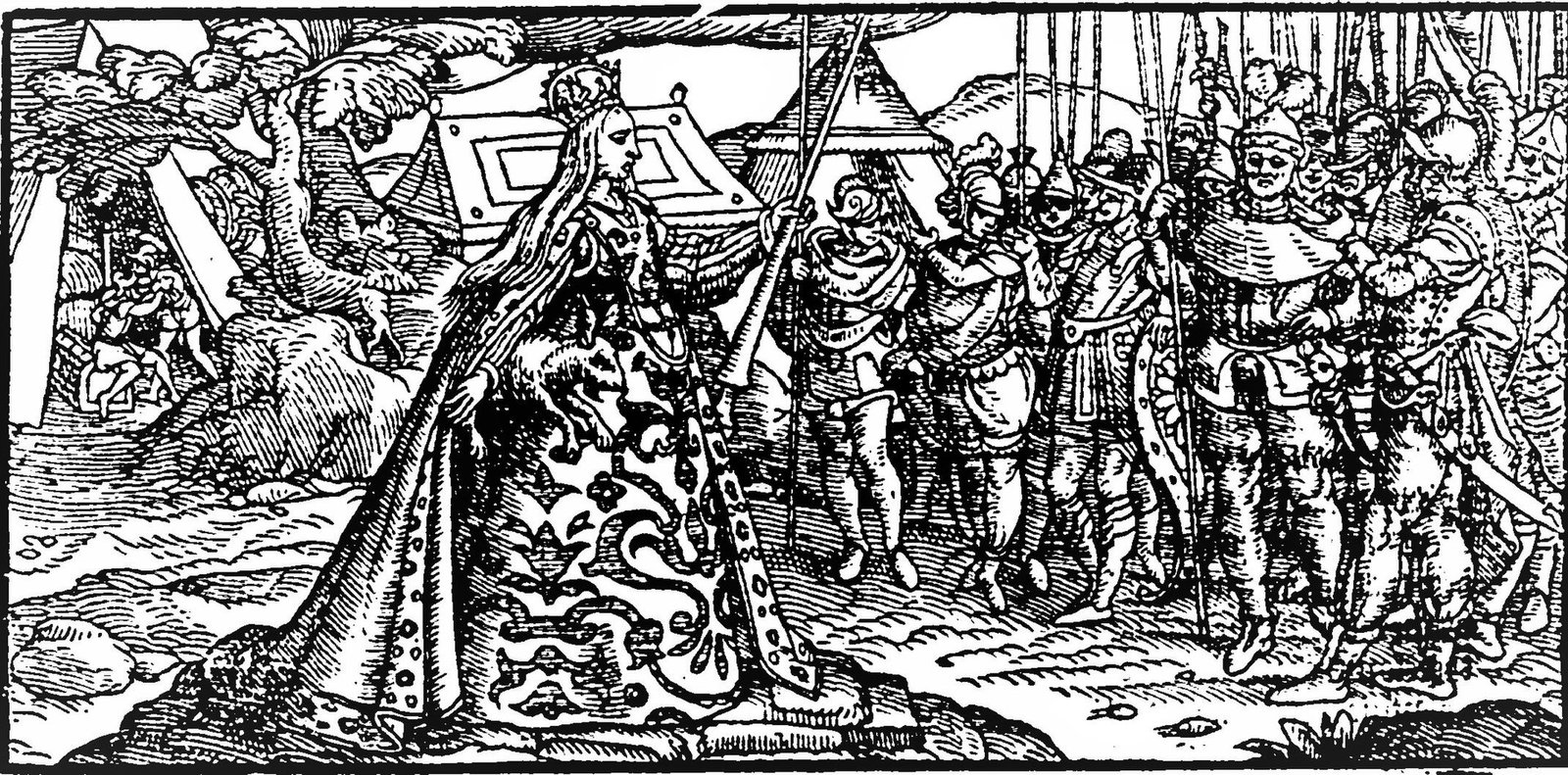
Image: Boudica depicted in Holinshed’s Chronicles (1577).jpg — Raphael Holingshed, CC BY-SA 4.0