Ada Lovelace was an English mathematician and writer born in London in 1815. She is often called the first computer programmer because of a method she published in 1843. It described how Charles Babbage’s proposed Analytical Engine could calculate Bernoulli numbers. The machine remained unfinished, so her program could not run on it.
If you want to understand that title, the key word is “published.” Lovelace’s method appeared in print as part of a substantial explanation of the Analytical Engine. Babbage had prepared an earlier program draft. Her place in computing history therefore rests on a specific publication, alongside ideas about what such a machine might do.
Where was Ada Lovelace born, and where did she live?
Augusta Ada Byron was born in London on 10 December 1815. She later became known as Ada Lovelace. London also marks the end of her life: she died there on 27 November 1852, aged 36.
She married William King on 8 July 1835. In 1838, King became Earl of Lovelace. Ada consequently received the title Countess of Lovelace. These names refer to the same mathematician whose work appeared in 1843.
Ada and William had three children. Byron was born in 1836, Anne Isabella in 1837, and Ralph Gordon in 1839. Her advanced mathematical studies with Augustus De Morgan followed in 1840–1841.
Who was Ada Lovelace’s father?
Ada’s father was the poet George Gordon Byron. Her mother was Anne Isabella Milbanke, who had studied mathematics. Milbanke actively supported her daughter’s mathematical education and arranged for her to learn with private tutors.
Her father also figures in the story of her burial. At Ada’s own request, she was buried beside Lord Byron at St Mary Magdalene Church in Hucknall, Nottinghamshire. Her death followed cancer described in contemporary records as uterine cancer.
What education did Ada Lovelace receive?
Lovelace received private tuition, with her mother encouraging mathematics. Her later education included informal lessons by correspondence with Augustus De Morgan. During 1840–1841, those exchanges covered advanced mathematics, particularly calculus.
The surviving correspondence makes that education tangible. Part of her mathematical exchange with De Morgan is preserved in box 170 of the Lovelace–Byron family papers at the Bodleian Library in Oxford. These letters document mathematical study behind the name attached to the 1843 publication.
Her contact with Babbage began earlier. In 1833, when she was 17, Ada met him and saw a small working section of his calculating machine. This encounter preceded both her lessons with De Morgan and her published account of the Analytical Engine.
What was Ada Lovelace’s computer?
The computer associated with Lovelace was the Analytical Engine. Babbage designed it as a mechanical, general-purpose computing machine. Ada’s contribution concerned its operations and possibilities, including a published method for a particular calculation.
The distinction between a design and a completed machine matters here. The Analytical Engine was never finished. Lovelace’s 1843 program therefore described operations for a proposed machine, rather than reporting a successful run on the intended equipment.
You can follow her contribution through the publication itself. She translated an article about Babbage’s design, then added seven explanatory notes. Those notes addressed both a mathematical procedure and a broader question: what could the machine process if numbers represented something beyond quantities?
What did Ada Lovelace invent or publish?
In 1843, Lovelace published an English translation of a French article by the Italian engineer Luigi Menabrea. His article concerned the Analytical Engine. Her accompanying explanations were labelled A through G.
Menabrea’s original article had appeared in 1842 in Bibliothèque Universelle de Genève. Lovelace’s translation and notes appeared the following year in volume three of Scientific Memoirs, on pages 666–731. These publication details identify the work behind her reputation as a programmer.
Note G contained an arrangement of operations for calculating Bernoulli numbers with the Analytical Engine. This is the method frequently described as the first published computer program. Her contribution also included explanations of how a general-purpose machine could work with symbols.
Calling the computer itself her invention would misidentify the designer. Babbage designed the Analytical Engine. Lovelace’s published contribution explained its potential and set out a calculation for it. The division of work within their collaboration remains a subject of historical debate.
Why is Ada Lovelace called the first computer programmer?
Lovelace receives the title because her Bernoulli-number method is often accepted as the first program published for a computer. The claim points to Note G in 1843. It does not depend on the Analytical Engine having been completed or the program having run.
The broader claim that she was the first person ever to prepare a program is disputed. In a 2023 study, Raúl Rojas identified a Babbage draft from 1837. It described a program for solving two linear equations with two unknowns, preceding Lovelace’s publication.
Thomas J. Misa offers a different emphasis. In a scholarly book chapter published in 2015, he acknowledged problems with the “first programmer” label. He nevertheless argued that Lovelace created an algorithm for calculating Bernoulli numbers. His assessment also stresses that both Lovelace and Babbage made substantial contributions.
When you encounter the familiar title, keep these claims separate. An earlier draft and a first published program are different milestones. Lovelace’s 1843 publication remains central to her reputation, while Babbage’s earlier work complicates an absolute claim of priority.
How did Lovelace connect computing with music?
In her 1843 notes, Lovelace explained that numbers could represent things other than quantities. A machine could then operate on those representations according to rules. Her argument extended the Analytical Engine’s possible purpose beyond numerical calculation alone.
Music supplied a concrete example. In Note A, she suggested that the Analytical Engine might compose complex musical pieces if relationships between musical sounds could be expressed appropriately. This was a conditional proposal about the machine’s capabilities.
The everyday connection is listening to music. If you think about a piece you enjoy, Lovelace’s example shifts attention toward relationships among its sounds. Her proposal was that suitably expressed musical relationships could become material for the Analytical Engine’s operations.
She also set limits on the machine’s independence. In Note G, Lovelace argued that the Analytical Engine made no claim to originate anything by itself. It could perform operations that people knew how to instruct it to carry out.
Is the famous Ada Lovelace image a photo?
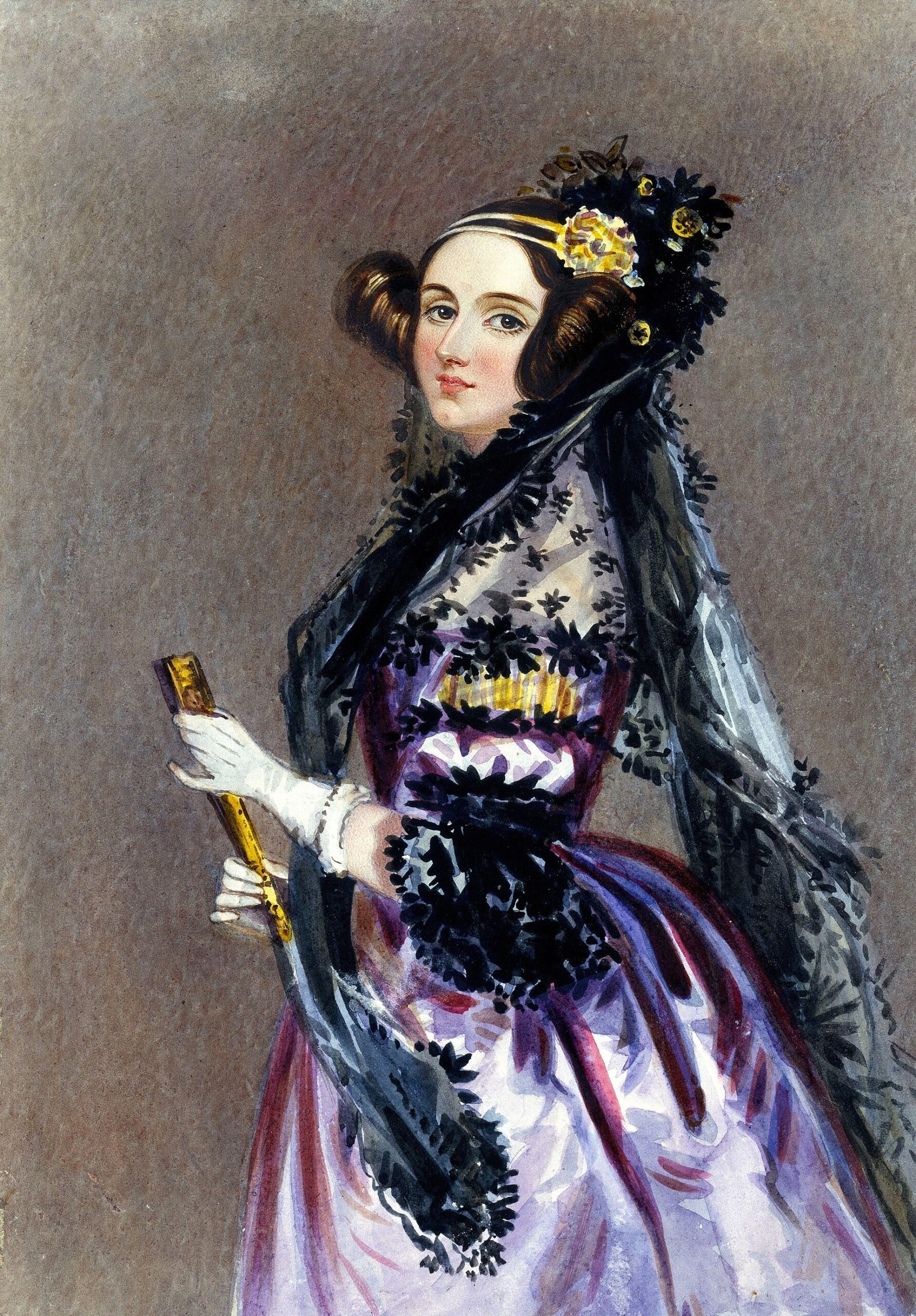
The familiar portrait in the Science Museum collection is a watercolour, not a photograph. It dates to around 1840 and is attributed to Alfred Edward Chalon.
Lovelace herself commented on its appearance. In a letter to her mother, she criticised the clothing in Chalon’s portrait. She considered the artist’s treatment of the clothes stiff and exaggerated. The portrait therefore survives alongside her own dissatisfaction with part of its presentation.
Timeline
- 10 December 1815: Augusta Ada Byron was born in London.
- 1828: She experimented with wings and planned a book about flight.
- 1833: She met Charles Babbage and saw a working section of his calculating machine.
- 8 July 1835: She married William King.
- 1838: She became Countess of Lovelace.
- 1840–1841: She studied advanced mathematics through correspondence with Augustus De Morgan.
- 1843: She published her Menabrea translation and Notes A–G, including the Bernoulli-number method.
- 27 November 1852: She died in London, aged 36.
- 2009: Suw Charman-Anderson founded Ada Lovelace Day.
Details you won’t find in guidebooks
In 1828, at the age of 12, Ada experimented with making wings from paper, silk and feathers. She also planned a book about flight called Flyology. This childhood project involved materials and a proposed written account, well before her publication about computing.
Her 1843 Note A contained another striking image drawn from making things. She compared the Analytical Engine’s production of algebraic patterns with the flowers and leaves woven by a Jacquard loom. The comparison gave readers a material image for patterned mathematical operations.
The location of her surviving De Morgan correspondence is unusually precise: box 170 in the Bodleian Library’s Lovelace–Byron family papers. Together with the seven published notes, these letters provide a concrete connection between her mathematical education and her work on the Analytical Engine.
When is Ada Lovelace Day?
Ada Lovelace Day takes place each year on the second Tuesday of October. Suw Charman-Anderson started it in 2009. Its purpose is to increase the visibility of women working in science, technology, engineering and mathematics, and to provide new role models.
The October observance is separate from Lovelace’s birthday on 10 December. It commemorates her through that wider purpose, while her historical contribution remains tied to the Analytical Engine and the notes she published in 1843.
FAQ
Why is Ada Lovelace called the first computer programmer?
Her 1843 Note G contained steps for calculating Bernoulli numbers with the proposed Analytical Engine. This method is often considered the first published computer program, although Babbage’s earlier drafts complicate the title.
Did Ada Lovelace invent the computer?
Charles Babbage designed the Analytical Engine. Lovelace published explanations of the machine, a method for calculating Bernoulli numbers, and ideas about processing symbols and music.
Where was Ada Lovelace born, and who was her father?
She was born in London on 10 December 1815 as Augusta Ada Byron. Her father was the poet George Gordon Byron.
Which school did Ada Lovelace attend?
Lovelace received private tuition, encouraged by her mother, Anne Isabella Milbanke. In 1840–1841, she studied advanced mathematics through correspondence with Augustus De Morgan.
When is Ada Lovelace Day?
Ada Lovelace Day takes place on the second Tuesday of October. Suw Charman-Anderson founded it in 2009 to increase the visibility of women in science, technology, engineering and mathematics.
Sources
- Vikipedi — Ada Lovelace tr.wikipedia.org
- Computer History Museum — Ada Lovelace computerhistory.org
- Wikipedia — Ada Lovelace en.wikipedia.org
- Clay Mathematics Institute — Ada Lovelace’s Mathematical Papers claymath.org
- York University — Lovelace (1843) yorku.ca
- Thomas J. Misa — Charles Babbage, Ada Lovelace, and the Bernoulli Numbers arxiv.org
- Raúl Rojas — The First Computer Program arxiv.org
- Somerville College, Oxford — Ada Lovelace Bicentenary held at Somerville some.ox.ac.uk
- Hollings, Martin and Rice — The early mathematical education of Ada Lovelace tandfonline.com
- Science Museum Group — Portrait of Ada, Countess of Lovelace collection.sciencemuseumgroup.org.uk
Image: Ada Lovelace portrait.jpg — Alfred Edward Chalon, Public domain