Where is Timbuktu?
Timbuktu is a historic city in Mali, a country in West Africa. It stands on the southern edge of the Sahara. The Niger River flows about 20 kilometres to the south of it.
That position explains almost everything about the city. Desert routes met river routes here. Goods moved in both directions, and ideas moved with them.
Timbuktu on a map: what you will see
Open any map of Mali and look north of the Niger bend. You will find Timbuktu where the green river valley gives way to sand. The climate there is hot desert. Most of the rain falls between June and September, brought by the West African monsoon. The rest of the year is dry.
This dryness matters later in the story. Paper lasts well in dry air, and that is one reason old books survived in the city for centuries.
Is Timbuktu a country?
No. Many people search for “Timbuktu country”, but Timbuktu is a city. It belongs to the country of Mali. In everyday English, people use the name to mean a place very far away. The real city is a working town with a long written history.
What does the name Timbuktu mean?
The meaning is debated.
One local story ties the name to a woman called Buktu. In this version, the name means “Buktu’s well”. The University of Cape Town’s timeline of the city repeats this as a local tradition.
The Malian historian Sékéné Cissoko proposed a different origin. He explained the name as a Berber phrase meaning “place covered with small dunes”. Scholars have not settled the question. If a guide gives you one certain answer, treat it with caution.
Why a desert town became rich
Timbuktu was one of the main markets of the Saharan trade network. Salt came from Teghaza in the north. Gold, grain and animals came from the south. Merchants met in Timbuktu to swap one for the other.
Think of a modern airport hub. Few passengers live there. They pass through, and the place earns its living from the connections. Timbuktu worked in a similar way.
UNESCO dates the city’s economic and cultural peak to the 15th and 16th centuries.
Timbuktu University and the schools of Sankore
People often search for “Timbuktu university”. The name that matters is Sankore. UNESCO’s historical account refers to the Sankore University and the city’s wider circle of learning. It gives two figures: 180 Quranic schools and 25,000 students.
Treat those numbers as UNESCO’s description of the city’s golden age, not as a modern census.
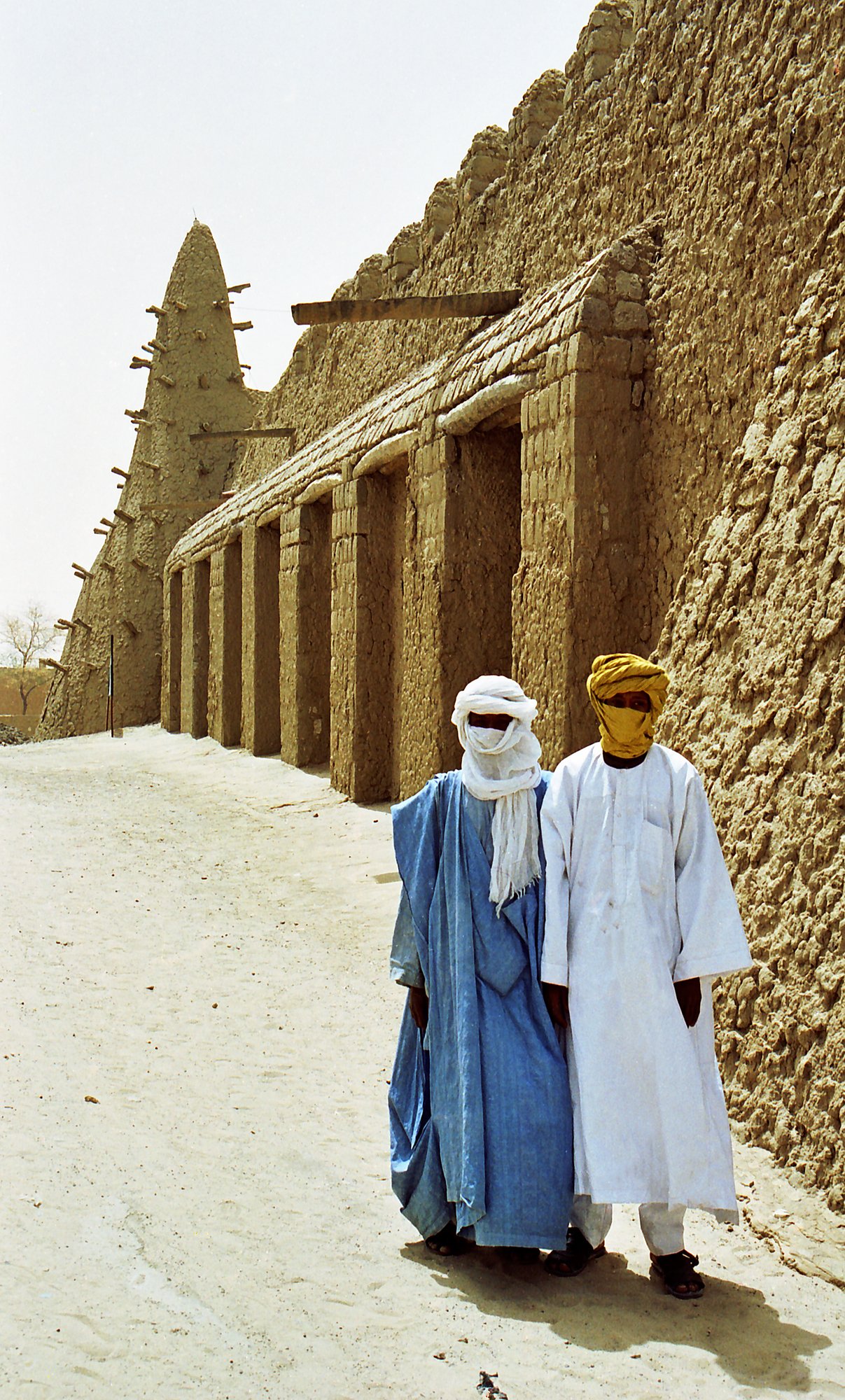
The Sankore Mosque was built in the 14th century. The imam El Akib reorganised it between 1578 and 1582. It is one of three great historic mosques in the city. The other two are Djingareyber and Sidi Yahia.
The Djingareyber Mosque is linked to the return of Mansa Musa, the ruler of Mali, from his pilgrimage to Mecca. El Akib enlarged it between 1570 and 1583.
Timeline
- 1353: The North African traveller Ibn Battuta arrives in Timbuktu.
- 1375: The Catalan Atlas shows the city as “Tenbuch”.
- 15th-16th centuries: The city reaches its economic and cultural peak.
- 1570-1583: El Akib enlarges the Djingareyber Mosque.
- 1591: A Moroccan army defeats the Songhay state and takes control of the Saharan trade region that includes Timbuktu.
- 1733: A copy of an astronomy manuscript is made in what is now the Mamma Haidara collection.
- 1973: CEDRAB opens. It later takes the name Ahmed Baba Institute.
- 1988: UNESCO adds Timbuktu to the World Heritage List.
- 1 April 2012: Insurgent groups take the city.
- June 2012-January 2013: About 285,000 manuscripts are evacuated, according to the University of Hamburg.
- 11 August 2025: The return of manuscripts from Bamako to Timbuktu begins.
The libraries: what is actually in the manuscripts
The famous “lost manuscripts” are not only holy books. The collections cover the Quran sciences and Islamic law. They also hold works on medicine, mathematics, history, grammar, astrology and numerology.
Most texts are in Arabic. Some are in Fulani and Songhay, written in Arabic script.
The libraries also keep ordinary paperwork. Private letters, state correspondence, legal documents and fatwas sit beside the books. This is why historians value them. They show how people argued, traded and settled disputes, not only what scholars taught.
Leo Africanus, writing about the city in the 16th century, claimed that trading in handwritten books earned more profit than trading in other goods. That is one writer’s claim, but it shows how much books mattered there.
How the modern libraries took shape
The first official manuscript library of the modern era was CEDRAB, opened in 1973. It later became the Ahmed Baba Institute.
From the 1990s, private libraries became more formal institutions. Three known names are Mamma Haidara, Fondo Kati and El Vangari.
In 2021, Charles C. Stewart published a survey of the contents of 31 of 35 private libraries. His study looks at work done since 2012, in which about 350,000 manuscripts have been inventoried.
Details you won’t find in guidebooks
- A medieval map already knew the city. The Catalan Atlas of 1375 labels Timbuktu “Tenbuch”. Near it, the atlas draws Mansa Musa on a throne, holding a large piece of gold.
- A poem teaches law. A qasida by El Kunti in the Mamma Haidara collection puts legal knowledge into verse. It was meant to help students memorise the rights of orphans and married women.
- Astronomy by copy. A manuscript copied in 1733 in the same library explains how to work out the start of the seasons from the movements of the stars. It includes a drawing of the heavens turning.
- Rescue by donkey cart and canoe. During the 2012-2013 evacuation, some manuscripts left the city on donkey carts and travelled on the Niger River in canoes.
- Safety created a new risk. Bamako is more humid than dry Timbuktu. Combined with unsuitable storage, the damp became a fresh threat to the rescued paper.
What happened in 2012
On 1 April 2012, insurgent groups advancing through northern Mali took Timbuktu. The manuscripts were now in danger.
UNESCO’s 2015 statement says armed groups burned or stole 4,203 manuscripts from the Ahmed Baba Institute. That is a real loss. It is small next to the total, though, because most of the collections were moved out of reach.
The University of Hamburg describes the evacuation as a rescue of about 285,000 manuscripts over eight months, from June 2012 to January 2013. UNESCO reported in 2015 that local people, with help from SAVAMA-DCI, had saved 90 percent of the city’s historic manuscripts.
Think of it as a family backup. You copy photos to a second place before your phone breaks. Timbuktu’s keepers did the same with centuries of paper. They moved it to Bamako, and they did it fast.
The return home
On 11 August 2025, Mali’s authorities began sending the evacuated manuscripts back to Timbuktu. The first flight carried about 5.5 tonnes of material in more than 200 chests, according to the Associated Press.
Planning to learn more?
If you want to understand Timbuktu before you read deeper, start with these points:
- It is a city in Mali, not a country.
- Trade built it. Salt, gold, grain and animals passed through its markets.
- Its three historic mosques are Djingareyber, Sankore and Sidi Yahia.
- Its libraries hold law, science and daily correspondence.
- UNESCO listed it as a World Heritage site in 1988.
FAQ
Where is Timbuktu located?
Timbuktu is in Mali, in West Africa. It lies about 20 kilometres north of the Niger River, on the southern edge of the Sahara.
What does the name Timbuktu mean?
No one agrees. A local tradition links the name to a woman called Buktu and reads it as ‘Buktu’s well’. The Malian historian Sékéné Cissoko offers another theory: a Berber phrase meaning ‘place covered with small dunes’.
Is Timbuktu a real place or a myth?
It is a real city in Mali. UNESCO placed it on the World Heritage List in 1988.
What happened to the Timbuktu manuscripts in 2012?
Insurgent groups took Timbuktu on 1 April 2012. UNESCO reported in 2015 that armed groups burned or stole 4,203 manuscripts from the Ahmed Baba Institute. Local people saved about 90 percent of the city’s historic manuscripts, helped by the organisation SAVAMA-DCI.
Have the manuscripts come back to Timbuktu?
The return began on 11 August 2025. The first flight carried about 5.5 tonnes of material in more than 200 chests.
Sources
- Wikipedia, “Timbuktu” en.wikipedia.org
- UNESCO World Heritage Centre, “Timbuktu” whc.unesco.org
- University of Cape Town, “Key Dates in the History of Timbuktu” tombouctoumanuscripts.uct.ac.za
- University of Cape Town, “Why does Timbuktu matter?” tombouctoumanuscripts.uct.ac.za
- University of Cape Town, “Manuscript Libraries” tombouctoumanuscripts.uct.ac.za
- University of Hamburg, “Manuscripts” csmc.uni-hamburg.de
- Charles C. Stewart, “What’s In the Manuscripts of Timbuktu?”, Cambridge University Press cambridge.org
- Library of Congress, “Ancient Manuscripts from the Desert Libraries of Timbuktu” loc.gov
- UNESCO, “Bamako heritage conference urges emergency action” unesco.org
- Associated Press, “Timbuktu’s famed manuscripts return home” apnews.com
Image: Djinguereber Mosque, Timbuktu, Mali.jpg — Dr. Ondřej Havelka (cestovatel), CC BY-SA 4.0