The Pergamon Altar stands in Berlin, but it was built in Bergama. That gap between birthplace and address is the whole story. If you plan a trip, you need to know both places.
Pergamon Altar location: where is it today?
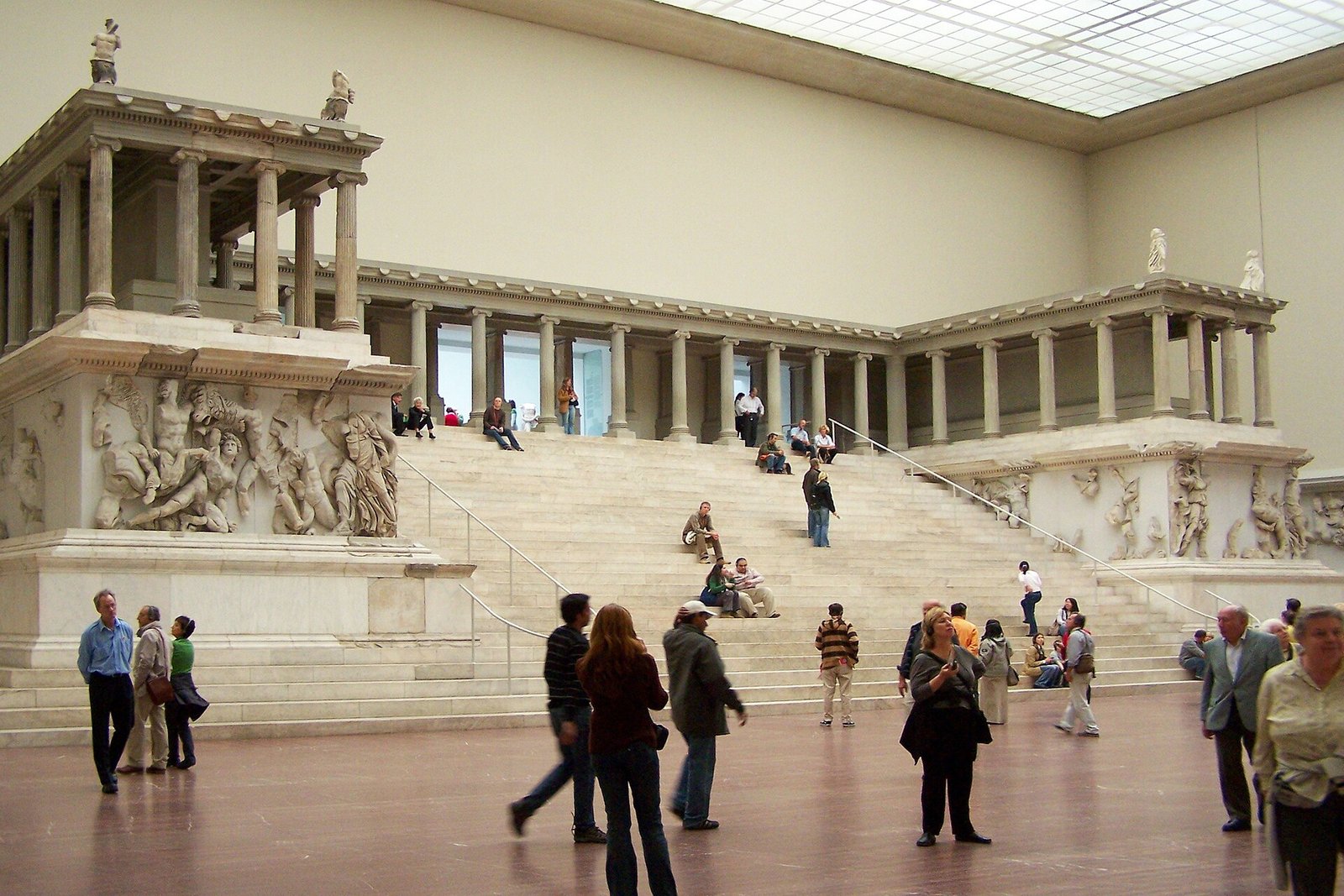
The reconstruction is in Germany. It belongs to the Antikensammlung collection and is housed in the Pergamonmuseum on Museum Island in Berlin.
The altar’s original foundations never left Turkey. They remain on the acropolis of Bergama, in today’s İzmir province. According to the Ministry of Culture and Tourism, visitors can see the foundation remains of the structure there.
So you have two options. In Berlin you see the rebuilt monument. In Bergama you stand where it was built.
There is a catch for the Berlin leg. The altar hall has been closed to visitors since 2014. The whole Pergamonmuseum closed in October 2023 for renovation. More on the reopening date below.
Pergamon Altar history: who built it and why
The altar went up in the first half of the 2nd century BC, under King Eumenes II. Its site was a terrace on the acropolis of ancient Pergamon.
The Ministry of Culture and Tourism gives the terrace as roughly 69 × 77 metres. It lay about 25 metres below the Temple of Athena. The altar structure itself measures 36.80 × 34.20 metres in plan, according to the Berlin State Museums.
A staircase about 20 metres wide on the west front led from the terrace up to a courtyard. Galleries with Ionic columns surrounded that courtyard.
Pergamon Altar of Zeus: who was it for?
The name “Altar of Zeus” is common, but it is not certain. The altar is linked with Zeus and with Athena, the goddess who brings victory. The dedicatory inscription has lost its divine names, though. Nobody can read the dedication with certainty.
What the reliefs show
Two friezes decorated the monument.
The great frieze is 113 metres long, according to the Cambridge Museum of Classical Archaeology. It shows the battle between the Olympian gods and the Giants.
The east side has the Athena group. The goddess seizes a Giant by the hair. Gaia begs for mercy. A winged Nike offers Athena a crown.
The smaller frieze ran along the inner walls of the upper courtyard. It tells the life of Telephos, the mythical founder of Pergamon and ancestor of the ruling family. Originally it had 74 marble slabs. Of these, 47 survive in whole or in part, says the Berlin catalogue.
Timeline
- First half of the 2nd century BC: The altar is built on the acropolis under Eumenes II.
- 7th–8th centuries AD: After the structure was dismantled, slabs of both friezes were reused in a defensive wall.
- 1878: Engineer Carl Humann begins excavating the frieze slabs for the Berlin museums.
- 1879 and 1881: According to Funda Berksoy, Sultan Abdülhamid II grants the permits that allow fragments to go to Berlin in return for payment.
- 1901–1907: The first reconstruction is shown in a temporary Pergamonmuseum.
- 1930: The present Pergamonmuseum opens.
- 1935–1937: The Zeppelintribüne is built in Nuremberg.
- 1945: The frieze slabs are taken to the Soviet Union at the end of the war.
- 1958: The Soviet Union returns them.
- 1959: The friezes are on show in Berlin again.
- 2014: The altar hall closes for renovation.
- October 2023: The whole museum closes.
- 4 June 2027: Planned reopening of the museum section with the altar.
Pergamon Altar Berlin: how the pieces got there
Humann began the excavations in 1878 for the Berlin museums. Slabs of both friezes had been used as reused building material in a defensive wall after the altar was taken apart in the 7th–8th centuries.
The pieces then travelled. Historian Bayram Bayraktar’s research shows that in the 1870s and 1880s they went in crates along the route Bergama–Çandarlı–İzmir and on to Berlin.
The legal basis is where historians disagree.
Berksoy describes an Ottoman antiquities regulation of 1874. It divided finds three ways: the excavator, the state treasury and the landowner. Export required registration with the Ministry of Education (Maarif Nezareti). She reports that Abdülhamid II gave permits in 1879 and 1881 that allowed parts of the altar to go to Berlin in return for payment.
The Prussian Cultural Heritage Foundation argues that the 1878–1886 excavations and the sharing of finds had Ottoman permission. It also says that frieze pieces sent before the excavation were legalised afterwards.
Bayraktar reads the same archives differently. He places the removal among transfers without sufficient legal procedure. He ties it to the colonial and expansionist policies of Europe.
The Ministry of Culture and Tourism has also named the altar in a parliamentary reply. It lists the Bergama Zeus Altar among works for which an initiative to retrieve them from Germany was made.
Pergamon Altar reconstruction: what is original?
Think of a jigsaw puzzle you bought second-hand with most of the box missing. You would fill the gaps to see the picture. Berlin did something similar on a very large scale.
More than 80 percent of the famous west front is modern completion. The materials are Portuguese marble, artificial stone and plaster. The originals are the relief slabs and architectural fragments.
The first museum reconstruction was shown in the temporary Pergamonmuseum between 1901 and 1907. The altar moved to its current building in 1930. Ludwig Hoffmann built that museum between 1910 and 1930, on the basis of designs by Alfred Messel.
Pergamon Altar museum: closed now, reopening in 2027
If you read this in October 2026, you cannot see the altar in Berlin. The hall closed in 2014 and the whole museum in October 2023.
The Berlin State Museums announced on 4 May 2026 that the section with the altar should reopen on 4 June 2027. Treat that as a plan, not a promise, and check the museum’s page before you book flights.
The renovation had one tricky job. Some large frieze slabs stayed in place. They weigh up to 2.5 tonnes each. To protect them, engineers used measuring systems that track wall and floor movements in real time.
Details you won’t find in guidebooks
- Unfinished slabs. Some slabs of the Telephos frieze were never completed. The Berlin State Museums say the work may have stopped after Eumenes II died.
- A wall full of gods. Before Humann’s dig, frieze slabs from both friezes had been worked into a defensive wall as building stone.
- A mostly modern front. The famous west front is over 80 percent new material.
- A trip to the Soviet Union. The frieze slabs were taken there at the end of World War II. They came back in 1958 and went on show again from 1959.
Pergamon Altar Hitler question: what is the link?
The documented link is architectural. Albert Speer used the Pergamon Altar as a model for the Zeppelintribüne in Nuremberg. That building was put up between 1935 and 1937 for Nazi party rallies.
Pergamon Altar photos and a book to read
While the hall is closed, the Berlin State Museums offer a “Pergamonaltar 3D” page. It combines a digital study of the architecture and reliefs with archive photographs and reconstruction drawings.
For a book, look for Pergamon: The Telephos Frieze from the Great Altar. Renée Dreyfus and Ellen Schraudolph prepared this two-volume exhibition catalogue. The Fine Arts Museums of San Francisco published it in 1996–1997.
Pergamon Altar Germany or Turkey: what you can do
You can visit the foundations in Bergama today. You can follow the Berlin reopening through the museum’s announcements. And you can read both sides of the legal argument before you decide what you think.
Sources
- Stiftung Preußischer Kulturbesitz, on the find history of the altar preussischer-kulturbesitz.de
- Wikipedia, Pergamon Altar en.wikipedia.org
- Kültür ve Turizm Bakanlığı, Gezilecek Yerler tanitma.ktb.gov.tr
- Staatliche Museen zu Berlin, Pergamonaltar 3D 3d.smb.museum
- University of Cambridge, Great Altar of Zeus at Pergamon, Zeus museum.classics.cam.ac.uk
- Aberdeen Archives, Gallery & Museums, Athena Group for the Pergamon Frieze emuseum.aberdeencity.gov.uk
- Staatliche Museen zu Berlin, Telephosfries, T.I. 32 search.smb.museum
- Deutsches Archäologisches Institut, Pergamon und seine Mikroregion dainst.org
- Bayram Bayraktar, Osmanlı Arşiv Belgeleri Işığında Bergama Zeus Sunağı’nın Berlin’e Götürülüşü Hakkında Bazı Düşünceler dergi.baltam.org
- Funda Berksoy, Zeitschrift für Kunstgeschichte, 2025 doi.org
- Staatliche Museen zu Berlin, Pergamonmuseum Profile smb.museum
- Museen der Stadt Nürnberg, Zeppelintribüne museen.nuernberg.de
- Stiftung Preußischer Kulturbesitz, Cultural Assets Relocated to Russia as a Result of the War preussischer-kulturbesitz.de
- Stiftung Preußischer Kulturbesitz, Between construction site and opening preussischer-kulturbesitz.de
- Associated Press, Pergamon Museum reopening apnews.com
- Staatliche Museen zu Berlin, The Pergamonmuseum returns smb.museum
- TBMM, Kültür ve Turizm Bakanlığının 7/6583-11738 sayılı önergeye yanıtı cdn.tbmm.gov.tr
- Rijksmuseum Research Library, Pergamon: The Telephos Frieze from the Great Altar rijksmuseum.nl
Image: Berlin – Pergamonmuseum – Altar 02.jpg — Lestat (Jan Mehlich), CC BY-SA 3.0