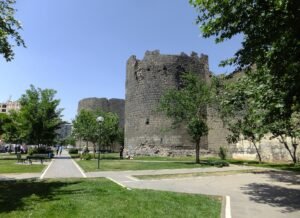
Few Turkish city names pack as much history into one word as Afyonkarahisar. It joins a crop, a rock and a fortress. An older form of the name also keeps the memory of a Seljuk statesman. This guide explains where the name comes from and how the city’s story unfolds, from Bronze Age mounds to a 2023 UNESCO listing.
Where does the name Afyonkarahisar come from?
The name has two main parts. Each one points at something you can still understand by looking at the city.
Karahisar means, roughly, “dark fortress”. It refers to the dark volcanic rock in the middle of the city and the fortress built on top of it. The rock is the city’s landmark, and the name simply describes it.
Afyon comes from agriculture. Poppy farming was practiced widely in the region for a very long time, and the city took its name from that crop.
The historical name had a third element. The city was once called Karahisarısâhib. The “Sâhib” in it is linked to Sâhib Ata Fahreddin Ali Bey, a statesman of the Anatolian Seljuk state. So the older name ties the fortress to a person who served that state.
The name also appeared in European travel writing. The traveler Tavernier recorded it as “Aphiom Carassar”. That is a good example of how foreign ears reshaped a Turkish place name.
When did the name officially change?
For a long time the province was known simply as Afyon. Law no. 5285 changed that. Parliament adopted it on 6 January 2005, and it came into force on 11 January 2005. From that day the province’s name became Afyonkarahisar.
Afyonkarahisar history: a short overview
The city’s past is layered. Each era left something you can visit.
Early settlement at Kusura
The oldest evidence in these notes comes from Kusura Mound in the Sandıklı district. Winifred Lamb excavated it from 1935 to 1937. Her work revealed three cultural layers dated between 3000 and 1500 BC. That is a span of about 1,500 years of repeated settlement on one mound. These are the Bronze Age layers of the region.
The Phrygian and Byzantine countryside
The area around Afyonkarahisar also holds later sites. Ayazini, in the İhsaniye district, was settled from the Phrygian period onward. In the Byzantine period it became a religious center. Rock-cut structures there can still be seen.
Nearby is Emre Lake, close to the town of Döğer in İhsaniye. It lies within the Phrygian Valley, about 50 kilometers from the city of Afyonkarahisar. If you plan a day trip, these two places fit well together.
The Seljuk period
The Seljuk era shaped the city most visibly. In 1235, during the reign of Alâeddin Keykubat I, the fortress walls were repaired. The work was done by the fortress commander, the architect Bedrettin Gevhertaş.
About four decades later came the Ulu Cami. It was built between 1272 and 1277. The sanjak governor Nusretiddun Hasan commissioned it, and Emir Hacı Bey was the architect.
In 1278, during the reign of Gıyaseddin Keyhüsrev III, a caravanserai went up in the Çay district. Ebul-Mücahhit Yusufhan commissioned it, and the architect was Oğul Bey, son of Mehmet. It is known as the Çay Taşhan.
Caravanserais like this one were roadside stops for traders and animals. They tell you the region sat on routes that mattered.
The Ottoman period
Afyonkarahisar passed firmly into Ottoman hands in 1429. Germiyanoğlu Yâkub Bey II died that year, and under his will the city became Ottoman for good.
Ottoman building continued. Around 1472, Gedik Ahmet Pasha commissioned the İmaret Mosque from the architect Ayas Ağa. It was repaired in 1795.
In 1573, on the order of Selim II, a man named Mahmut Bey repaired the fortress again. He worked on its bastions, cisterns and tower. A fortress that gets repaired in 1235 and again in 1573 was clearly still in use.
In the mid-17th century the Taşhan in the city center was built. Kadı Abdullah Efendi had it built as a two-story building, with contributions from the city’s makers of traditional shoes (yemeni). It is also known as the Hoca Üveys Han.
In 1914 the Bedesten was rebuilt. It was made up of 71 shops lined up side by side.
Liberation in 1922
The modern chapter closes with the Great Offensive. On 27 August 1922, Afyonkarahisar was freed from Greek occupation. That date is still the key anniversary in the city’s modern story.
The fortress on the dark rock
The fortress sits on a volcanic rock mass in the city center. The rock stands 226 meters high. You can see it from many parts of town, and it explains the “Karahisar” half of the name.
The repairs of 1235 and 1573 show that rulers of different eras invested in it. First the Seljuks and then the Ottomans kept it in working order.
The Ulu Cami: forty wooden columns
The Ulu Cami is a Seljuk building in the city. Its roof rests on 40 wooden columns. They stand in five rows of eight.
In 2023 the mosque joined the UNESCO World Heritage List. It is one of five buildings in the serial property “Anatolian Mosques of the Medieval Period with Wooden Hypostyle Halls”. A hypostyle hall is simply a hall whose roof is held up by many columns.
Markets and houses: the everyday city
History here is not only about mosques and fortresses. It is also about shopping.
Think about the last time you wandered through a covered bazaar. You compared prices, stopped for tea and picked a shop. The Bedesten’s 71 shops in a row were built for exactly that kind of day. The Taşhan was paid for in part by shoemaking tradesmen, so it grew out of a trade, not out of a palace.
The Taşhan was restored by the Kütahya Regional Directorate of Foundations. It opened to culture and tourism in March 2018.
The houses matter too. A 2016 compilation by the Culture Portal says Afyonkarahisar has about 400 registered historic houses whose exteriors are protected. Around the fortress, the Mihrioğlu Mansion and the Şehitoğlu Mansion have been restored and opened to visitors.
Timeline
- 3000–1500 BC: The three cultural layers found at Kusura Mound cover this period.
- 1235: The fortress walls are repaired under Alâeddin Keykubat I.
- 1272–1277: The Ulu Cami is built.
- 1278: The Çay Caravanserai is built.
- 1429: The city passes firmly to the Ottomans under Yâkub Bey II’s will.
- About 1472: Gedik Ahmet Pasha has the İmaret Mosque built.
- 1573: The fortress is repaired on Selim II’s order.
- Mid-17th century: The Taşhan in the city center is built.
- 1914: The Bedesten is rebuilt.
- 27 August 1922: The city is freed from Greek occupation.
- 1935–1937: Winifred Lamb excavates Kusura Mound.
- 11 January 2005: Law no. 5285 makes the province’s name Afyonkarahisar.
- March 2018: The restored Taşhan in the city center opens.
- 12 December 2020: The Kybele votive statue returns from the United States.
- 2023: The Ulu Cami joins the UNESCO World Heritage List.
The Kybele statue comes home
The city’s recent history includes a recovery story. A votive statue of Kybele, dated to the 3rd century AD, was smuggled out of Afyonkarahisar. It was returned from the United States and arrived in Türkiye on 12 December 2020.
The case shows how heritage protection works in practice. Evidence mattered more than claims.
Details you won’t find in guidebooks
- A traveler’s spelling. Tavernier wrote the city’s name as “Aphiom Carassar”. Say it aloud and you can hear both halves of the Turkish name.
- What happened to the Ulu Cami’s column capitals. Between 1946 and 1953 the mosque’s decoration was damaged and some column capitals were replaced. Some of the old wooden capitals were displayed in the Afyonkarahisar Museum and outdoors.
- A leopard over the door. Above the entrance of the Çay Caravanserai is a leopard emblem. It is described as the architect’s symbol.
- Carved on the outside too. At the Ayazini church, the apse and dome shapes are also carved into the tuff rock on the building’s outer face.
- A church with two dates. One proposal dates the Virgin Mary Church at Ayazini to about AD 1000. The Culture Portal notes that some sources place it in the 8th to 10th centuries.
- How Kybele was proven to be from here. Several kinds of evidence were used together. One was its similarity to the Kovalık finds found at Çavdarlı village in 1964. Another was eyewitness testimony. The third was the personal archive of Hasan Tahsin Uçankuş, a former museum director.
FAQ
Why is the city called Afyonkarahisar?
“Afyon” comes from the poppy farming that was long practiced widely in the region. “Karahisar” comes from the dark volcanic rock in the middle of the city and the fortress on top of it.
Who was Sâhib in the old name Karahisarısâhib?
The “Sâhib” in the historical name Karahisarısâhib is linked to Sâhib Ata Fahreddin Ali Bey, a statesman of the Anatolian Seljuk state.
When did the province officially become Afyonkarahisar?
Law no. 5285, adopted on 6 January 2005 and in force from 11 January 2005, changed the province’s name from Afyon to Afyonkarahisar.
When did the Ottomans take the city for good?
Afyonkarahisar came under firm Ottoman rule after Germiyanoğlu Yâkub Bey II died in 1429 and his will took effect.
Is anything in Afyonkarahisar a UNESCO World Heritage site?
Yes. The Afyonkarahisar Ulu Cami was added to the UNESCO World Heritage List in 2023. It is one of five buildings in the serial property “Anatolian Mosques of the Medieval Period with Wooden Hypostyle Halls”.
Sources
- TDV İslâm Ansiklopedisi — Afyonkarahisar islamansiklopedisi.org.tr
- TBMM — Law no. 5285 www5.tbmm.gov.tr
- Afyonkarahisar Governorship tourism portal — Excavations and Surface Surveys afyondayiz.gov.tr
- Afyonkarahisar Governorship — Afyonkarahisar Castle afyonkarahisar.gov.tr
- Culture Portal — Afyonkarahisar Ulu Cami kulturportali.gov.tr
- UNESCO — World Heritage Committee decision 45 COM 8B.46 whc.unesco.org
- Afyonkarahisar Provincial Directorate of Culture and Tourism — Mosques afyon.ktb.gov.tr
- Culture Portal — Taşhan kulturportali.gov.tr
- Afyonkarahisar Provincial Directorate of Culture and Tourism — Bazaars, Bedestens afyon.ktb.gov.tr
- Culture Portal — Çay Caravanserai kulturportali.gov.tr
- Culture Portal — Historic Afyon House kulturportali.gov.tr
- Culture Portal — Ayazini Ruins kulturportali.gov.tr
- İhsaniye District Governorship — Emre Lake ihsaniye.gov.tr
- General Directorate of Cultural Heritage and Museums — Return of Kybele kvmgm.ktb.gov.tr
Image: Afyonkarahisar Kalesi havadan.jpg — Nabbegat, CC BY-SA 4.0