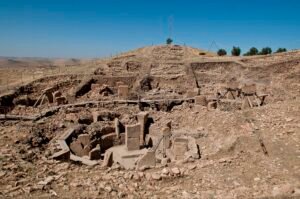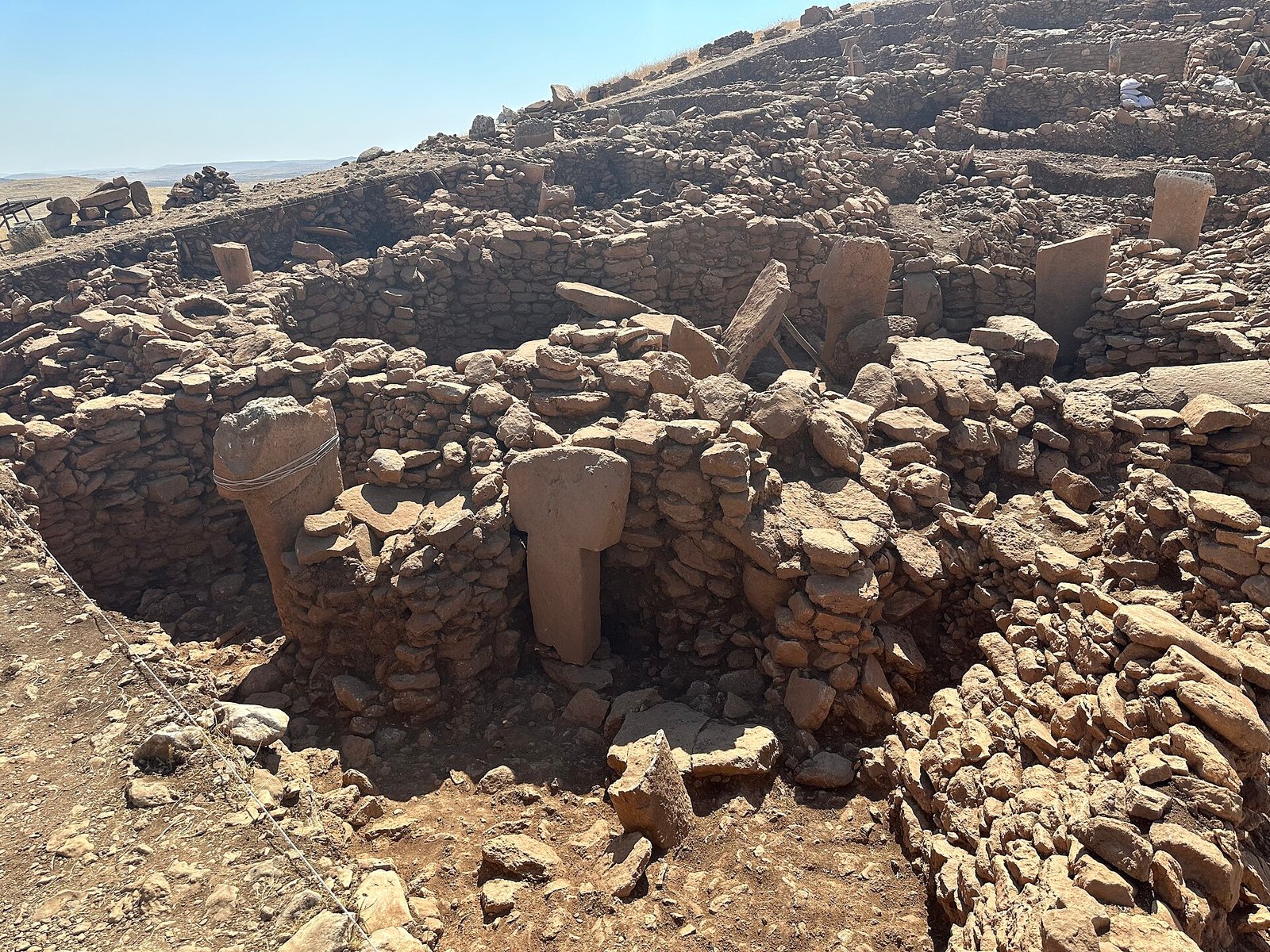
Karahan Tepe sits in the hills of southeastern Türkiye. It is a village of stone houses and carved public buildings. People settled here roughly 11,400 years ago.
It is one of the main sites of the Taş Tepeler (“Stone Hills”) research network. If you have heard of Göbekli Tepe, this is its closest relative. This guide covers where it is, how old it is, what has been found and how it compares with its famous neighbor.
Karahan Tepe: Where Is It? (Map and Location)
Karahan Tepe is also written Karahantepe. It lies near Kargalı in Şanlıurfa’s Haliliye district. The Ministry of Culture and Tourism lists it as a Pre-Pottery Neolithic settlement.
The excavation project places it 55 kilometers from Şanlıurfa city center. It stands on a limestone rise inside Tek Tek Mountains National Park. The ministry also records a local name for the place: Keçilitepe.
On a map, look east of Göbekli Tepe. English Wikipedia puts the distance at about 46 kilometers. The same article quotes excavation director Necmi Karul giving about 60 kilometers, without saying how it was measured.
How Karahan Tepe Was Discovered
Bahattin Çelik discovered the site in 1997. Excavation did not begin until September 2019. An international team has worked there since 2019 on behalf of the Prehistoric Archaeology Department of Istanbul University. Necmi Karul directs the dig.
Since 2021 the excavations have been part of the Taş Tepeler Project. That project promotes 12 main sites. They are Göbeklitepe, Karahantepe, Sayburç, Sefertepe, Harbetsuvan Tepesi, Gürcütepe, Çakmaktepe, Kurttepesi, Taşlıtepe, Ayanlar, Yoğunburç and Yeni Mahalle.
How Old Is Karahan Tepe?
In a 2022 conference volume from Istanbul University, Karul dates the excavated western slope to 9400–8200 BCE. The early settlement phase, around 9400 BCE, makes the site about 11,400 years old in 2026.
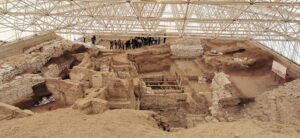
The team has found layers from both Pre-Pottery Neolithic A and B. The settlement spread over about 10 hectares, so think of a small town rather than a single shrine.
Karahan Tepe vs Göbekli Tepe
The two sites share a time and a style. UNESCO dates the monumental structures at Göbekli Tepe to 9600–8200 BCE. It notes that they include T-shaped pillars, which are also found at Karahan Tepe.
Which site is older? The Ministry of Culture and Tourism page on Karahan Tepe suggests it may predate Göbekli Tepe. Karul’s own dates do not support a clear lead. His range of 9400–8200 BCE overlaps Göbekli Tepe’s range, so the two look like contemporaries.
The digs at Karahan Tepe also show everyday life next to its public buildings. Ground stones, mortars, pestles and stone troughs came from the houses east and south of the public building complex. If you grind spices in a mortar at home, you use the same basic tool those households used.
Karahan Tepe Statues and the 2023 Discovery
On 30 September 2023 the ministry announced a seated human statue, 2.3 meters tall. It was fixed into the floor within a bench. Archaeologists also uncovered a vulture sculpture set into a wall and stone plates left on the floor in the same area.
Some of the statues from Karahan Tepe are now displayed at the Şanlıurfa Archaeology Museum. If you plan a trip, the museum is a useful stop in the city before you head out to the site.
Karahan Tepe Face: The T-Shaped Pillar of 2025
On 6 October 2025 the ministry announced a T-shaped pillar with a human face carved on it. It was the first such pillar found at Karahan Tepe. Until then the T-shaped pillars there had no carved faces.
Karahan Tepe Latest News
Two announcements stand out.
In November 2025, a 17-meter-wide building was reported. It has wide, three-step benches. Seated human figures were set into its floor and walls. Reports compared its shape to an amphitheater. On 26 November 2025, Karul said the public buildings should not be described only as temples. He sees them as places that brought people together.
On 25 August 2026 the ministry announced a composite statue about 11,000 years old and 70 centimeters tall. It shows a person seated on the back of a leopard. It was found in its original position on a bench running along the wall of a stone-paved structure 3 meters across.
Timeline
- 9600–8200 BCE UNESCO’s date range for the monumental structures at Göbekli Tepe.
- 9400–8200 BCE Necmi Karul’s date range for the excavated western slope of Karahan Tepe.
- 1997 Bahattin Çelik discovers Karahan Tepe.
- September 2019 Excavations begin.
- 2021 The work becomes part of the Taş Tepeler Project.
- 30 September 2023 The 2.3-meter seated human statue is announced.
- 6 October 2025 The T-shaped pillar with a human face is announced.
- 26 November 2025 Karul comments on the 17-meter public building with three-step benches.
- 25 August 2026 The 70-centimeter statue of a person seated on a leopard is announced.
Details you won’t find in guidebooks
The hill supplied its own building stone. The limestone rises at Karahan Tepe provided the material for the buildings. They also provided the raw stone for the T-shaped pillars.
Some rooms were cut straight out of bedrock. The AD Building has an inner diameter of up to 23 meters. One side was formed by cutting about 4.5 meters into the natural rock.
The AB Building has a head and ten posts. It measures about 7 by 6 meters and is 3.5 meters deep. A human head shaped from the bedrock faces ten phallus-shaped posts. Karul links the stairs, the winding channel and the building’s place in the complex to initiation or rites of passage. That is an interpretation, not a proven function.
Buildings were filled in on purpose. In a 2021 article, Karul reported that the special buildings uncovered by then had been deliberately filled in. They were not simply abandoned and buried by chance.
The leopard statue survived in place. Because it was found where it was set, archaeologists can read its surroundings together with the statue.
Karahan Tepe Photos and Visiting
Check the Ministry of Culture and Tourism page for current visiting information before you go. The Şanlıurfa Archaeology Museum is the place to see some of the statues in person.
FAQ
How old is Karahan Tepe?
Necmi Karul dates the excavated western slope to 9400–8200 BCE. The earliest phase, around 9400 BCE, makes the site about 11,400 years old in 2026.
Is Karahan Tepe older than Göbekli Tepe?
A Ministry of Culture and Tourism page suggests it may be earlier. Karul’s dates (9400–8200 BCE) overlap with UNESCO’s dates for Göbekli Tepe (9600–8200 BCE), so the two sites are best described as contemporaries.
Where is Karahan Tepe?
It is in the Kargalı area of Haliliye district, Şanlıurfa. The excavation project places it 55 kilometers from the city center, inside Tek Tek Mountains National Park.
What have archaeologists found there?
Finds include public buildings cut into bedrock, T-shaped pillars, a 2.3-meter seated human statue, a pillar with a carved human face, and a 70-centimeter statue of a person seated on a leopard.
Can you see Karahan Tepe finds in a museum?
Some of the statues are now displayed at the Şanlıurfa Archaeology Museum.
Sources
- Kültür ve Turizm Bakanlığı — Karahantepe Örenyeri muze.gov.tr
- Taş Tepeler — Karahantepe, Necmi Karul tastepeler.org
- Türkçe Vikipedi — Karahantepe tr.wikipedia.org
- İstanbul Üniversitesi — Karahantepe 2021 Yılı Kazıları, Necmi Karul cdn.istanbul.edu.tr
- Kültür ve Turizm Bakanlığı — Karahantepe ktb.gov.tr
- GoTürkiye — Taş Tepeler goturkiye.com
- İstanbul Üniversitesi — Karahantepe 2024 Yılı Çalışmaları, Necmi Karul cdn.istanbul.edu.tr
- English Wikipedia — Karahan Tepe en.wikipedia.org
- UNESCO World Heritage Centre — Göbekli Tepe whc.unesco.org
- Anadolu Agency — Neolithic structure resembling amphitheater unearthed in southeastern Türkiye aa.com.tr
- Türk Arkeoloji ve Etnografya Dergisi — Buried Buildings at Pre-Pottery Neolithic Karahantepe dergipark.org.tr
- Kültür ve Turizm Bakanlığı — Tarihin Sıfır Noktasında İlk Boyalı Heykel Bulundu basin.ktb.gov.tr
- Kültür ve Turizm Bakanlığı — Karahantepe’de İnsan Yüzlü T Biçimli Dikilitaş Bulundu basin.ktb.gov.tr
- Kültür ve Turizm Bakanlığı — Karahantepe’de 11 Bin Yıllık Benzersiz Heykel engelsiz.ktb.gov.tr
Image: Karahantepe2.jpg — Vincent Vega, CC BY-SA 4.0