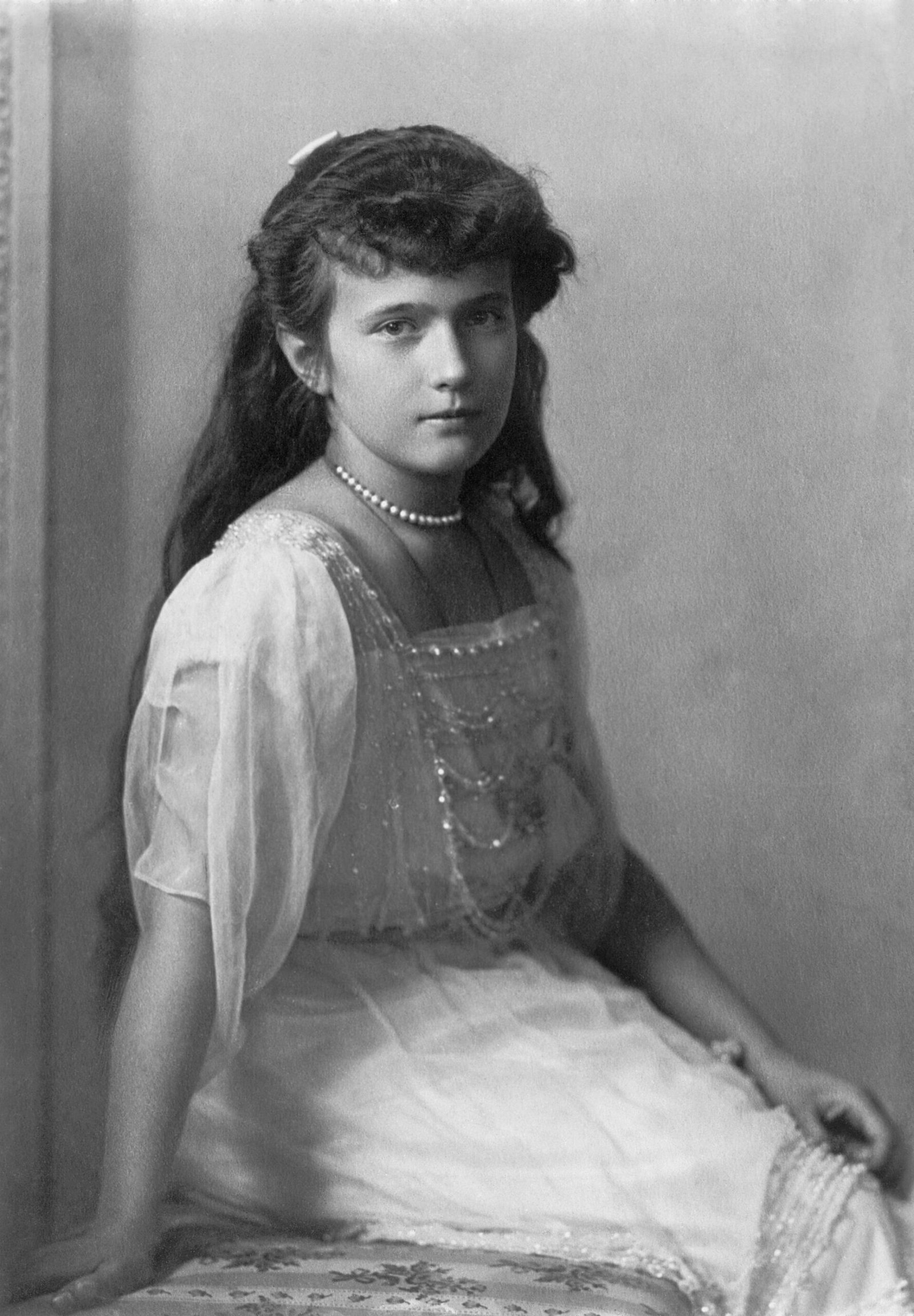
Anastasia Nikolaevna Romanova was born at Peterhof on 18 June 1901. Seventeen years later, on 17 July 1918, she was shot with her family in the Ipatiev House in Yekaterinburg. The story that she escaped lasted most of a century. It ended in a laboratory. This article follows the facts, from her childhood to the 2009 DNA study that accounted for every member of the family.
Who was Grand Duchess Anastasia Nikolaevna of Russia?
Anastasia was the fourth daughter of Nicholas II, the last tsar of Russia, and his wife Alexandra Feodorovna. Her birth date is 18 June 1901 in the Gregorian calendar. In the Russian calendar of the time it was 5 June. The place was Peterhof.
She was the youngest of the four sisters. Her younger brother Alexei was heir to the throne. If you have only met her through the survival legend, the real record is shorter and harder: a childhood at court, captivity, and a death at 17.
Anastasia’s siblings: Olga, Tatiana, Maria and Alexei
Anastasia had three older sisters, Olga, Tatiana and Maria. The four girls were so often treated as a unit that they used a shared signature. They took the first letters of their names and wrote OTMA.
The fifth child was Alexei, the only son and the heir. All five children shared their parents’ captivity after 1917. All five died with them.
What was Anastasia’s personality like?
Historian Helen Rappaport describes Anastasia as mercurial, witty and prone to irreverent jokes. That is the picture that survives from people who knew the family. If you expect a solemn princess from the photographs, adjust the image. The youngest daughter was the joker of the house.
Rappaport’s 2014 book Four Sisters examines the lives of Anastasia and her three older sisters together. It is the standard reference if you want the sisters as people rather than as victims.
The 1914 mirror photograph: a selfie before the word existed
In October 1914 Anastasia was 13. She stood in front of a mirror with a Kodak Brownie camera and photographed herself. The picture is now on Wikimedia Commons.
The gesture is familiar. You have almost certainly done the same thing with a phone in a bathroom mirror. The difference is that she needed a box camera, a roll of film and a mirror to do it, and the result had to be developed before anyone saw it.
From Tobolsk to Yekaterinburg
After the fall of the monarchy, the Provisional Government moved the Romanov family to Tobolsk in Siberia in August 1917. Anastasia went with them.
In May 1918 the children were transferred to Yekaterinburg. The last known photographs of the Romanov children were taken on that journey. After that, there are no more pictures.
How did Anastasia die, and who killed her?
On 17 July 1918 the Bolsheviks killed Anastasia together with her family in the Ipatiev House in Yekaterinburg. She was 17 years old. Her cause of death was gunshot wounds received during the mass killing.
The group killed that night numbered 11 people: the tsar, the tsarina, their five children and four members of the household. The word assassination suggests a single target. This was the killing of an entire family and the people who stayed with them.
Did Anastasia Romanov survive? The first grave
The legend fed on a gap in the evidence. In July 1991 investigators exhumed a mass grave near Yekaterinburg. It held nine skeletons. First examinations showed that two of the family’s children were missing.
DNA research published in 1994 confirmed that the 1991 grave held a family group: a mother, a father and three children. The mitochondrial DNA attributed to Tsarina Alexandra and three daughters matched that of Prince Philip, a relative on the maternal line. The parents and three daughters were accounted for. Two children were not.
The second grave, 2007
In the summer of 2007 amateur archaeologists found the remains of two people about 70 metres from the first grave. An official excavation led by Sergey Pogorelov recovered 44 fragments of bone and teeth from this second site.
The research team led by Michael Coble tested the fragments with mitochondrial DNA, autosomal STR and Y-STR analysis. The 2009 study identified the two as Alexei and one of his sisters. Its conclusion was direct: the two graves together hold the whole family, and no member survived 1918.
One question stayed open. Russian experts held that the girl in the second grave was Maria. American experts held that she was Anastasia. The 2009 study stated that DNA could not resolve that distinction. The findings were published in PLOS ONE in 2009.
The impostors: Anna Anderson and the others
The best known claimant was Anna Anderson. Her claim collapsed in 1994, when tissue from her was tested and showed no relationship to the Romanovs. Her mitochondrial DNA matched a maternal relative of Franziska Schanzkowska, a Polish factory worker who had gone missing.
Nadezhda Vasilyeva and Eugenia Smith also claimed to be Anastasia. The identification of all the family’s remains invalidated every survival claim at once. There was no missing daughter left to be.
Where is Anastasia’s grave?
The remains from the 1991 grave were buried in the Peter and Paul Cathedral in St Petersburg on 17 July 1998, the 80th anniversary of the killings. If you visit the cathedral, you are standing at the burial place of the tsar, the tsarina and three of their daughters.
Whether Anastasia is among those three, or whether she was the sister found in 2007, is the one point the DNA left open.
Timeline
- 18 June 1901 Anastasia is born at Peterhof; the Julian date is 5 June.
- October 1914 She photographs herself in a mirror with a Kodak Brownie.
- August 1917 The family is taken to Tobolsk.
- May 1918 The last photographs of the children are taken on the journey to Yekaterinburg.
- 17 July 1918 Anastasia, her family and four members of the household are killed.
- July 1991 Nine skeletons are exhumed from the first mass grave.
- 1994 DNA results on the first grave are published; Anna Anderson is shown not to be a Romanov.
- 17 July 1998 The remains from the first grave are buried in St Petersburg.
- Summer 2007 The second grave is found.
- 2009 The PLOS ONE study identifying the two missing children is published.
Details you won’t find in guidebooks
- Hard beds and cold water. Anastasia and her siblings slept on hard beds without pillows and took cold baths in the morning. The only exceptions were periods of illness.
- The OTMA signature. The four sisters used the initials of Olga, Tatiana, Maria and Anastasia as a shared name.
- The molar they refused to grind. In the 2009 study the researchers kept one molar fragment from the second grave intact. It could have yielded DNA, but they chose not to destroy it.
- The bloodstained shirt. DNA from a shirt Nicholas II wore during an attack on him in 1891 was recovered and matched a tooth sample from the grave. That match supported the identification.
Books and movies about Anastasia
Helen Rappaport’s Four Sisters, published in 2014, covers the lives of Anastasia and her three older sisters. The survival legend reached a wide audience through the 1956 film Anastasia and the 1997 animated film of the same name.
FAQ
Did Anastasia Romanov survive the 1918 killing?
No. The 2009 DNA study of the second Yekaterinburg grave concluded that the two graves together hold the whole family and that no member survived 17 July 1918.
Was Anna Anderson really Anastasia?
No. Tissue from Anderson tested in 1994 showed no relation to the Romanovs. Her mitochondrial DNA matched a maternal relative of Franziska Schanzkowska, a missing Polish factory worker.
Where is Anastasia buried?
The remains from the 1991 grave were buried in the Peter and Paul Cathedral in St Petersburg on 17 July 1998. Which daughter lay in the 1991 grave and which in the 2007 grave, Maria or Anastasia, could not be settled by DNA.
How old was Anastasia when she died?
She was 17. She was born on 18 June 1901 and killed on 17 July 1918.
Who were Anastasia’s siblings?
Three older sisters, Olga, Tatiana and Maria, and one younger brother, Alexei, who was heir to the throne.
Sources
- Wikipedia — Grand Duchess Anastasia Nikolaevna of Russia en.wikipedia.org
- Vikipedi — Anastasiya Nikolayevna Romanova tr.wikipedia.org
- Smithsonian Magazine — Thousands of intimate photographs reveal the everyday lives of the Romanovs smithsonianmag.com
- Wikimedia Commons — Grand Duchess Anastasia Nikolaevna self photographic portrait (1914) commons.wikimedia.org
- PubMed — Gill et al., 1994, identification of the Romanov remains pubmed.ncbi.nlm.nih.gov
- PubMed — Coble et al., 2009, Mystery solved: the identification of the two missing Romanov children pubmed.ncbi.nlm.nih.gov
- PLOS ONE — Coble et al., 2009, full text journals.plos.org
- Investigative Genetics — Coble, 2011, The identification of the Romanovs pmc.ncbi.nlm.nih.gov
Image: Grand Duchess Anastasia Nikolaevna Crisco edit letters removed.jpg — Boissonnas et Eggler, St. Petersburg, Nevsky 24. – Bain News, Public domain