What Chora Church is
Chora Church stands in the Edirnekapı quarter of Istanbul’s Fatih district. It began as the main church of the Khora Monastery and was dedicated to Christ. Later it was converted into a mosque. In Turkish it is called Kariye.
The Ministry of National Education lists the address as Derviş Ali Mahallesi, Kariye Cami Sokağı No:18, Fatih. You can use that line in a map app.
Its fame comes from what covers the walls and ceilings: a Byzantine programme of mosaics and frescoes that tells the story of Mary and Christ.
Why is it called Chora, and why Kariye?
The Greek word khora means the countryside, or the area outside a settlement. Some writers link the name to the church lying outside the walls of Constantine. Semavi Eyice, writing in the TDV Encyclopaedia of Islam, does not find that convincing. He points instead to the inscriptions reading Khora on the mosaics of Christ and Mary, and stresses their mystical meaning.
The Turkish name has a plainer route. Eyice explains Kariye through the word karye, meaning village.
How old is the church? Two accounts
The Ministry’s culture portal tells a story of rebuilding in the reign of Justinian. Eyice calls a sixth-century foundation a legend. He places the first mention of the monastery at about 742.
The firmer record starts later. Maria Doukaina, mother-in-law of Emperor Alexios I Komnenos, had the church rebuilt in the late 11th century. In the 12th century Isaakios Komnenos had it rebuilt again. The main church core you see today goes back to that phase, according to Smarthistory.
Then came the Latin occupation of 1204–1261. The monastery and church were badly damaged.
Who paid for the mosaics?
The man behind the decoration was Theodoros Metokhites, a senior official under Andronikos II. Around 1316–1321 he had Chora renovated. He financed the mosaic and fresco programme.
His building work changed the plan. He added an inner and an outer narthex, the entrance halls in front of the main space. On the south side he added a parekklesion, a side chapel that served as a funeral chapel.
Metokhites was interested in classical texts. He gave his personal library to the Chora Monastery. That is rare in a patron’s story: he paid for images and also left books.
The donor mosaic above the door
Look above the entrance into the main church. A mosaic shows Metokhites kneeling. He wears an elaborate hat. In his hands he holds a model of the church and offers it to Christ, who sits on a throne.
Think of the donor’s name on a plaque in a modern hospital wing or a school hall. The idea is the same. The person who paid is shown beside the building, and the image says: this was given. Here it is done in glass and stone cubes, at the door where every visitor passes.
Christ over the inner door
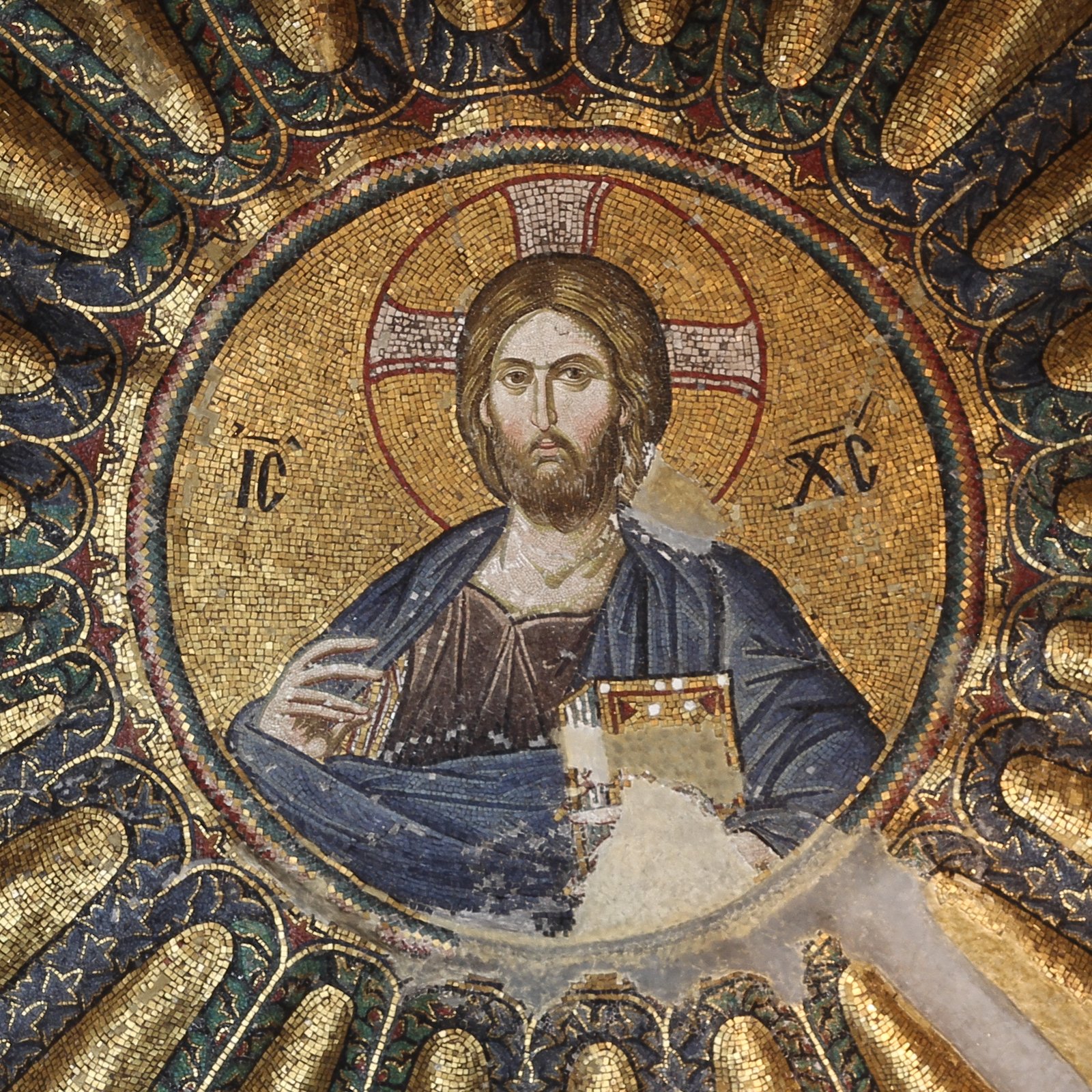
Above the passage from the outer narthex to the inner narthex is a Pantokrator mosaic. Christ blesses with his right hand. In his left hand he holds a Gospel book decorated with jewels.
It is a quiet image. There is no crowd and no action. Yet it sets the tone for the rooms beyond.
The Mary cycle in the inner narthex
The inner narthex holds the richest storytelling. The culture ministry lists scenes such as the birth of Mary, her first steps, and the angel Gabriel announcing that she will bear a child.
The NASSCAL catalogue counts 18 mosaics in the Mary cycle here. It links 17 of them to scenes from the Protoevangelium of James and other apocryphal texts. So most of the series follows writings outside the four Gospels.
If you walk slowly, read the panels like a picture book. Birth comes first, then early childhood, then the announcement.
What survives in the main space
The main worship space is the naos. Only three mosaics have survived there: Christ, Mary with the Child, and the Dormition, the Death of Mary.
The Dormition has a detail worth finding. Christ holds a baby in his arms. The baby stands for the soul of Mary.
The main dome above the naos is 7.7 metres across. It is not the only dome that matters, as the next section shows.
The parekklesion: fresco, not mosaic
The south chapel is where the visit turns from mosaics to painting. The Anastasis in its apse is a fresco, made in a different technique from mosaic. You should know this before you go, so you do not look for tesserae on that wall.
The scene shows Christ in white clothes after he has broken the gates of the realm of the dead. He pulls Adam and Eve out of their tombs.
The chapel dome is smaller, at 4.5 metres across. Mary and the Child fill its centre. Twelve angels are shown in the dome’s segments.
Timeline
- About 742 According to Semavi Eyice, the Khora Monastery is first mentioned.
- Late 11th century Maria Doukaina has the church rebuilt.
- 12th century Isaakios Komnenos has the building rebuilt; it forms today’s main church core.
- 1204–1261 The monastery and church are badly damaged during the Latin occupation.
- About 1316–1321 Metokhites’s expansion and decoration programme produces the mosaics and frescoes.
- Reign of Bayezid II: Grand Vizier Hadım Atik Ali Pasha converts the church into a mosque.
- 29 August 1945 A Council of Ministers decision (no. 3/3054) assigns the building to the Ministry of National Education as a museum and museum depot.
- 1948 The Byzantine Institute of America begins work under Thomas Whittemore.
- 1950 After Whittemore’s death, Paul Underwood continues the work.
- 21 August 2020 A Presidential decision published in the Official Gazette passes management to the Directorate of Religious Affairs and provides for opening to worship.
- 6 May 2024 After restoration, Kariye Mosque reopens for worship.
From church to mosque to museum
The change to a mosque happened under Bayezid II. Grand Vizier Hadım Atik Ali Pasha carried it out.
The museum phase rests on the Council of Ministers decision of 29 August 1945. It assigned the building to the Ministry of National Education as a museum and museum depot.
The Byzantine Institute of America started work in 1948 under Thomas Whittemore. He died in 1950, and Paul Underwood carried the work on.
Details you won’t find in guidebooks
- Only three mosaics survive in the naos: Christ, Mary with the Child, and the Dormition.
- In the Dormition, the baby Christ holds is Mary’s soul.
- Of the 18 mosaics in the inner narthex Mary cycle, 17 relate to the Protoevangelium of James and other apocryphal texts.
- Metokhites gave his personal library to the monastery.
- When the building became a museum, its wooden minbar was removed. It was moved to the central part of the Zeyrek Kilise Mosque.
Chora today
The Presidential decision published on 21 August 2020 passed the building’s management to the Directorate of Religious Affairs and provided for opening to worship. After restoration work, Kariye Mosque reopened for worship on 6 May 2024, as recorded by Fatih Municipality.
That means you are visiting a working mosque. Plan around that, and check current opening arrangements before you travel.
Getting there is simple. The culture portal names IETT buses and minibuses for Edirnekapı. Use the street address above to set your stop.
FAQ
Who paid for the Chora Church mosaics?
Theodoros Metokhites, a senior official of Emperor Andronikos II, financed the mosaic and fresco programme during his renovation of about 1316–1321.
Is the Anastasis at Chora a mosaic?
No. The Anastasis in the apse of the parekklesion is a fresco, not a mosaic. It shows Christ in white pulling Adam and Eve from their tombs.
Is Chora Church a museum or a mosque today?
It is a mosque. It was a museum from a 1945 Council of Ministers decision, passed to the Directorate of Religious Affairs by a decision published on 21 August 2020, and reopened for worship on 6 May 2024 after restoration.
Why is it called Chora and Kariye?
Chora is a Greek word for the countryside or the area outside a settlement. Semavi Eyice explains the Turkish name Kariye through the word karye, meaning village.
How do you get to Chora Church?
The Ministry of Culture and Tourism’s culture portal names IETT buses and minibuses for reaching Kariye in Edirnekapı. The address is Derviş Ali Mahallesi, Kariye Cami Sokağı No:18, Fatih, Istanbul.
Sources
- Ministry of Culture and Tourism, Culture Portal, Kariye Camii kulturportali.gov.tr
- Ministry of National Education, Out-of-School Learning Environments, Kariye Camii okuldisiogrenme.eba.gov.tr
- TDV Encyclopaedia of Islam, Semavi Eyice, Kariye Camii islamansiklopedisi.org.tr
- Ministry of Culture and Tourism, Kariye Museum ktb.gov.tr
- Smarthistory, Evan Freeman, Picturing Salvation smarthistory.org
- English Wikipedia, Chora Church en.wikipedia.org
- NASSCAL, Cycle of the Virgin, Chora Church, Istanbul nasscal.com
- Anadolu Agency, Kariye Camisi ibadete açılıyor aa.com.tr
- Fatih Municipality, Kariye Camii açılışı fatih.bel.tr
Image: Saint-Sauveur-in-Chora – Pantocrator de l’ésonarthex.jpg — Eusebius, CC BY 3.0