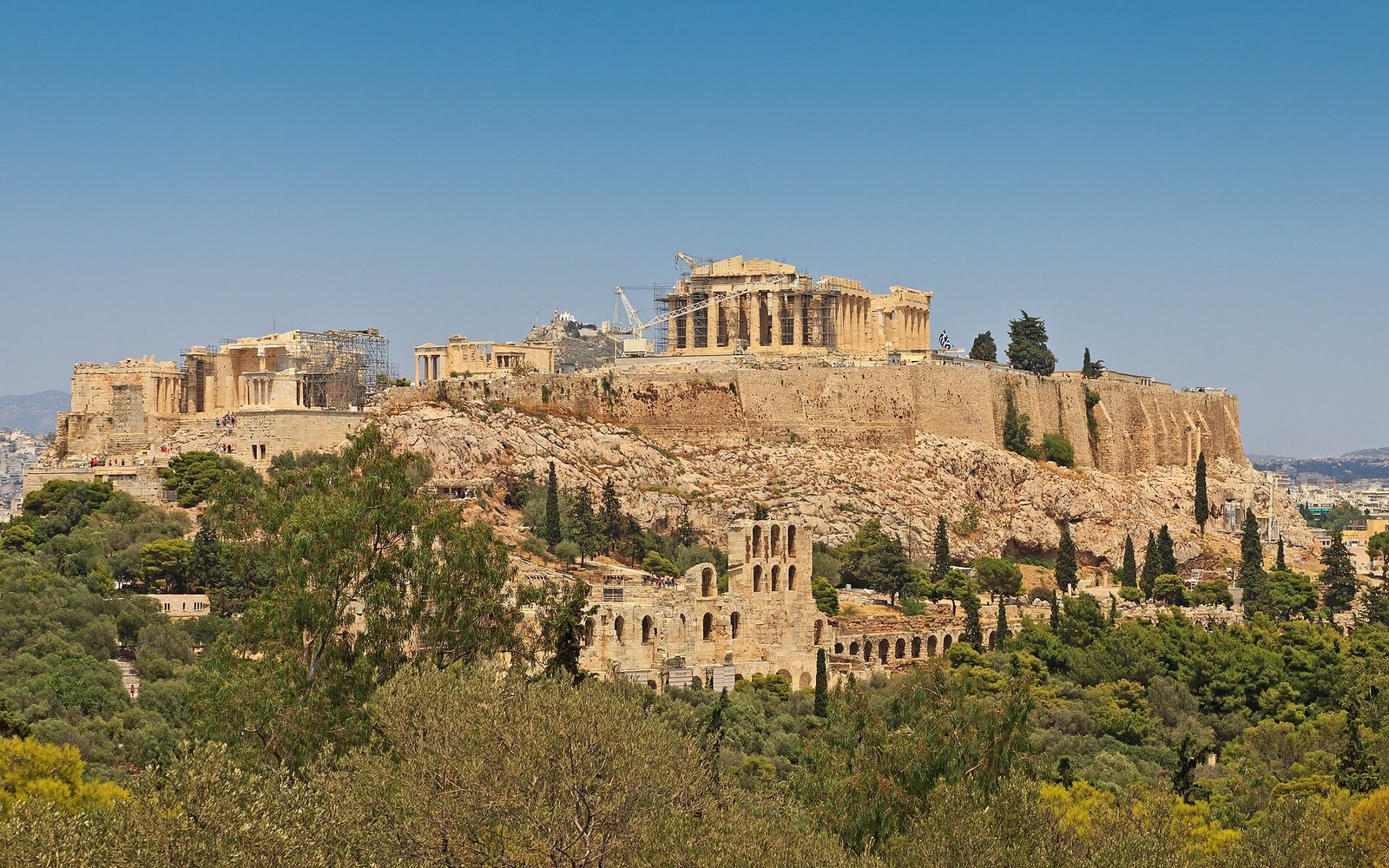
The Acropolis of Athens is a rocky hill in central Athens, Greece, carrying an ancient sanctuary devoted chiefly to Athena. Besides the Parthenon, it contains the Erechtheion, the monumental Propylaia gateway, the Temple of Athena Nike, and other sanctuaries and remains.
Why does a sanctuary also contain reused columns in a defensive wall and a temple that once stored public money? If you look beyond the Parthenon, these details connect the Acropolis to worship, government and warfare. Its buildings also carry the consequences of conversion, demolition and restoration.
What does acropolis mean, and where is the Athenian Acropolis?
The word acropolis combines the Greek akron, meaning highest point, and polis, meaning city. It describes an upper town or citadel. The term is therefore not restricted to Athens, although the Athenian Acropolis carries the sanctuary chiefly dedicated to Athena.
The hill stands in the centre of Athens, the capital of Greece. UNESCO describes it as averaging 156 metres in height and measuring approximately 170 by 350 metres. Its sides are steep except on the west, where the Propylaia forms the sanctuary’s monumental entrance.
The rock itself has a history separate from the buildings. Tectonic thrusting moved a mass of limestone over Athens schist. Erosion then separated that mass from its surroundings. The natural elevation beneath the sanctuary was therefore formed by geological processes.
Archaeological evidence places people on the hill in the fourth millennium BCE. In the thirteenth century BCE, its first defensive wall enclosed the residence of a local Mycenaean ruler. The hill’s early history includes settlement and fortification, long before the surviving monumental ensemble.
During the eighth century BCE, the establishment of Athena’s cult increasingly gave the hill a religious character. Athena was the city’s protective goddess. The Acropolis developed from a fortified residence into a religious centre, with the later building programme adding its best-known monuments.
What were the purposes of the Parthenon, Erechtheion, Propylaia and Temple of Athena Nike?
The four major monuments served different functions within Athena’s sanctuary. The Parthenon was dedicated to Athena. The Erechtheion accommodated several cults. The Propylaia provided the monumental entrance, while the small Temple of Athena Nike honoured Athena as a giver of military victory.
The Parthenon: Athena’s image and public money
Construction of the Parthenon took place between 447 and 438 BCE. Its pediment sculptures were completed in 432 BCE. Iktinos and Kallikrates were its architects, while the sculptor Pheidias directed the overall works and sculptural programme.
Inside the eastern part stood Pheidias’s statue of Athena, made of gold and ivory. The goddess held a figure of Nike in her right hand. The statue belonged to the building’s religious setting, but the western room had another documented use: storing Athens’s public money.
The Erechtheion: several cults under one roof
Built in the Ionic order between 421 and 406 BCE, the Erechtheion housed Athena Polias’s wooden cult image in its eastern section. Its western section accommodated the cults of Poseidon, Hephaistos and the local hero Boutes. Its religious functions therefore extended beyond Athena alone.
At the southwest corner, six female figures called Caryatids supported a porch roof. These figures were architectural supports within the building. You can connect their familiar appearance with a specific function: carrying the roof above the porch.
The Propylaia: the sanctuary’s entrance
Mnesikles built the Propylaia between 437 and 432 BCE on the western side of the Acropolis. It formed the monumental entrance to Athena’s sanctuary. Its position and purpose distinguish it from the temples within the enclosure.
The outbreak of the Peloponnesian War interrupted construction. Parts of the original design remained unfinished. The Propylaia therefore records both the ambitions of the building programme and the interruption caused by war.
The Temple of Athena Nike: military victory
Attributed to Kallikrates, the Temple of Athena Nike is a small Ionic temple. It stands on an older Mycenaean bastion guarding the southwest entrance. Its dedication concerns Athena’s power to grant military victory, linking the shrine’s religious purpose with its defensive setting.
Its construction dates vary between institutional accounts. The Acropolis Restoration Service proposes 427–424 BCE. The Acropolis Museum gives 426–421 BCE. Both place the temple in the 420s BCE, but their proposed ranges differ.
Beyond the four major monuments
The Acropolis also contains the sanctuaries of Artemis Brauronia, Zeus Polieus and Pandion. Remains of the Temple of Rome and Augustus add another monument to the site. If you treat the Acropolis as only the Parthenon, you leave out these other places of worship.
How did the Persian invasion and Pericles’ building programme transform the sanctuary?
In 480 BCE, the Persian army sacked Athens. The destruction included Athena’s old temple and the unfinished Older Parthenon. Both were burned and damaged. The later monumental sanctuary followed this destruction, rather than surviving intact from the earlier period.
Fifth-century BCE works reshaped the usable summit. Strong perimeter walls, approximately 740 metres long, retained earth fills. Terracing expanded the hilltop surface to 29,000 square metres. The sanctuary’s development involved substantial work on its supporting ground and boundaries as well as its buildings.
The fifth-century programme led by Pericles produced the monumental ensemble associated with the Acropolis: the Parthenon, Propylaia, Erechtheion and Temple of Athena Nike. Their construction extended across different dates. Together, they gave the sanctuary its principal temples and monumental entrance.
Timeline
- Fourth millennium BCE: Evidence places human settlement on the hill.
- Thirteenth century BCE: The first wall encloses a Mycenaean ruler’s residence.
- Eighth century BCE: Athena’s cult strengthens the hill’s religious role.
- 480 BCE: Persian forces destroy the earlier temples and unfinished Older Parthenon.
- Fifth century BCE: Walls, fills and terraces enlarge the sanctuary.
- 447–438 BCE: The Parthenon is constructed.
- 437–432 BCE: The Propylaia is built.
- 432 BCE: The Parthenon’s pediment sculptures are completed.
- 420s BCE: The Temple of Athena Nike is built.
- 421–406 BCE: The Erechtheion is constructed.
- Around 410 BCE: A marble parapet is added to the Athena Nike bastion.
- 1205: The Parthenon is dedicated to the Holy Mother of Athens.
- Ottoman period: The Parthenon serves as a mosque.
- 1686: The Temple of Athena Nike is dismantled for defensive building material.
- 1687: A gunpowder explosion devastates the Parthenon during Venetian bombardment.
- 1835–1845: The Temple of Athena Nike is reassembled.
- 1875: The Frankish tower above the Propylaia is demolished.
- 1975: ESMA is established and integrated conservation begins.
- 1979: The Caryatids are moved to a museum for protection.
- 1987: The Acropolis enters UNESCO’s World Heritage List.
Details you won’t find in guidebooks
The north wall contains 26 unfinished, unfluted marble column drums reused after the Persian destruction. These architectural pieces became part of the defences. Material from damaged buildings thus survives within the fabric of the sanctuary’s enclosure.
From 433 BCE, the Parthenon’s western room, the opisthodomos, stored Athens’s public money. This gives the building a documented financial function alongside its dedication to Athena. Its eastern interior held the gold-and-ivory statue, while public funds were kept in the west.
Around 410 BCE, a marble parapet decorated with reliefs of winged Nike figures was added to the Athena Nike bastion. It protected visitors at the dangerous edge. Think of the railing beside an everyday balcony: the ancient barrier also addressed the practical problem of preventing a fall.
Modern restoration uses white marble from Mount Penteli to complete missing portions. Ancient builders used stone from the same mountain. The new material therefore connects present conservation work with the source used for the ancient monuments.
How was the Acropolis reused and restored over time?
The Parthenon became a church in late antiquity. In 1205, it was dedicated to the Holy Mother of Athens. During Ottoman rule, it served as a mosque. Its successive religious uses extended the building’s history far beyond its original dedication to Athena.
The Propylaia also changed function. During the Middle Ages, Frankish and Florentine rulers converted it into a palace. A Frankish tower above its southern wing was demolished in 1875. The gateway’s later history therefore includes both residential adaptation and the removal of a later addition.
In 1686, the Ottomans dismantled the Temple of Athena Nike. They used its stones to strengthen the entrance defences. The following year, Venetian bombardment struck the Parthenon and ignited gunpowder stored inside by the Ottomans. The explosion destroyed large portions of the building.
Reassembling the Temple of Athena Nike between 1835 and 1845 marked the first restoration intervention on the Acropolis monuments. The temple’s history includes dismantling, reuse of its stones and reconstruction.
The Committee for the Conservation of the Acropolis Monuments, ESMA, was established in 1975. The Erechtheion was its first focus. In 1979, the Caryatids were moved to a museum to protect them from damage caused by outdoor exposure.
The integrated conservation programme begun in 1975 follows principles of limiting intervention to what is necessary and making treatments reversible. UNESCO World Heritage inscription followed in 1987. Conservation forms another chapter in the history of buildings repeatedly altered by worship, warfare and repair.
FAQ
Are the Acropolis and the Parthenon the same thing?
The Acropolis is the rocky hill and sanctuary in central Athens. The Parthenon is one building within it, alongside the Erechtheion, Propylaia and Temple of Athena Nike.
What stands on the Acropolis besides the four main monuments?
The site also contains the sanctuaries of Artemis Brauronia, Zeus Polieus and Pandion, plus remains of the Temple of Rome and Augustus.
Why was the Parthenon so badly damaged in 1687?
During the Venetian siege, bombardment struck the Parthenon and ignited gunpowder stored inside by the Ottomans. The explosion destroyed large parts of the building.
Why were the Caryatids moved to a museum?
The Caryatids were moved to a museum in 1979 to protect them from damage caused by outdoor exposure. Their protection formed part of the modern conservation work on the Acropolis.
Sources
- Wikipedia — Acropolis of Athens en.wikipedia.org
- Greek UNESCO Monuments — The Acropolis of Athens greekunescomonuments.gr
- UNESCO — Acropolis, Athens whc.unesco.org
- University of Athens, Pergamos — 3.11 Acropolis, Athens pergamos.lib.uoa.gr
- Acropolis Restoration Service — Circuit Walls ysma.gr
- Acropolis Restoration Service — Parthenon ysma.gr
- Acropolis Restoration Service — Propylaia ysma.gr
- Acropolis Restoration Service — Erechtheion ysma.gr
- Acropolis Restoration Service — Temple of Athena Nike ysma.gr
- Acropolis Museum — The Temple of Athena Nike theacropolismuseum.gr
- Acropolis Museum — Museum History theacropolismuseum.gr
- Greek Ministry of Culture — UNESCO culture.gov.gr
Image: Attica 06-13 Athens 50 View from Philopappos – Acropolis Hill.jpg — A.Savin, CC BY-SA 3.0