On 27 August 1883 a volcano in the Sunda Strait produced what the US Geological Survey calls the loudest and farthest-travelling sound in the historical record. This article explains where Krakatoa is, what happened, how loud it really was, and what came after.
Where is Krakatoa? Location of the 1883 eruption
Krakatau and Krakatoa are both widely used spellings of the same name. Both describe a group of volcanic islands in the Sunda Strait, the waterway between Java and Sumatra in Indonesia.
In 1883 this region was part of the Dutch East Indies. The big city nearby was Batavia, which is today’s Jakarta.
Before the eruption, the main island of Krakatau was made of three joined volcanic cones. From north to south they were Perboewatan, Danan and Rakata. Keep those three names in mind. They explain what was lost.
Timeline of the 1883 eruption of Krakatoa
- 20 May 1883: The captain of the German warship Elizabeth saw a cloud of ash and dust rising over Krakatau.
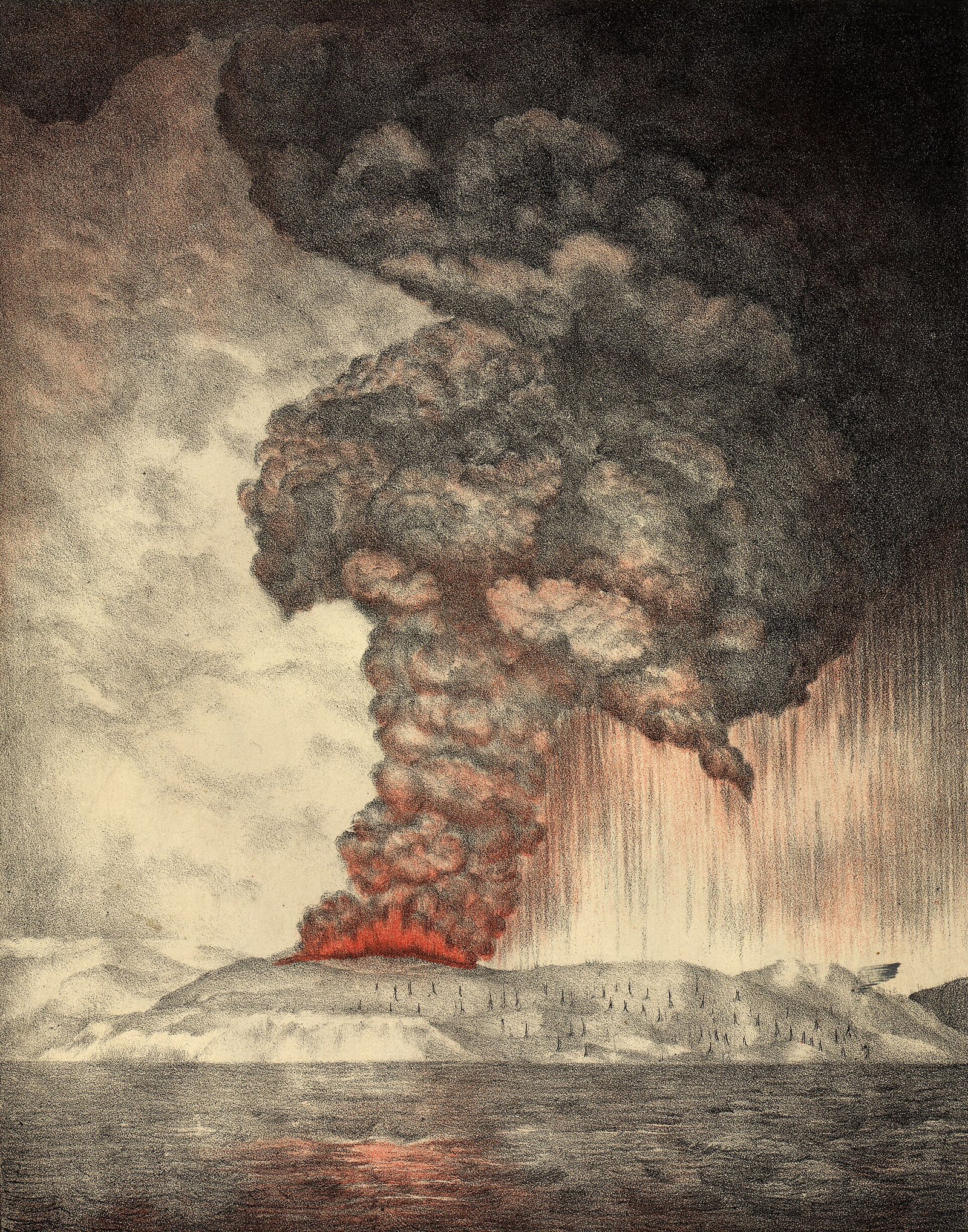
- 27 May 1883: A photograph of the early phase was taken. It later became the source of a famous Royal Society print.
- 26 August 1883: The destructive climax of the eruption began.
- 27 August 1883: The largest explosions struck, and tsunamis hit the coasts.
- 1883–1886: William Ascroft drew the strange skies over London after the eruption.
- 1885: Samples of volcanic material that fell on the ship Charles Bal were donated to a museum collection.
- 1888: The Royal Society’s colour lithograph of Krakatau was published.
- 1927: New eruptions began in the 1883 caldera and started building Anak Krakatau.
How long did the 1883 eruption of Krakatoa last?
The activity did not start in August. On 20 May 1883 a ship’s captain saw an ash cloud over the island. In May the explosions from Perboewatan were already strong. In Batavia, about 160 kilometres away, they shook doors and windows.
Think of a heavy lorry passing your house and rattling the glass. Now imagine that shaking arriving from a volcano 160 kilometres away. That was a warning, not the main event.
The destructive climax came on 26–27 August. The biggest explosion of 27 August is usually dated to 10:02 local time. Some sources give 09:58 instead. So the eruption phase ran for months, but the catastrophe was packed into about two days.
The sound of Krakatoa in 1883
The USGS describes the sound of the 1883 Krakatau explosions as the loudest and farthest-reaching in the historical record. The numbers behind that claim are striking.
The explosions were heard on Rodrigues Island in the Indian Ocean. That island is about 4,800 kilometres from Krakatau. Sound took roughly four hours to cover that distance. That detail rarely appears in popular accounts.
The blast also acted as a pressure wave. Even about 160 kilometres from Krakatau, windows were reported broken and houses shaken. At that distance, you would not have needed to see the volcano to feel it.
The pressure wave was not only local. Barometers and similar instruments in Great Britain and America recorded Krakatau’s atmospheric pressure wave. A volcano in the Sunda Strait left a mark on instruments across the world.
How many decibels was the 1883 eruption of Krakatoa?
This is where you should be careful with what you read online.
A calculation reported on Wikipedia estimates a sound pressure level of about 180 dB SPL at 160 kilometres from the source. That is an estimate, not a reading from an instrument.
You will also see a figure of about 310 decibels at the source. Acoustics expert Michael Vorländer answers that claim directly. No one measured the sound near the eruption, he says. Calculations made backwards from how the sound spread are very uncertain.
So the safe summary is this. The sound was the loudest in the historical record, according to the USGS. Any exact decibel number is a reconstruction. The distance of 4,800 kilometres is a far firmer fact than a decibel figure.
What the 1883 eruption did to the island
The destruction was physical as well as acoustic. According to NOAA, the northern two-thirds of the island of Krakatau collapsed beneath the sea during the 1883 catastrophe.
The eruptions left a caldera about 6 kilometres wide. A caldera is a large basin that forms when a volcano collapses or is hollowed out.
Scientists still discuss how the caldera formed. One model says the island collapsed into an emptied magma chamber. An alternative theory stresses that the island was broken up and carved out by the explosions themselves.
The eruption’s size is rated VEI 6 on the Volcanic Explosivity Index, an eight-step scale.
The 1883 Krakatoa tsunami
The tsunamis struck the coasts of the Sunda Strait on 27 August. In some places they reached about 40 metres in height.
That is roughly the height of a 13-storey building. The waves came from the same explosions that made the sound. The ocean carried the destruction to coasts that may not have seen the volcano at all.
Death toll of the 1883 eruption of Krakatoa
The reported official death toll is 36,417. NASA says the tsunamis caused most of the roughly 36,000 deaths.
The number matters for two reasons. First, it shows that the killer was the sea rather than falling ash or lava. Second, it explains why Krakatau is remembered as a disaster, not only as a loud noise.
Survivors of the 1883 Krakatoa eruption
Most accounts of the disaster focus on the dead. One survival story is worth knowing.
Captain Lindemann was aboard the ship Loudon in Lampong Bay. When the tsunami approached, he turned the ship head-on into the wave. This allowed the people aboard to survive the catastrophe.
Facing a wave head-on is a well-known principle for a ship at sea. It is the same instinct you use when you turn a boat’s bow into a wake.
Ash, darkness and a colder world
The eruption affected the sky as well as the sea. According to NOAA, the ash fall covered about 800,000 square kilometres and left the region in darkness for two and a half days.
The effects went global. NOAA reports that global temperatures fell by up to about 0.5 °C in the year after the eruption.
Smithsonian explains another visible effect. Krakatau released sulphur dioxide, which formed sulphuric acid aerosols. These contributed to unusual sunsets that were observed for years.
You can think of it as a veil in the upper air. It cooled the planet a little and coloured the evening sky.
Pictures of the 1883 eruption of Krakatoa
If you are searching for images, two sources stand out. The Royal Society’s famous view of Krakatoa is a colour lithograph published in 1888. It was made from a photograph taken on 27 May 1883. So it shows the early phase, not the August climax.
The second source is a set of sky drawings. William Ascroft watched the sky from London and made 533 drawings between 1883 and 1886. The Science Museum Group keeps them in its collection. They record what the sky looked like after the eruption, thousands of kilometres from the volcano.
Details you won’t find in guidebooks
- Four hours of travel. The sound took about four hours to reach Rodrigues Island from Krakatau.
- A captain’s turn. Captain Lindemann turned the Loudon head-on into the approaching tsunami in Lampong Bay, and everyone aboard survived.
- 533 sky drawings. The Science Museum Group holds William Ascroft’s drawings of the post-eruption sky over London, made between 1883 and 1886.
- A print from May. The Royal Society’s well-known image is a colour lithograph from 1888, based on a photograph taken on 27 May 1883.
- Dust in a museum. Samples of volcanic material that fell on the ship Charles Bal in 1883 were donated in 1885 by a relative of a crew member. They are now in the collections of the Lapworth Museum of Geology.
Has Krakatoa erupted since 1883?
Yes. New eruptions began in 1927 inside the 1883 caldera. They built a cone called Anak Krakatau, which means “Child of Krakatau”.
So the story did not end in 1883. The volcano that destroyed most of its own island started building a new one.
FAQ
Where is Krakatoa?
Krakatau, also spelled Krakatoa, is a group of volcanic islands in the Sunda Strait between Java and Sumatra in Indonesia. In 1883 the area belonged to the Dutch East Indies.
Has Krakatoa erupted since 1883?
Yes. New eruptions began in 1927 inside the 1883 caldera. They built the cone called Anak Krakatau, which means “Child of Krakatau”.
When did the 1883 Krakatoa eruption happen?
The destructive climax came on 26–27 August 1883. The largest explosion on 27 August is usually dated to 10:02 local time, although some sources give 09:58.
Sources
- Wikipedia — 1883 eruption of Krakatoa en.wikipedia.org
- Wikipedia — Krakatoa en.wikipedia.org
- San Diego State University — Krakatau, Indonesia (1883) volcanoes.sdsu.edu
- USGS — Volcano Watch: Mixing Magmas at Krakatau usgs.gov
- Oregon State University — Historical Eruption Sounds volcano.oregonstate.edu
- Live Science — What was the loudest sound ever recorded? livescience.com
- NOAA NCEI — On This Day: Historic Krakatau Eruption of 1883 ncei.noaa.gov
- NASA Earth Observatory — Anak Krakatau science.nasa.gov
- Smithsonian — Volcanic Eruption! forces.si.edu
- Science Museum Group — Sky sketches from September 1883 to September 1886 collection.sciencemuseumgroup.org.uk
- Royal Society Picture Library — View of Krakatoa, 1883 pictures.royalsociety.org
- University of Birmingham — Petrology at the Lapworth Museum birmingham.ac.uk
Image: Krakatoa eruption lithograph.jpg — Lithograph: Parker & Coward, Britain;, Public domain