Who was Constantine the Great?
Constantine I, known as Constantine the Great, ruled as Roman emperor from 306 to 337. His father was the emperor Constantius Chlorus. His mother was Helena, who was later recognized as a saint. If you walk through Istanbul today, you are walking through a city that he turned into a capital. He did not build it from nothing. He reorganized an existing city, Byzantion, and opened it as Constantinople on 11 May 330.
Where was Constantine the Great born, and where was he from?
Constantine was born in Naissus, today the city of Niš in Serbia. His birthday was 27 February. The year is less certain. Historians have proposed 271, 272 and 273, so the common date of 272 should not be treated as settled. The short answer to ‘where was he from’ is the central Balkans. He was not from Rome, and he was not from the city that later carried his name.
His rise began far from Naissus. His father died at Eboracum, today’s York in England, on 25 July 306. After that death the soldiers there proclaimed Constantine emperor.
The road to sole rule
On 28 October 312 Constantine defeated Maxentius at the Battle of the Milvian Bridge near Rome. The victory secured his position in the western Roman lands. In 313 he and Licinius reached an agreement in Milan. It supported religious freedom and the return of property that had been taken from Christians. In 324 he defeated Licinius as well and became the sole ruler of the Roman Empire.
Why Istanbul? The founding of Constantinople
Constantine chose Byzantion as his new capital. The city was not empty land. It had already been developed under Septimius Severus and Caracalla. Constantine reorganized it and opened it with ceremonies on 11 May 330.
One monument from that moment still stands. The porphyry Column of Constantine, known today as Çemberlitaş, is dated to about 330. Columbia University’s documentation catalog of Istanbul records its height as 34.8 meters. You can stand next to it today in the middle of the old city.
Constantine the Great and religion
This is the question most readers search for. The Milan agreement of 313 did not make Christianity the state religion. That step came later, with the Edict of Thessalonica issued by Theodosius I in 380. What Constantine did do was call the Council of Nicaea in 325, in today’s İznik, and pay its costs. Bishops from different regions of the empire gathered there to agree on a common statement of faith.
Was his conversion sincere? Scholars disagree. One theory explains it purely by political advantage. Its supporters point to pagan images on coins minted after 312 and to his support for traditional cults. Other researchers answer with the aid he gave to the church.
Even the famous sign before the battle of 312 is disputed. Lactantius wrote of a dream on the night before the fight. Eusebius, writing about 25 years later, described a cross seen in the daytime sky, followed by a dream. It is a bit like reading two accounts of the same meeting at work, one written the next day and one written a quarter century later. You would not expect them to match.
Family, violence and a late baptism
Constantine had six known children: Crispus, Constantine II, Constantius II, Constans, Constantina and Helena. In 326 he had his son Crispus killed at Pola. In the same year he ordered the death of his wife Fausta. Later sources claim a forbidden relationship between the two. The historian Hans Pohlsander warns that these accounts may contain as much gossip as fact.
The emperor who convened Nicaea in 325 waited a long time for his own baptism. He was baptized only in 337, shortly before his death, by Eusebius of Nicomedia.
Death near İzmit and a tomb in Istanbul
Constantine died on 22 May 337 at a villa called Achyron near Nicomedia, today’s İzmit. His body was carried to Constantinople. He was buried there in a porphyry sarcophagus in the Church of the Holy Apostles. That church no longer exists. The Fatih Mosque complex occupies its site. Construction of the complex began in March 1463 and was completed in December 1470. If you visit Fatih Mosque, you are standing where the founder of the city was laid to rest.
Timeline
- c. 272 Born in Naissus; the exact year is disputed.
- 25 July 306 Proclaimed emperor by soldiers at Eboracum.
- 28 October 312 Defeated Maxentius at the Milvian Bridge.
- 313 Agreed a shared policy of religious tolerance with Licinius in Milan.
- 324 Defeated Licinius and became sole ruler of the empire.
- 325 Convened the Council of Nicaea.
- 326 Ordered the deaths of Crispus and Fausta.
- 11 May 330 Constantinople formally opened.
- 337 Baptized shortly before his death.
- 22 May 337 Died near Nicomedia; buried in Constantinople.
Constantine the Great coin
Coins are the most common objects that survive from his reign. The British Museum holds coin B.13715. It was minted in London in about 313 to 314. Its reverse shows the sun god Sol. It weighs 2.70 grams. This is exactly the kind of evidence used in the debate over his religion: a pagan god on a coin struck after the Milvian Bridge.
Constantine the Great statue
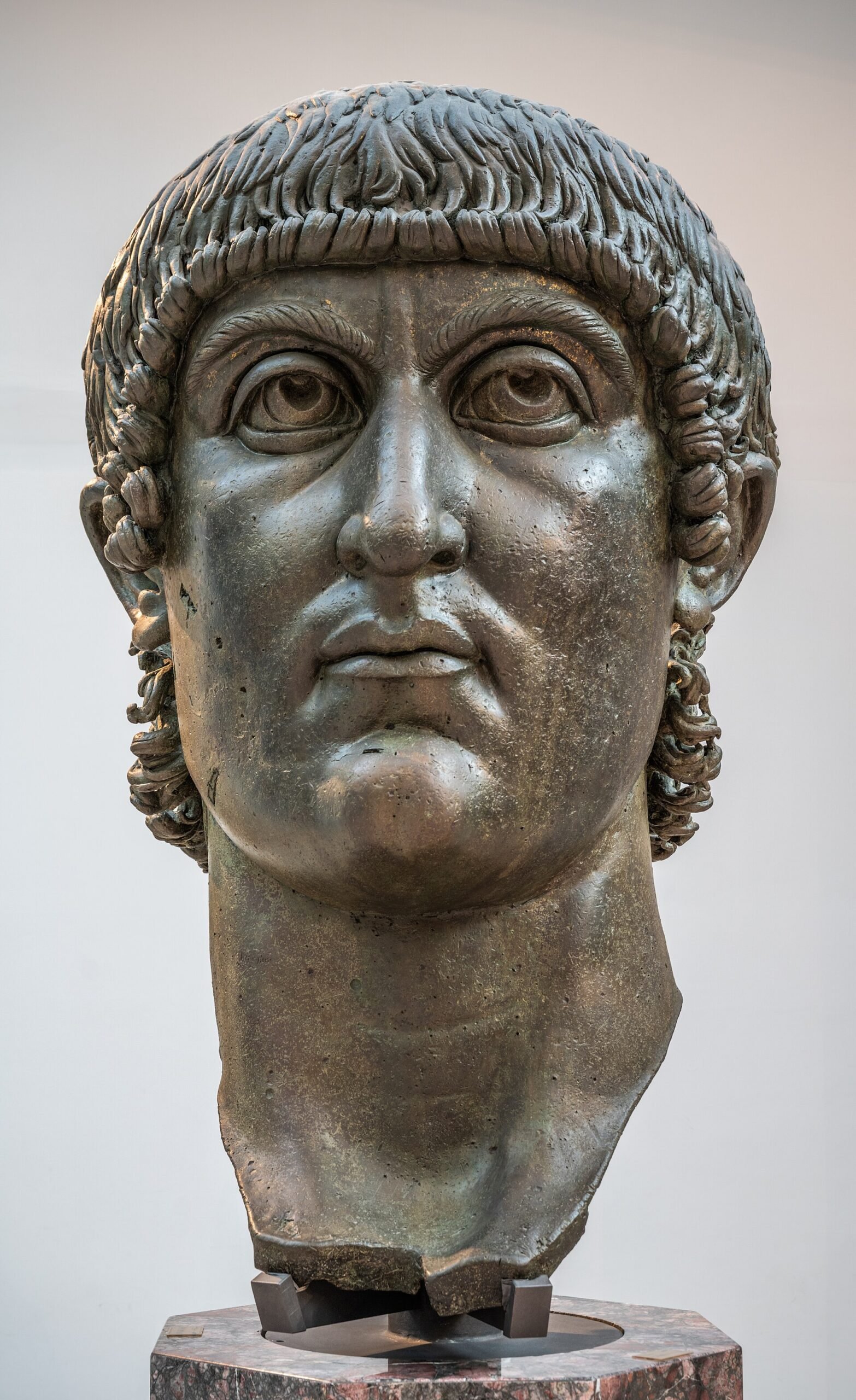
The best-known statue is in Rome, not Istanbul. The Musei Capitolini keep fragments of a colossal statue dated between 313 and 324. The marble head alone is 260 centimeters tall. A modern reconstruction of the full figure, about 13 meters high, went on display in the garden of Villa Caffarelli in Rome on 6 February 2024.
Details you won’t find in guidebooks
- The Forum of Constantine was built over the necropolis of old Byzantion. The emperor’s showpiece square sat on top of a cemetery.
- Constantine called the Council of Nicaea in 325 but was baptized only in 337, shortly before he died, by Eusebius of Nicomedia.
- British Museum coin B.13715, struck in London in about 313 to 314, carries the sun god Sol and weighs 2.70 grams.
- The marble head of the colossal statue in Rome measures 260 centimeters on its own.
Where to read more
The main ancient narrative is the Life of Constantine by Eusebius. The annotated English translation by Averil Cameron and Stuart G. Hall was published by Oxford University Press in 1999. For the emperor’s dealings with cities, including his new capital, see Noel Lenski’s Constantine and the Cities: Imperial Authority and Civic Politics, published by University of Pennsylvania Press in 2016 at 416 pages.
FAQ
Did Constantine the Great make Christianity the official religion of Rome?
No. The Milan agreement of 313 with Licinius backed religious freedom and the return of property seized from Christians. Christianity became the state religion only under Theodosius I, with the Edict of Thessalonica in 380.
Where is Constantine the Great buried?
He was buried in a porphyry sarcophagus in the Church of the Holy Apostles in Constantinople. The Fatih Mosque complex, built between March 1463 and December 1470, stands on that site today.
Where was Constantine the Great born?
In Naissus, today the city of Niš in Serbia, on 27 February. The year is disputed: 271, 272 and 273 have all been proposed.
Can you still see anything from Constantine’s time in Istanbul?
Yes. The porphyry Column of Constantine, known today as Çemberlitaş, dates to about 330. Columbia University’s documentation catalog records its height as 34.8 meters.
Sources
- Vikipedi, I. Konstantin tr.wikipedia.org
- Hans A. Pohlsander, De Imperatoribus Romanis, Constantine I roman-emperors.sites.luc.edu
- OpenStax, World History Volume 1, The Eastward Shift openstax.org
- Kültür ve Turizm Bakanlığı, Hıristiyanlığın Kutsal Kenti ekitap.ktb.gov.tr
- Wikipedia, Constantine the Great en.wikipedia.org
- Columbia University, MCID, Çemberlitaş Column mcid.mcah.columbia.edu
- University of St Andrews, The Theology of the Council of Nicaea saet.ac.uk
- Cambridge University Press, The Impact of Constantine on Christianity cambridge.org
- Fatih Belediyesi, Gravürlerle Fatih fatih.bel.tr
- Hans Pohlsander, De Imperatoribus Romanis, Crispus Caesar roman-emperors.sites.luc.edu
- Oxford University Press, Eusebius: Life of Constantine academic.oup.com
- JSTOR, Noel Lenski, Constantine and the Cities jstor.org
- British Museum, Coin B.13715 britishmuseum.org
- Musei Capitolini, Colossal statue of Constantine: head museicapitolini.org
- Musei Capitolini, Statua colossale di Costantino museicapitolini.org
Image: 0 Gaius Flavius Valerius Constantinus, Palatino.jpg — Wilfredor, CC0