The Kingdom of Sardinia was governed from Turin because the city had been the House of Savoy’s capital since 1563, long before the dynasty acquired Sardinia in 1720. The island supplied the monarchy’s highest-ranking title, while the court and central power remained in Turin, in Piedmont.
If you follow the royal title alone, Cagliari might seem the obvious place to look for the government. Yet the route from the island exchange of 1720 to Italian unification in 1861 runs through Turin’s court, the administrative union of 1847, the constitution of 1848, and Cavour’s economic and diplomatic policies.
How did the House of Savoy acquire Sardinia in 1720?
Vittorio Amedeo II first obtained a royal crown through Sicily. The Peace of Utrecht in 1713 gave him the island and the title of king. Sardinia entered the dynasty’s possessions through a later exchange.
After the War of the Quadruple Alliance, Vittorio Amedeo II surrendered Sicily to the Austrian Habsburgs and received Sardinia. The Treaty of The Hague confirmed this arrangement on 17 February 1720. Because Sardinia already held the status of a kingdom, he retained his royal rank despite losing Sicily.
The exchange explains the state’s name. Sardinia supplied the dynasty’s highest-ranking title, so the wider monarchy became known as the Kingdom of Sardinia. Acquiring that title did not move the court away from its established base in Turin.
Why did the kingdom extend beyond the island of Sardinia?
Between 1720 and 1847, Sardinia, Savoy, Piedmont, and Nice formed a composite monarchy. They shared a sovereign but retained different legal and administrative arrangements. Before 1847, the mainland Savoy possessions remained legally separate units.
You can connect this to everyday household paperwork: several folders can belong to one household without becoming a single document. Likewise, a shared ruler did not initially mean a single administrative system. The Sardinian royal title covered a monarchy whose component territories still had distinct institutions.
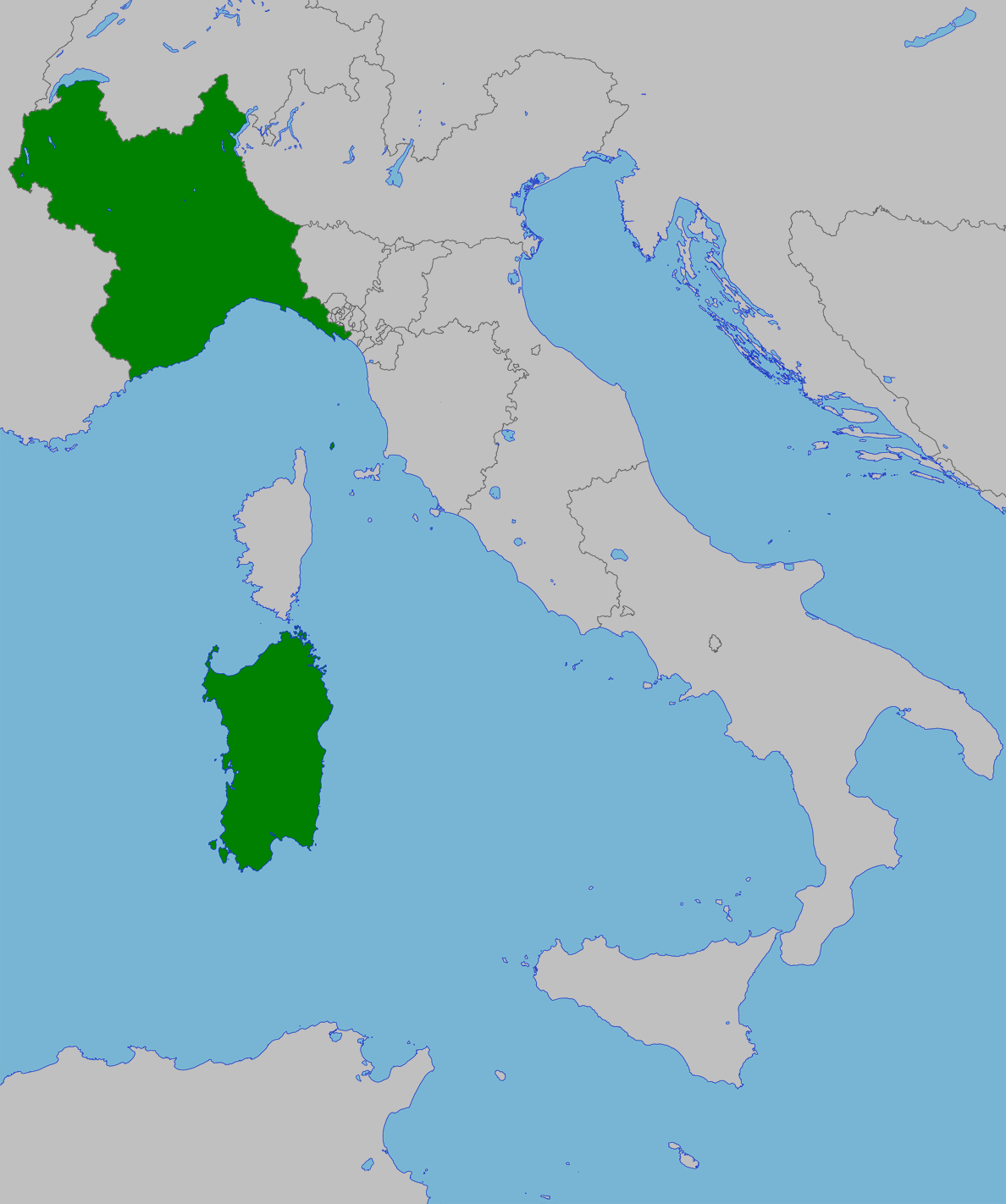
Its mainland possessions also expanded. The House of Savoy returned to Turin in 1814. Under the restoration arrangements of 1814–1815, the territories of the former Republic of Genoa joined the Kingdom of Sardinia.
The distinction between a royal title and a territory matters throughout this story. When the Kingdom of Sardinia later acquired Lombardy and territories in central Italy, these joined the expanding monarchy. They did not become parts of the island of Sardinia.
Why were Turin and Piedmont central to its government?
Emanuele Filiberto moved the capital of the Duchy of Savoy from Chambéry to Turin in 1563. Turin therefore already served as the dynasty’s governing centre when Sardinia was acquired in 1720. Its central role preceded the kingdom’s Sardinian name.
Cagliari had a different function. It was the capital of the island and the seat of the viceroy. The royal court and central power were based in Turin. Keeping these roles separate helps you understand how a kingdom named after an island could be governed from Piedmont.
There was a substantial interruption. During the French occupation of Turin from 1798 to 1814, the Savoy rulers took refuge in Sardinia. Cagliari temporarily became the monarchy’s effective governing centre. Their return to Turin in 1814 restored the mainland seat of government.
Carlo Alberto changed the relationship between island and mainland in 1847. His Fusione perfetta removed their administrative separation and centralised institutions in Turin. Before this reform, the territories shared a sovereign but maintained separate arrangements. Afterwards, the monarchy’s institutions were brought together under the Turin government.
How did the 1848 constitution and Cavour’s policies shape unification?
On 4 March 1848, Carlo Alberto issued the Statuto Albertino. It began constitutional monarchy in the Kingdom of Sardinia. The legislature had two chambers: an elected Chamber of Deputies and a Senate whose members the king appointed for life.
Election did not mean that everyone could vote. Eligibility to vote for the Chamber of Deputies depended on being male and meeting wealth requirements. The constitution created representative institutions while preserving an appointed Senate and a restricted electorate.
Vittorio Emanuele II became King of Sardinia in 1849. With Cavour’s support, the Savoy monarchy moved to the centre of Italian unification. Their cooperation developed within the constitutional framework established the previous year.
In 1852, Cavour and Urbano Rattazzi formed the Connubio alliance. It brought the centre-right and centre-left together around constitutional protection, economic development, and diplomacy for independence. Vittorio Emanuele II appointed Cavour prime minister on 2 November 1852.
Cavour’s economic programme had already begun. After becoming minister of agriculture and commerce in 1850, he advanced free trade through agreements with France, Belgium, and England. His first government pursued the development of credit institutions and major railway investment in 1853.
Administrative reform accompanied these policies. The Cavour law of 23 March 1853 abolished separate economic offices within the central administration. Their responsibilities passed to the relevant ministries. This continued the concentration of government functions after the administrative union of 1847.
Diplomacy extended the kingdom’s influence. Sardinia allied with France and England and entered the Crimean War in 1855. That participation allowed Cavour to bring the Italian question before European diplomacy at the Paris Congress in 1856.
On 21 July 1858, Cavour met Napoléon III at Plombières. He advanced preparations based on French support against Austria. Economic reform, parliamentary cooperation, and international alliances were thus connected parts of the monarchy’s movement towards a larger role in Italy.
How did the Kingdom of Sardinia become the Kingdom of Italy in 1861?
Territorial expansion accelerated in 1859. The Villafranca Armistice of 11 July opened the way for Lombardy, except Mantua, to pass to the Kingdom of Sardinia. Plebiscites on 11–12 March 1860 then brought Tuscany and the duchies of Parma and Modena into the kingdom.
Expansion also involved territorial concessions. Napoléon III accepted Sardinian gains in central Italy and demanded Nice and Savoy. Both were ceded to France in 1860. The monarchy grew in Italy while surrendering these possessions.
Southern Italy entered the same process after Garibaldi’s Expedition of the Thousand. His meeting with Vittorio Emanuele II near Teano on 26 October 1860 became the symbol of the south’s transfer to the king’s authority.
On 18 February 1861, Vittorio Emanuele II opened the enlarged kingdom’s first Italian parliament. It met in a temporary chamber at Palazzo Carignano in Turin. The city that had governed the Savoy monarchy now hosted the parliament of the expanding Italian state.
Sardinian law number 4671, dated 17 March 1861, established that Vittorio Emanuele II and his successors would take the title King of Italy. The transition retained the monarchy and its institutions while giving the sovereign the Italian royal title.
Rome’s later role should be kept separate from that moment. It was captured on 20 September 1870 and became the kingdom’s capital on 1 July 1871. The proclamation of 1861 therefore preceded Rome’s establishment as capital.
Timeline
- 1563: Emanuele Filiberto moves the Savoy capital from Chambéry to Turin.
- 1713: Vittorio Amedeo II acquires Sicily and a royal title.
- 1720: The House of Savoy exchanges Sicily for Sardinia.
- 28 April 1794: An uprising begins in Cagliari against Piedmontese administration.
- 1798–1814: The rulers take refuge in Sardinia during the French occupation of Turin.
- 1814–1815: The dynasty returns to Turin; former Genoese territories join the kingdom.
- 1847: The Fusione perfetta unites island and mainland administrations.
- 4 March 1848: Carlo Alberto issues the Statuto Albertino.
- 1852: Cavour becomes prime minister.
- 1855–1858: Sardinia enters the Crimean War in 1855; Cavour raises the Italian question at Paris in 1856 and meets Napoléon III at Plombières in 1858.
- 1859–1860: Territorial gains enlarge the monarchy; Nice and Savoy pass to France.
- 18 February 1861: The first Italian parliament opens in Turin.
- 17 March 1861: Vittorio Emanuele II takes the title King of Italy.
Details you won’t find in guidebooks
Turin’s authority met resistance in Sardinia. After the government rejected Sardinian demands for participation in public office, an uprising began in Cagliari on 28 April 1794. It led to the expulsion of Viceroy Balbiano and Piedmontese officials from the island.
Cavour’s plans also changed. At Plombières in 1858, he had not yet embraced a single state covering the whole peninsula. He accepted a proposal dividing Italy into three large states. The eventual kingdom of 1861 therefore differed from the arrangement he accepted at that meeting.
Institutional numbering preserved the Sardinian connection. The first parliamentary term of the Kingdom of Italy was numbered VIII rather than I. The proclamation law followed a different pattern: it began as Sardinian law number 4671 and became Italian law number 1 a few days later.
FAQ
Why was the Kingdom of Sardinia governed from Turin?
Turin had been the House of Savoy’s capital since 1563. When the dynasty acquired Sardinia in 1720, its court and central power remained in Turin, while Cagliari served as the island’s capital and the viceroy’s seat.
Did the Kingdom of Sardinia include mainland territories?
Yes. Sardinia, Savoy, Piedmont, and Nice shared a ruler while retaining separate legal and administrative arrangements until 1847. The Sardinian royal title supplied the name used for the wider monarchy.
Was Cagliari ever the monarchy’s governing centre?
Yes. During the French occupation of Turin from 1798 to 1814, the Savoy rulers took refuge in Sardinia. Cagliari temporarily became their effective governing centre.
When did the Kingdom of Sardinia become the Kingdom of Italy?
On 17 March 1861, Sardinian law number 4671 established that Vittorio Emanuele II and his successors would hold the title King of Italy.
Sources
- Musei Reali Torino — La nostra storia museireali.cultura.gov.it
- MuseoTorino — Torino: storia di una città museotorino.it
- Wikipedia — Kingdom of Sardinia (1720–1861)) en.wikipedia.org
- SardegnaCultura — Sa Die de sa Sardigna sardegnacultura.it
- Italian Ministry of Culture, SIAS — Regno di Sardegna, 1814–1861 sias-archivi.cultura.gov.it
- Italian Senate — La storia del Senato senato.it
- Chamber of Deputies Historical Archive — Disegni e proposte di legge archivio.camera.it
- VIVE — Victor Emmanuel II and the Risorgimento process vive.cultura.gov.it
- MuseoTorino — La politica del connubio; Cavour primo ministro museotorino.it
- Treccani — Cavour, Camillo Benso conte di treccani.it
- MuseoTorino — Le grandi riforme dell’apparato pubblico e delle infrastrutture museotorino.it
- Italian Ministry of Culture, SIAS — Historical context, 1859–1860 sias-archivi.cultura.gov.it
- Italian Senate — Historical context of Italian unification senato.it
- Museo Civico Siena — L’incontro di Teano museocivico.comune.siena.it
- MuseoTorino — L’unificazione italiana museotorino.it
- Italian Senate — VIII Legislatura senato.it
- Italian Senate — Disegno di legge n. 198, historical explanation senato.it
Image: Kingdom of Sardinia 1815 (location).png — Bukkia, CC BY-SA 4.0