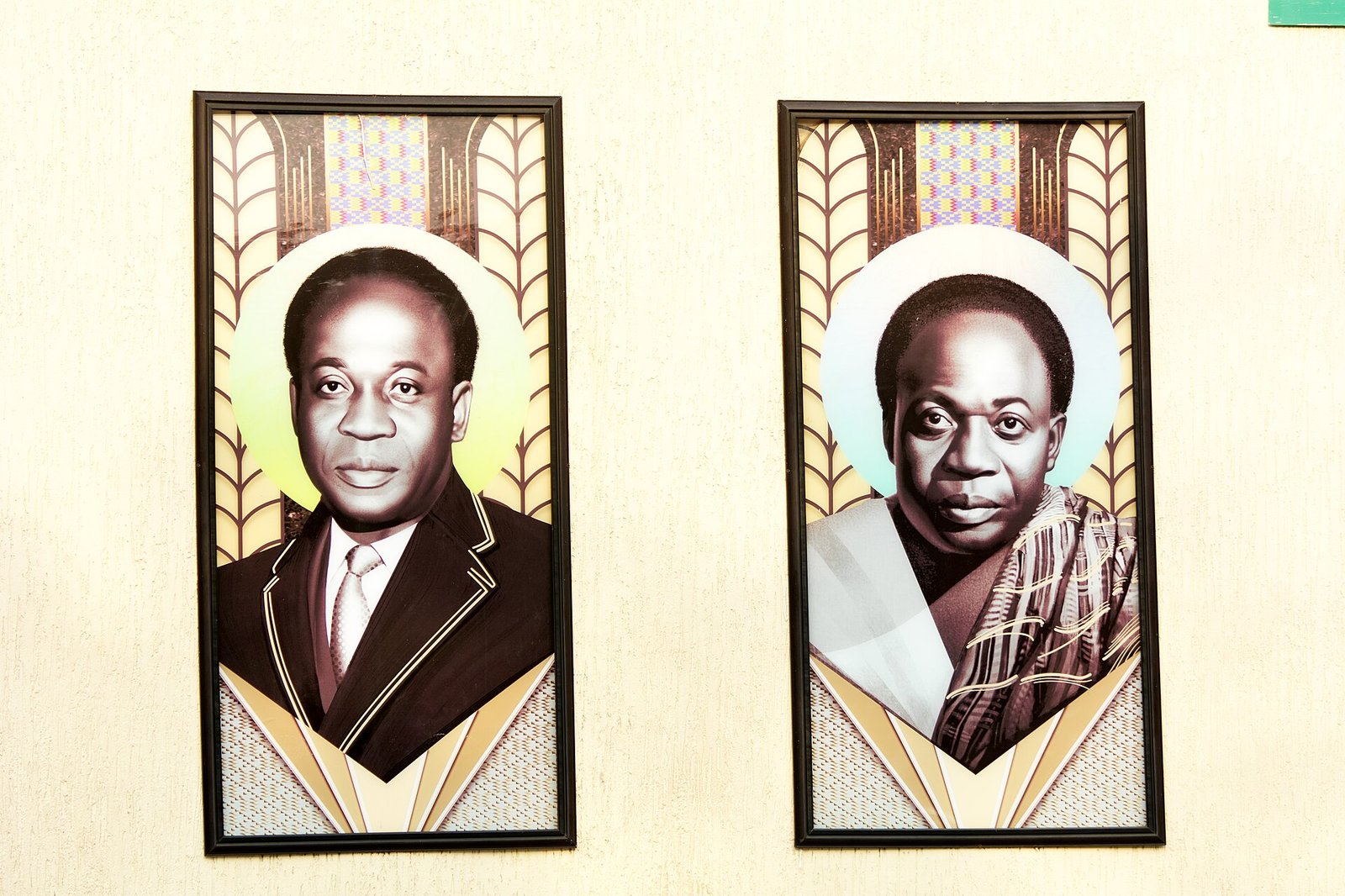
Kwame Nkrumah was Ghana’s independence leader and its first president. He led the struggle that brought independence from Britain on 6 March 1957 and became president on 1 July 1960. Ghanaian military and police officers overthrew him on 24 February 1966, amid economic difficulties and increasingly repressive government.
How did a leader whose party won an election while he was imprisoned later preside over a one-party state? If you follow Nkrumah from the 1951 election to the 1966 coup, you encounter both the achievement of independence and the restrictions imposed after it. His books, the university bearing his name, and his memorial in Accra carry different parts of that story.
Where was Kwame Nkrumah from?
Nkrumah’s accepted birth date is 21 September 1909. He was born in Nkroful, a village in the British-ruled Gold Coast. His birthplace belonged to the territory whose independence he would later lead.
He trained as a teacher before leaving for higher education in the United States in 1935. He later went to Britain. In 1945, he helped organize the Pan-African Congress there, placing African political cooperation within his work before his return home.
In 1947, Nkrumah returned to the Gold Coast. He became general secretary of the United Gold Coast Convention, usually shortened to UGCC. This organization supported independence, but Nkrumah eventually broke with it.
How did Nkrumah lead Ghana toward independence?
In 1949, Nkrumah founded the Convention People’s Party, or CPP. Its strategy of “Positive Action” included protests and strikes against colonial rule. Independence campaigning therefore extended beyond party organization into collective action.
An everyday-life connection helps explain the strategy: a strike brings a political demand into the working day. The CPP made strikes part of Positive Action. In 1950, Nkrumah was imprisoned after supporting a general strike that developed into violence.
Prison did not prevent an electoral victory. Nkrumah remained incarcerated throughout the 1951 election campaign, yet the CPP won 34 of the 38 directly elected seats. He was released after the victory and became prime minister of the Gold Coast in 1952.
The next decisive sequence came in 1956. After the CPP won the July election, the Legislative Assembly requested independence within the Commonwealth on 3 August. The vote was 72 in favor and none against. Opposition members did not participate, a qualification that matters when you read the apparently unanimous result.
The independence legislation received royal assent on 7 February 1957. Under that law, Ghana became an independent, sovereign state within the British Commonwealth on 6 March 1957. Nkrumah became independent Ghana’s first prime minister.
What changed when Nkrumah became president?
On 1 July 1960, Nkrumah became Ghana’s first president. This was a separate milestone from independence in 1957. His career therefore crossed the transition from colonial government to independent government and then to the presidency.
Nkrumah linked Ghana’s freedom to the liberation of Africa as a whole. For him, national independence was incomplete without wider African emancipation. On 25 May 1963, he was among the leaders who signed the founding charter of the Organization of African Unity in Addis Ababa.
His government also pursued major development projects. The Volta River Project was inaugurated on 23 January 1966. Its opening came shortly before the coup that ended his rule, placing a major development milestone close to his political downfall.
Why was Kwame Nkrumah overthrown?
The restrictions associated with Nkrumah’s government began before the presidency. The Preventive Detention Act of 1958 allowed people to be held without charge or trial for up to five years. It became a major instrument of repression under his administration.
In 1964, Ghana became a one-party state, and Nkrumah was made president for life. The leader whose party had advanced through competitive elections now governed within a system that restricted political competition.
Economic difficulties weakened the financial basis of his investment program. A World Bank historical review records nominal government cocoa revenues falling from 67 million new cedis in 1957 to 13 million in 1965. These figures concern public revenue from cocoa, rather than the whole economy, but they show the scale of the decline in that funding source.
On 24 February 1966, Ghanaian army and police personnel carried out a coup while Nkrumah was abroad, traveling toward China. The coup leaders justified their intervention by citing violations of rights and freedoms, corruption, repressive government, and a rapidly worsening economy.
The takeover dismantled the institutions of his government. The CPP and the National Assembly were dissolved, and the constitution was suspended. Nkrumah’s removal therefore involved both the overthrow of a leader and the suspension of the existing constitutional order.
Did the CIA organize Nkrumah’s overthrow?
Claims about direct American involvement remain disputed. Turkish Wikipedia describes the coup as CIA-directed. The published United States diplomatic record presents a different official interpretation, while documenting American awareness of coup planning.
A memorandum dated 27 May 1965 records that the plotters were keeping Washington informed. It also describes Western refusals of economic assistance as helping prepare the conditions. Its author, Komer, nevertheless recorded that he had been told there was no direct American participation.
The official summary of the relevant United States diplomatic volume likewise maintains that the American government knew of the plans but did not otherwise participate. When you assess the coup, advance knowledge, economic pressure, and direct organization are separate claims. The account of American knowledge does not resolve the disputed claim of direct CIA organization.
What happened to Nkrumah after the coup?
After his overthrow, Nkrumah settled in Conakry, the capital of Guinea. He later traveled to Bucharest, Romania’s capital, for medical treatment. He died there on 27 April 1972.
His public commemoration continued after his death. His birthday, 21 September, was observed for a period as Kwame Nkrumah Memorial Day. In 2025, the official holiday designation returned to Founder’s Day.
Kwame Nkrumah books: what did he write?
Nkrumah’s books include Africa Must Unite, published in 1963, and Neo-Colonialism, the Last Stage of Imperialism, published in 1965. Both appeared during his presidency.
The publication dates place his writing alongside major political developments. Africa Must Unite appeared in the year he signed the Organization of African Unity’s founding charter. Neo-Colonialism, the Last Stage of Imperialism appeared the year before his overthrow.
Kwame Nkrumah Memorial Park, museum, and mausoleum
Kwame Nkrumah Memorial Park opened in Accra in 1992. The mausoleum at its center contains the remains of Nkrumah and his wife, Fathia. The park reopened on 4 July 2023 after renovation and modernization.
The site connects his burial with the independence struggle. It occupies a former colonial polo ground where Nkrumah proclaimed independence. If you visit the memorial, the location itself links the commemoration of his life to the announcement of Ghana’s sovereignty.
The park’s displays include his Cadillac and the damaged remains of a bronze statue. The statue’s torso and severed head survive from its destruction after the 1966 coup. These objects connect personal possessions and public commemoration with the violence directed at his image after his removal.
Where is Kwame Nkrumah University of Science and Technology?
Kwame Nkrumah University of Science and Technology, or KNUST, is in Kumasi. The technology college there received that name on 22 August 1961, during Nkrumah’s presidency.
Its later naming history reflects his changing political standing. Nkrumah’s name was removed after the 1966 coup. Legislation restored it in 1998, returning his name to the university decades after his overthrow.
Details you won’t find in guidebooks
Nkrumah married Fathia Rizk, an Egyptian Copt, on 31 December 1957. Their wedding took place on the evening she arrived in Ghana. The marriage followed independence within the same calendar year.
Martin Luther King and Coretta Scott King attended Ghana’s independence ceremony on 6 March 1957 at Nkrumah’s invitation. During a private meal with him, they discussed nonviolent struggle. The encounter connects the independence celebration with a direct conversation about methods of political action.
Timeline
- 21 September 1909: Accepted birth date in Nkroful.
- 1935–1945: Higher education in the United States, followed by participation in organizing the Pan-African Congress in Britain.
- 1947–1949: Returned to the Gold Coast, became UGCC general secretary, and later founded the CPP.
- 1950–1952: Imprisoned after the general strike, released after the CPP’s election victory, and became prime minister.
- 6 March 1957: Ghana became independent.
- 1 July 1960: Became Ghana’s first president.
- 1964: Ghana became a one-party state.
- 24 February 1966: Overthrown by military and police officers.
- 27 April 1972: Died in Bucharest.
- 1992–2023: Accra’s memorial park opened and later reopened after renovation.
FAQ
Where was Kwame Nkrumah from?
Nkrumah came from Nkroful, a village in the British-ruled Gold Coast. His accepted birth date is 21 September 1909.
Who was Kwame Nkrumah’s wife?
His wife was Fathia Rizk, an Egyptian Copt. They married on 31 December 1957, the evening she arrived in Ghana.
Why was Kwame Nkrumah overthrown?
Ghanaian military and police officers overthrew him on 24 February 1966 amid economic difficulties and increasingly repressive rule. The coup leaders cited rights violations, corruption, authoritarian government, and a worsening economy.
Where is Kwame Nkrumah buried?
His remains are in the mausoleum at Kwame Nkrumah Memorial Park in Accra, alongside those of his wife, Fathia.
Sources
- Turkish Wikipedia — Kwame Nkrumah tr.wikipedia.org
- KNUST — Kwame Nkrumah knust.edu.gh
- London School of Economics — Kwame Nkrumah lse.ac.uk
- Stanford University — Nkrumah, Kwame kinginstitute.stanford.edu
- UK Parliament — Ghana Independence Bill hansard.parliament.uk
- UK Parliament — Ghana Membership of Commonwealth api.parliament.uk
- English Wikipedia — Kwame Nkrumah en.wikipedia.org
- The Kwame Nkrumah Trust — Brief Life & Works knt.org.uk
- World Bank — Historical Review of Ghana’s Economy documents1.worldbank.org
- US Department of State, Office of the Historian — CIA Memorandum, 25 February 1966 history.state.gov
- US Department of State — Ghana Background Notes, 1998 2009-2017.state.gov
- US Department of State, Office of the Historian — Komer Memorandum, 27 May 1965 history.state.gov
- US Department of State, Office of the Historian — FRUS Africa Volume Summary history.state.gov
- New York Public Library — Kwame Nkrumah Resource Guide libguides.nypl.org
- English Wikipedia — Kwame Nkrumah Memorial Park en.wikipedia.org
- Ghana News Agency — Refurbished Kwame Nkrumah Memorial Park in Pictures gna.org.gh
- Kwame Nkrumah Memorial Park — Refurbished Park Reopening knmp.gov.gh
- KNUST — University History knust.edu.gh
- Graphic Online — Nkrumah’s Birthday Returns as Founder’s Day graphic.com.gh
Image: Portrait photos of Dr. Kwame Nkrumah.jpg — Kwameghana(Bright Kwame Ayisi), CC BY-SA 4.0