Kocaeli sits on the Gulf of İzmit, and its story runs through Greek colonists, Roman emperors and Ottoman frontier lords. Even the name hides two histories. One explains the province, the other its capital. This guide untangles both and shows you what is still standing.
The Origin of the Name Kocaeli
The name Kocaeli comes from the phrase “Koca-ili”. It points to Akçakoca, an Ottoman frontier lord who made conquests in the region. The phrase means his homeland, or his lands.
The timing matters. Akçakoca died in 1328 near Kandıra. That was before İzmit, the region’s main city, came firmly under Ottoman rule. So the name honors a man who shaped the area, not a man who finished the job.
Today you can find his memorial tomb at Babadağ. The city also remembers him in everyday life: İzmit has a neighborhood called Akçakoca.
There is also a link between old and new administration. The province of Kocaeli continues the Ottoman Kocaeli Sancak. Its center is İzmit.
Why the Capital Is Called İzmit
The province name is Turkish-Ottoman. The city name is much older.
Around the end of the eighth century BC, settlers from Megara founded a Greek colony called Astakos. That is the ancient predecessor of İzmit. The Kocaeli Provincial Directorate of Culture and Tourism records this foundation.
The old settlement was later destroyed. In 264 BC, King Nicomedes I founded a new city on the site and gave it his own name: Nikomedia. Kings of the period often named cities after themselves, and Nicomedes did exactly that.
The modern name follows from this. One account explains İzmit as a linguistic change of Nikomedia, combined with the Greek word of direction “eis”. Greek speakers said they were going “eis Nikomedeian”, toward Nikomedia. Over the centuries that phrase wore down into İzmit.
So the next time you see “İzmit” on a road sign, you are reading a worn-down Greek journey phrase.
Nikomedia: A Roman Capital
Nikomedia was not just a provincial town. In AD 286, under Emperor Diocletian, it became the eastern capital of the Roman Empire. It held that position until 324.
That is 38 years at the center of imperial politics. The city you cross on the highway once hosted the court of an emperor.
The proof is not only in books. After the 1999 earthquake, a Roman imperial building was identified in the Çukurbağ area of İzmit. The Kocaeli Archaeology Museum ran rescue excavations there between 2001 and 2016. A rescue excavation is a dig done quickly because the site is under threat.
The finds include colored reliefs. They also include an opus sectile floor. This is a floor made by cutting marble in different colors and sizes into geometric patterns, not by laying tiny mosaic pieces.
Ottoman Rule From 1337
İzmit passed firmly into Ottoman hands in 1337, during the reign of Orhan Gazi. After that, the region became a corridor. The road from Istanbul toward Damascus and Baghdad ran through it, and the buildings that appeared along it were designed for travelers and armies.
Gebze: Çoban Mustafa Paşa Complex
The mosque inscription of the Çoban Mustafa Paşa Complex in Gebze carries the Hijri date 930, which is 1523–1524. The complex served caravans heading to Anatolia and Iran, pilgrims and armies on campaign. It included a mosque, a madrasa, a library, a caravanserai, a hospital and a soup kitchen.
Who designed it is debated. Documents connected to Sinan attribute the work to him. But the early construction date raised objections to that claim. Another view holds that Sinan finished the building or worked on it as an assistant architect.
İzmit: Pertev Mehmet Paşa Complex
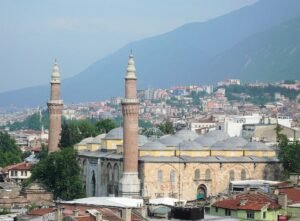
In İzmit, the Pertev Mehmet Paşa Complex, also known as the New Friday Mosque, was built by Mimar Sinan. It stands on the Istanbul–Damascus–Baghdad military and caravan road and was completed in 1579. Only the mosque and the fountain survive in their original form.
A Bathhouse and Wooden Houses
The Süleyman Paşa Bathhouse was built by Süleyman Paşa, son of Orhan Gazi. It is a double bathhouse, with separate sections, and is also called the Dere Bathhouse and the Yukarı Pazar Bathhouse. The 1999 earthquake damaged it. The Kocaeli Metropolitan Municipality restored it in 2012.
For everyday Ottoman life, walk to Kapanca Street in the Akçakoca neighborhood. Its wooden houses reflect nineteenth-century architecture, and 18 of them are registered by a conservation board decision. In the Veliahmet neighborhood, the Saatçi Ali Efendi Mansion shows wooden shutters, barred windows and painted decoration on both inner and outer walls.
Eskihisar: A Byzantine Fortress
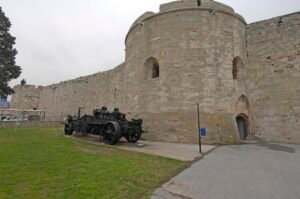
Not everything on the coast is Ottoman. Eskihisar Castle in Gebze is a Byzantine fortress. It was built to defend the harbor and the shoreline of the Gulf of İzmit. It has a rectangular plan, ten towers and four gates.
From Independence to Industry
İzmit was liberated from occupation on 28 June 1921. It became a provincial center in 1924.
The city then turned to industry. The İzmit SEKA Paper Factory opened in 1936. In 2016 the factory was converted into the SEKA Paper Museum, which opened on 6 November 2016.
Timeline
- Late 8th century BC: Settlers from Megara found the colony of Astakos.
- 264 BC Nicomedes I founds Nikomedia.
- AD 286 Nikomedia becomes the eastern capital of Rome under Diocletian.
- 324 Nikomedia’s period as eastern capital ends.
- 1328 Akçakoca Bey dies near Kandıra.
- 1337 İzmit comes firmly under Ottoman rule.
- 1523–1524 The date on the mosque inscription of the Çoban Mustafa Paşa complex.
- 1579 The Pertev Mehmet Paşa Complex is completed.
- 28 June 1921 İzmit is liberated from occupation.
- 1924 İzmit becomes a province.
- 1936 The İzmit SEKA Paper Factory opens.
- 2001–2016 Rescue excavations at Çukurbağ.
- 2007 The Archaeology and Ethnography Museum begins service in the historic station buildings.
- 2012 The Süleyman Paşa Bathhouse is restored.
- 6 November 2016 The SEKA Paper Museum opens.
- 2020 The ethnography section moves to the Atatürk Redif and Ethnography Museum.
- August 2024 The Çukurbağ relief of two emperors embracing is shown for the first time.
Museums You Can Visit
The museum now called the Kocaeli Archaeology Museum began service in 2007. It was created by converting workshops, a hangar, a water tank, lodgings and storage buildings of the historic İzmit railway station. In 2020 its ethnography section moved to the Atatürk Redif and Ethnography Museum. The old Archaeology and Ethnography Museum was then reorganized as the Kocaeli Archaeology Museum.
The SEKA Paper Museum is the other big stop. It reuses the old paper factory, which opened in 1936, and displays former production machines.
Details You Won’t Find in Guidebooks
- Two dates on one mosque. At the Çoban Mustafa Paşa Mosque, the marble inscription reads 1523–1524. The wooden door leaves read 1522–1523.
- The imam with a sword. At the Orhan Mosque in İzmit, the municipality reports a tradition: imams have climbed the pulpit for the Friday sermon with a sword for more than 120 years.
- A floor of cut marble. Çukurbağ yielded an opus sectile floor, built from marbles of different colors and sizes in geometric designs.
- Ten broken pieces. The Çukurbağ relief showing Diocletian and Maximian embracing was restored from 10 broken fragments. It was opened to visitors for the first time in August 2024.
- A museum with 18 halls. The SEKA Paper Museum occupies 12,345 square meters and has 18 halls, including old production machines.
FAQ
Where does the name Kocaeli come from?
It comes from “Koca-ili”, a phrase tied to the Ottoman frontier lord Akçakoca, who made conquests in the region. It means his homeland or lands.
What was İzmit called in ancient times?
The earlier settlement was Astakos, a Greek colony founded by settlers from Megara in the late eighth century BC. In 264 BC King Nicomedes I founded Nikomedia, and the name İzmit is explained as a later transformation of that name.
When did İzmit become Ottoman?
İzmit came under firm Ottoman rule in 1337, in the time of Orhan Gazi. Akçakoca had already died in 1328.
Was Nikomedia ever a Roman capital?
Yes. In AD 286, under Emperor Diocletian, it became the eastern capital of the Roman Empire. It kept that role until 324.
What can you visit in Kocaeli today?
You can see the Kocaeli Archaeology Museum, the SEKA Paper Museum, the Süleyman Paşa Bathhouse, the Pertev Mehmet Paşa Mosque in İzmit, the Çoban Mustafa Paşa Complex in Gebze and the Byzantine fortress of Eskihisar.
Sources
- Kocaeli Metropolitan Municipality, Historical and Cultural Heritage kocaeli.bel.tr
- Wikipedia, Kocaeli Province en.wikipedia.org
- Kocaeli Provincial Directorate of Culture and Tourism, History kocaeli.ktb.gov.tr
- Wikipedia, İzmit en.wikipedia.org
- Turkey Culture Portal, Çoban Mustafa Paşa Complex kulturportali.gov.tr
- TDV Encyclopedia of Islam, Çoban Mustafa Paşa Complex islamansiklopedisi.org.tr
- Turkey Culture Portal, Pertev Mehmet Paşa Mosque kulturportali.gov.tr
- Kocaeli Metropolitan Municipality, Mosques, Complexes, Tombs kocaeli.bel.tr
- Turkey Culture Portal, Süleyman Paşa Bathhouse kulturportali.gov.tr
- Turkey Culture Portal, Saatçi Ali Efendi Mansion kulturportali.gov.tr
- General Directorate of Cultural Heritage and Museums, Kocaeli Museum Directorate kvmgm.ktb.gov.tr
- Journal of Mosaic Research, Gedük and Noei, 2024 dergipark.org.tr
- Anadolu Agency, Roman emperors’ embrace scene aa.com.tr
- Kocaeli Metropolitan Municipality, SEKA Paper Museum kocaeli.bel.tr
- Ministry of National Education, Eskihisar Castle okuldisiogrenme.eba.gov.tr
Image: Gebze square and mosque view, Kocaeli, Turkey.jpg 02.jpg — Gundemce, CC BY-SA 4.0