The Akkadians were Semitic-speaking communities who lived alongside the Sumerians in southern Mesopotamia from at least 2700 BCE. Their ruler Sargon founded the Akkadian Empire around 2334 BCE by defeating Lugalzagesi of Uruk and bringing southern Mesopotamian city-states under his authority.
Yet the capital that gave this empire its name still has no securely identified archaeological location. If you follow Sargon’s rise, his grandson Naram-Sin’s royal claims and the evidence for political collapse, you can trace an empire whose mapped reach was broader than its control in some places.
Who were the Akkadians before Sargon?
Akkadian-speaking communities were already living in southern Mesopotamia centuries before Sargon’s empire. Their presence alongside the Sumerians goes back to at least 2700 BCE. The history of the people therefore begins earlier than the history of the state that carried their name.
Akkadian belongs to the Semitic language family. It is related to Arabic and Hebrew. Its principal historical varieties include Old Akkadian, Babylonian and Assyrian. These language relationships help explain what the term “Akkadian” identifies, without turning it into a modern national label.
Akkadian was being recorded in cuneiform from around 2400 BCE. Around 2000 BCE, it was developing into Babylonian and Assyrian varieties. The language’s history thus extends beyond the empire’s approximate end in 2154 BCE.
Calling the Akkadians directly Kurdish is not supported by the historical distinction between Akkadian identity and modern ethnic nations. Their ancient language and political setting belong to the evidence for their own period. Neither corresponds directly to a modern ethnic nation.
Where was the Akkadian Empire located, and which country is it in now?
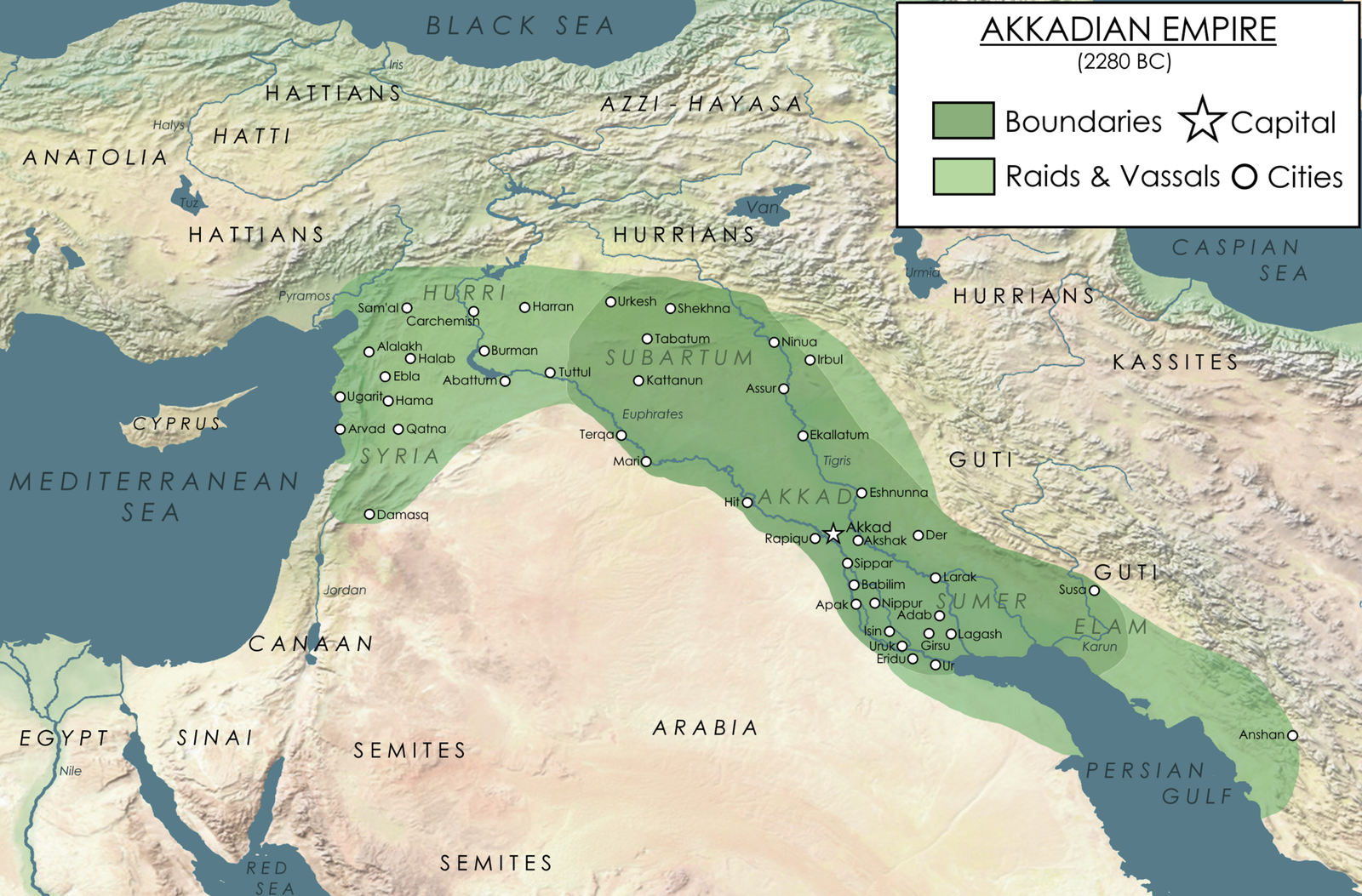
The empire originated around the city of Akkad in what is now Iraq. Its areas of rule and military campaigning overlapped parts of present-day Iraq, Syria, Iran and Turkey. Those modern countries provide reference points for locating its reach.
If you are approaching this history through travel in Turkey, the connection is therefore geographical: parts of modern Turkey fall within the empire’s wider sphere of rule and campaigning. The state’s founding center, however, lay in present-day Iraq.
An Akkadian Empire map needs careful reading. A broad area of color does not mean uninterrupted control across every district. Beyond centers such as Susa, Tell Brak and Gasur, Akkadian authority could be limited in places. Military reach and sustained political control were not always equivalent.
What was the Akkadian Empire’s capital?
The capital was Akkad, also called Agade. Its exact archaeological location has not been securely established. The main proposals place it in central Iraq, roughly within 30 kilometers of modern Baghdad.
That uncertainty matters when you look at a map. A proposed position for Akkad represents a location hypothesis. The city’s role as the imperial capital and the identification of its physical site are separate historical questions.
A text nevertheless offers a glimpse of the capital’s connections. An Old Babylonian copy of an inscription attributed to Sargon reports that ships from Meluhha, Magan and Dilmun docked at Akkad’s quay. The account places arriving vessels within the remembered life of the imperial city.
How did Sargon build the Akkadian Empire?
Sargon’s decisive achievement was his defeat of Lugalzagesi, the ruler of Uruk. He brought the city-states of southern Mesopotamia under his authority. In the Middle Chronology, the empire begins around 2334 BCE.
The distinction between a people and an empire is especially useful here. Akkadian-speaking communities had existed alongside the Sumerians long before this conquest. Sargon’s achievement was the political unification of southern cities under the dynasty centered on Akkad.
After Sargon, his sons Rimush and Manishtushu took the throne. They maintained the dynasty’s rule over Mesopotamia. Their succession carried Akkadian kingship beyond the founder’s reign and into the next generation of his family.
Sargon’s grandson Naram-Sin brought the empire to its greatest strength. He used the title “King of the Four Quarters” and had a divine sign added to his name. These were explicit claims about the extent and status of his kingship.
Under Naram-Sin and Shar-kali-sharri, regional fortresses and administrative centers were established in northern Mesopotamia. Such centers provide a more specific picture of imperial organization than the outer edge of a map alone.
The familiar description of Akkad as the “first empire” remains debated. Whether the label applies depends on the definition of empire and the importance assigned to lasting political integration. Sargon’s consolidation of southern city-states is firmer ground than an unqualified claim of historical priority.
Akkadian Empire timeline
The Middle Chronology places the empire at approximately 2334–2154 BCE, giving it a lifespan of about 180 years. Absolute dates remain uncertain. The Metropolitan Museum of Art uses approximately 2350–2150 BCE for the Akkadian period.
- At least 2700 BCE: Akkadian-speaking communities lived alongside the Sumerians in southern Mesopotamia.
- Around 2400 BCE: Akkadian began to be recorded in cuneiform.
- Around 2334 BCE: The Akkadian Empire began in the Middle Chronology.
- After Sargon: Rimush and then Manishtushu ruled.
- Under Naram-Sin: The empire reached its height.
- Under Naram-Sin and Shar-kali-sharri: Regional fortresses and administrative centers were established in northern Mesopotamia.
- Around 2154 BCE: The Akkadian Empire ended in the Middle Chronology.
What was Akkadian Empire religion?
The dynasty’s patron goddess was Ishtar, the goddess of love and war. The Sumerians knew her as Inanna. These names connect the dynasty’s religious patronage with the Sumerian religious world alongside which Akkadian-speaking communities had lived.
Naram-Sin’s addition of a divine sign to his name brought divine status into the presentation of the ruler himself. His title, “King of the Four Quarters,” expressed expansive kingship. Together, the title and sign show how his authority was formally represented.
A surviving object adds another royal connection to ritual. The Disc of Enheduanna identifies Sargon’s daughter in an inscription on one face. The other face carries a ritual scene, bringing a named member of the dynasty into the material evidence for religious activity.
Details you won’t find in guidebooks
Sargon’s name is a modern rendering of the Akkadian Sharru-ken. It means approximately “the king is legitimate.” The name itself therefore expresses a claim about kingship, alongside the military achievement associated with his rise.
Mesopotamian tradition describes Sargon as the cupbearer of the king of Kish before he became a ruler. This belongs to the tradition about his earlier life. It places service at another king’s court before his own imperial career.
An inscription attributed to Sargon states that 5,400 men ate at his table every day. If you have ever organized a shared meal, that claim gives you an everyday point of comparison. Here, feeding people appears as a statement of royal scale.
The Disc of Enheduanna in the Penn Museum dates to around 2300 BCE and measures 25 centimeters across. Its two faces preserve different kinds of evidence: a ritual image and an inscription identifying Sargon’s daughter. The small object’s dimensions contrast with the extensive political reach associated with her father’s dynasty.
Why did the Akkadian Empire collapse?
After Shar-kali-sharri, southern city rulers regained their independence. The authority of the final kings, Dudu and Shu-Turul, contracted toward Akkad and its surroundings. This sequence supports a picture of political fragmentation over time.
The traditional explanation emphasizes a Gutian invasion. Modern assessments also include internal rebellions and gradual political breakup. The collapse therefore involves a debate about the relative weight of several pressures, rather than agreement on a single cause.
Climate evidence has added another argument. A study published by Cullen and colleagues in 2000 linked roughly 300 years of increased dust in Gulf of Oman sediments with arid conditions contributing to Akkad’s collapse. This offers environmental evidence relevant to the debate.
A 2021 study by Sołtysiak and Fernandes examined 75 individuals from three northern Mesopotamian settlements. It did not support the widespread dietary changes expected from a major drought. The sediment evidence and the human evidence consequently leave the role of drought contested.
FAQ
Who founded the Akkadian Empire?
Sargon founded the Akkadian Empire around 2334 BCE in the Middle Chronology. He defeated Lugalzagesi of Uruk and united southern Mesopotamian city-states under his rule.
Which country was the Akkadian Empire in?
The empire originated in present-day Iraq. Its areas of rule and military campaigning also overlapped parts of modern Syria, Iran and Turkey.
How long did the Akkadian Empire last?
The Middle Chronology dates it to approximately 2334–2154 BCE, a span of about 180 years. Absolute dates remain uncertain.
Does Akkad appear in the Bible?
Genesis 10:10 names Accad among the cities associated with Nimrod’s kingdom in Shinar. This name is considered a possible reference to the historical city of Akkad.
Sources
- Getty — Mesopotamia: Civilization Begins getty.edu
- The Metropolitan Museum of Art — The Akkadian Period metmuseum.org
- Wikipedia — Akkadian Empire en.wikipedia.org
- Vikipedi — Akad İmparatorluğu tr.wikipedia.org
- Wikipedia — Akkad (city)) en.wikipedia.org
- Yale University — Akkadian nelc.yale.edu
- Yale eHRAF Archaeology, Harvey Weiss — Akkadian ehrafarchaeology.yale.edu
- Penn Museum — Disc of Enheduanna, B16665 collections.penn.museum
- Cullen and colleagues — Climate change and the collapse of the Akkadian empire ldeo.columbia.edu
- Sołtysiak and Fernandes — Much ado about nothing doi.org
Image: The Akkadian Empire.png — Ennomus, CC BY-SA 4.0