The Phoenicians were seafaring communities of the ancient eastern Mediterranean. Their homeland lay mainly along the coast of present-day Lebanon. From independent cities such as Tyre, Sidon, Byblos, and Arwad, they developed trading connections across the Mediterranean. Their influence also spread through a script with 22 letters.
If you picture Phoenicia as a single kingdom, start with its cities instead. Tyre, Sidon, Byblos, and Arwad were independent rivals. Their shared language and maritime activity connected them, but the name Phoenicia does not describe one unified state founded at a single moment.
Where was Phoenicia? Locating it on a map
Phoenicia’s core was a coastal strip between Arwad in the north and Mount Carmel in the south. Most of this territory lay in what is now Lebanon. On a map, you should distinguish this eastern Mediterranean homeland from the settlements Phoenicians established farther west.
The distinction matters because Phoenician settlements reached Cyprus, Sicily, Sardinia, Malta, and the Balearic Islands. They also clustered in northwestern Africa and southeastern Iberia. These places belonged to a wider trading world whose coastal homeland remained in the eastern Mediterranean.
For travelers interested in Turkey, the connection includes writing. Phoenician inscriptions from the ninth century BCE are documented in Anatolia and Cyprus. They provide evidence that the script circulated beyond its original coastal setting.
Who were the Phoenicians, and where did they come from?
The Phoenicians spoke a Semitic language and developed within the coastal world of the Levant. One account of their origins proposes migration from the Erythraean Sea or Persian Gulf. Most researchers favor local development, drawing on archaeological and historical continuity in the Levant.
Their most influential period is generally placed between about 1200 BCE and 332 BCE, when Persian rule ended. Yet their cities had earlier histories. Byblos was already a developed center in the third millennium BCE. The other principal Phoenician cities became recognizable urban centers around 1500 BCE.
The date 1200 BCE therefore needs care. Academic usage generally applies the term Phoenician to the period after that date. It does not mark the founding of a single Phoenician state. The older history of Byblos also shows why the cities cannot all be given one starting point.
Tyre, Sidon, Byblos, and Arwad: the coastal cities
Tyre, Sidon, Byblos, and Arwad were the principal independent Phoenician cities. Competition between them was part of their political setting. The narrow coastal strip and limited agricultural resources encouraged cities such as Tyre and Sidon to develop maritime trade.
Tyre stood on the southern coast of present-day Lebanon. It became an important trading center and founded colonies that included Cádiz and Carthage. These connections linked a city in the eastern Mediterranean with settlements much farther west.
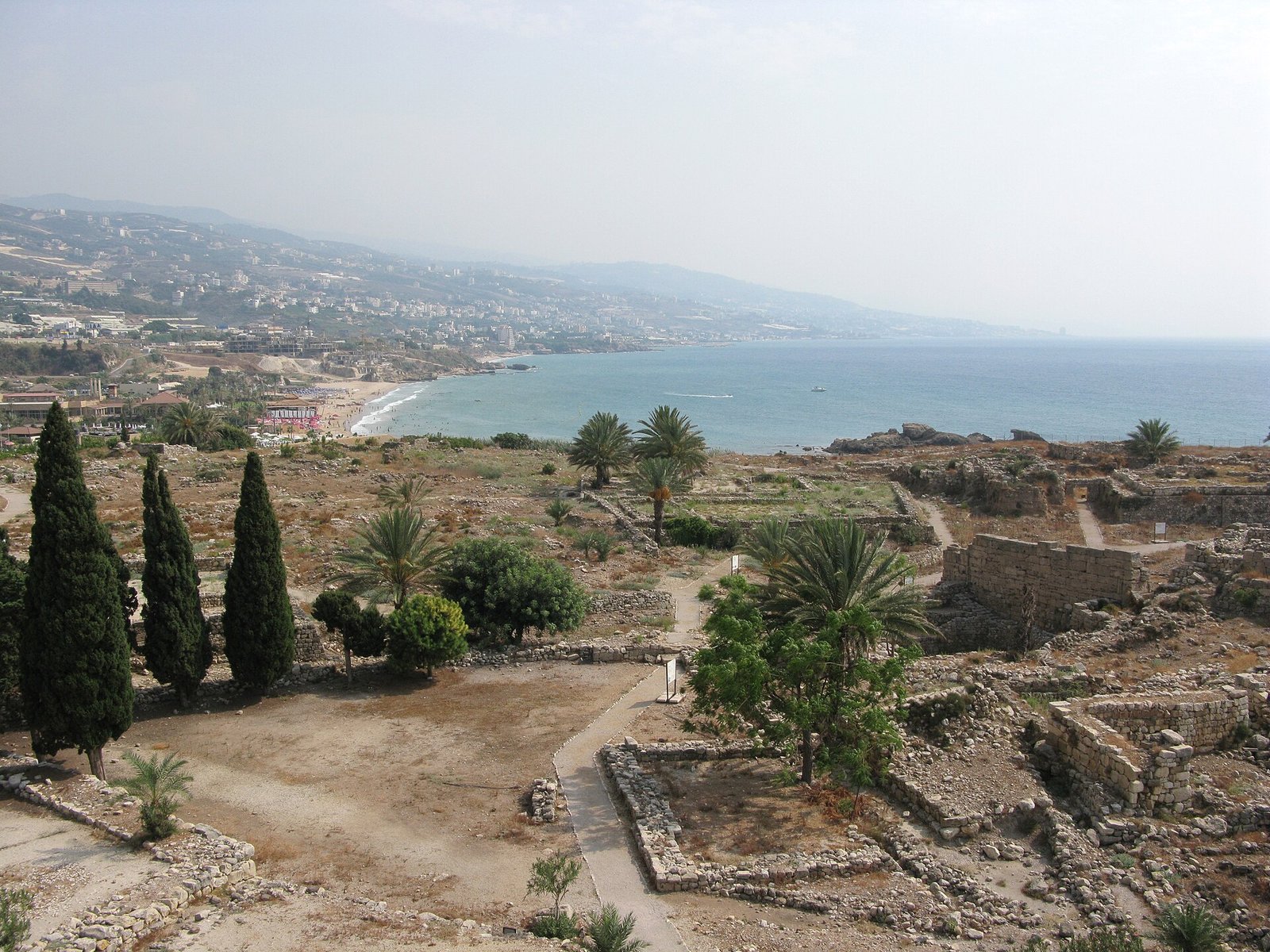
Byblos connects the history of urban life with the history of writing. Besides its early development as a center, it preserves evidence important to the alphabet’s history. The sarcophagus of Ahiram at Byblos bears a significant early Phoenician inscription.
How did Mediterranean trade connect their cities?
Phoenician communities established colonies and trading posts to support commercial activity. By the late eighth century BCE, Phoenician and Greek trading posts extended across the Mediterranean. The Phoenician network included both island settlements and centers on continental coasts.
Lebanese cedar and murex sea snails were among the homeland’s major natural resources. The snails supplied material for purple dye production. Timber and dye therefore belong alongside ships and coastal settlements when you consider the resources behind Phoenician commerce.
An everyday comparison is the distinction between a product’s origin and the place where you buy it. Phoenician commerce likewise asks you to separate the homeland from its wider network. Tyre lay in the eastern Mediterranean, while colonies such as Carthage and Cádiz extended its commercial connections westward.
Carthage, Gadir, and Malta in the Phoenician world
Carthage was founded in the ninth century BCE on the coast of the present-day Gulf of Tunis. It was among the colonies established by Tyre. From the sixth century BCE, Carthage developed into a trading empire spanning a large part of the Mediterranean.
Cádiz offers another kind of evidence for western settlement. At the Gadir archaeological site, excavators uncovered ninth-century BCE streets, houses, and everyday objects. These remains document a lived urban environment as well as the western reach of Phoenician settlement.
Malta was among the islands where Phoenician settlements were concentrated. Its place in this history belongs alongside Cyprus, Sicily, Sardinia, and the Balearic Islands. Together with settlements in northwestern Africa and southeastern Iberia, these locations show the geographical breadth of the network.
How did the Phoenician alphabet work?
The Phoenician alphabet contained 22 letters and was written from right to left. In its basic form, it represented consonants. These features describe the script itself; Phoenician was the language that people recorded with it.
Phoenician belonged to the Canaanite group within Northwest Semitic. It was related to Hebrew and was a distinct language, rather than Turkish or Arabic. Keeping language and script separate helps explain how other communities could adapt Phoenician letters for their own speech.
Scholars distinguish the writing classified as Phoenician, documented from the twelfth century BCE, from earlier Proto-Canaanite and Proto-Sinaitic alphabetic scripts.
Aramaeans, Hebrews, and Greeks adopted Phoenician letters and modified them for their own languages. The alphabet’s influence involved adaptation. Ninth-century BCE inscriptions in Anatolia and Cyprus also document its use outside the homeland.
What is the difference between Phoenician and Punic?
From the sixth century BCE, the changing Phoenician language and script used in Carthaginian-controlled North Africa and western colonies are called Punic. The term identifies a western development within the wider Phoenician linguistic tradition. It also belongs to the period when Carthage became a major trading power.
Rome destroyed Carthage in 146 BCE at the end of the Punic Wars. The language’s documented history continued beyond that destruction. Inscriptions preserve examples of Late Punic, the western continuation of Phoenician, into the second century CE.
Timeline
- Third millennium BCE: Byblos was already a developed center.
- Around 1500 BCE: Other principal Phoenician cities became established urban centers.
- Twelfth century BCE: Alphabetic documents classified as Phoenician began to appear.
- Ninth century BCE: Carthage was founded, and Phoenician settlement at Gadir is archaeologically documented.
- Late eighth century BCE: Phoenician and Greek trading posts extended across the Mediterranean.
- Sixth century BCE: Carthage developed a large trading empire, while Punic language and writing became distinct in the west.
- 332 BCE: The end of Persian rule marks the close of the period generally identified as Phoenicia’s most influential.
- Around 250 BCE: Kerkuane was abandoned, probably during the First Punic War.
- 146 BCE: Rome destroyed Carthage.
- Second century CE: Inscriptions still document the use of Late Punic.
Details you won’t find in guidebooks
Ancient Tyre’s island center lay approximately 500–700 meters offshore. That distance gives a concrete sense of its coastal geography. The city that founded Carthage and Cádiz had an urban center physically separated from the mainland.
At Gadir, eight houses survive across two terraces, arranged around two paved streets. Fossilized cattle hoofprints remain visible in the clay surfaces of its Phoenician streets. Alongside houses and household objects, those marks preserve a small trace of everyday movement.
Kerkuane in Tunisia preserves a Phoenician-Punic town plan because it was abandoned around 250 BCE and was not rebuilt by the Romans. Its abandonment probably occurred during the First Punic War. The absence of Roman rebuilding is central to the survival of that urban layout.
A 2025 ancient DNA study published in Nature examined 210 individuals. In the sampled western Mediterranean Punic communities, it found ancestry components predominantly resembling those of Sicily and the Aegean. Shared Punic culture therefore did not imply one uniform biological origin. The finding concerns the communities studied in the western Mediterranean.
FAQ
Where was Phoenicia located?
Phoenicia’s core occupied the eastern Mediterranean coast between Arwad in the north and Mount Carmel in the south, mainly in present-day Lebanon.
What language did the Phoenicians speak?
They spoke Phoenician, a distinct language in the Canaanite group of Northwest Semitic languages. It was related to Hebrew.
How many letters did the Phoenician alphabet have?
The Phoenician alphabet had 22 letters. Its basic form represented consonants and was written from right to left.
Were Carthage and Malta part of the Phoenician world?
Carthage was a colony founded by Tyre that later developed a large trading empire. Malta was among the Mediterranean islands where Phoenician settlements were concentrated.
Sources
- Wikipedia — Phoenicia en.wikipedia.org
- Metropolitan Museum of Art — The Phoenicians metmuseum.org
- Scuola Normale Superiore, Mnamon — Phoenician: Language mnamon.sns.it
- Scuola Normale Superiore, Mnamon — Phoenician: Script mnamon.sns.it
- UNESCO — Tyre whc.unesco.org
- UNESCO — Archaeological Site of Carthage whc.unesco.org
- Cádiz City Council — Yacimiento Arqueológico Gadir turismo.cadiz.es
- UNESCO — Byblos whc.unesco.org
- Cambridge University Press — Phoenician and Punic cambridge.org
- Wikipedia — Tyre, Lebanon en.wikipedia.org
- UNESCO — Punic Town of Kerkuane and its Necropolis whc.unesco.org
- Ringbauer and colleagues, Nature — Punic people were genetically diverse with almost no Levantine ancestors pmc.ncbi.nlm.nih.gov
Image: Byblos ancient ruins, Phoenician city of Byblos, Lebanon.jpg — Vyacheslav Argenberg, CC BY 4.0