Who was Bayezid the Thunderbolt?
Bayezid I was the fourth Ottoman sultan. He ruled from 1389 to 1402 and became known as Yıldırım Bayezid, or Bayezid the Thunderbolt. His reign included conquests in Anatolia, pressure on Istanbul, and victory over a crusading army at Nicopolis.
His career also ended in a military disaster. Timur defeated and captured him at Ankara in 1402. Bayezid died in captivity the following year. If you follow his reign from Nicopolis to Ankara, you encounter both a major Ottoman victory and the defeat that broke his rule.
What was Bayezid I’s date of birth, and whose son was he?
Bayezid was the son of Sultan Murad I and Gülçiçek Hatun. His birth year is disputed. Approximately 1354 and 1360 both appear in accounts of his life. Neither should be presented as an established exact date.
His famous nickname predates his accession. According to Halil İnalcık, Bayezid earned the name Yıldırım through his courage and bold action at the Battle of Frenk Yazısı in 1386. The name therefore belonged to his military reputation before he became sultan.
Bayezid took the throne after his father died following the First Battle of Kosovo in 1389. During his accession, he ordered the killing of his brother Yakub Çelebi. His reign began with both succession to his father and the elimination of a close family rival.
Who were Bayezid I’s wives and children?
Around 1381, Bayezid married Sultan Hatun, the daughter of Germiyanoğlu Süleyman Şah. Territories transferred to the Ottomans as her dowry became his administrative responsibility. He served as sancakbeyi, a provincial governor, of those territories.
If you think of marriage as an everyday family decision, this marriage shows its political dimensions in Bayezid’s life. The wedding involved property, territory, and public office. His connection to Germiyan was therefore part of his career before he inherited the Ottoman throne.
Bayezid also married Olivera Despina of the Serbian ruling family. He formed a military partnership with her brother, Stefan Lazareviç. This family connection accompanied an alliance whose forces would support him at Nicopolis.
His sons included Süleyman, İsa, Musa, Mustafa, and Mehmed Çelebi. Mehmed later became Sultan Mehmed I. These names matter beyond a family list: the struggle among Bayezid’s sons shaped the period after his defeat at Ankara.
Bayezid I’s map: where did he expand Ottoman rule?
To follow Bayezid’s reign on a map, begin with his campaign in Anatolia during the winter of 1389–1390. Alaşehir and the regions of Aydın, Saruhan, Menteşe, Hamîd, and Germiyan came under Ottoman administration. This expansion followed closely after his accession.
Istanbul became another focus. Bayezid placed the city under a tight siege in spring 1394. He later commissioned Anadoluhisarı in 1396–1397 to strengthen the pressure on Istanbul. The fortress belongs within the history of that sustained effort against the city.
Konya entered Ottoman control after Bayezid defeated Karamanoğlu Alâeddin Bey in autumn 1397. Other Karaman territories also passed under Ottoman rule. Alongside the earlier acquisitions, this campaign extended the Anatolian territory governed during his reign.
The Balkan part of the map leads to Nicopolis, called Niğbolu in Turkish, in present-day Bulgaria. Bayezid’s victory there strengthened Ottoman control along the Danube. You can connect these places through three strands of his reign: Anatolian expansion, pressure on Istanbul, and warfare in the Balkans.
What happened at the Battle of Nicopolis?
The Battle of Nicopolis ended in an Ottoman victory on 25 September 1396. It took place before Nicopolis Castle. King Sigismund of Hungary played a decisive role in organizing the crusading campaign, whose central aim was to stop Ottoman expansion in the Balkans.
The crusaders began besieging Nicopolis on 10 September. The Ottoman garrison resisted. As a result, the siege became a blockade. The battle later that month therefore followed an unsuccessful effort to overcome the castle’s defenders.
French forces launched the first attack in the battle. The Ottoman defensive line included sharpened stakes, which slowed the advance of the heavily armed cavalry. This obstacle is a concrete part of the fighting, rather than a general explanation based only on Bayezid’s reputation.
According to crusading sources, Stefan Lazareviç’s Serbian troops fought beside Bayezid. They helped repel Sigismund’s attack. Their participation connects the battle to the military cooperation Bayezid had established with the brother of his wife Olivera Despina.
Surviving noble captives included Jean de Nevers and Marshal Boucicaut. They returned to their countries after ransoms were paid. Captivity and ransom thus formed part of the battle’s aftermath, alongside the Ottoman military victory.
Nicopolis strengthened Ottoman control along the Danube and increased Bayezid’s standing in the Islamic world. Its importance reached beyond the battlefield. Yet the victory came during a reign that still included further campaigns in Anatolia and continuing pressure on Istanbul.
Bayezid I vs Timur: why did they fight?
The conflict between Bayezid and Timur involved rulers seeking protection from their opponents. Anatolian beys took refuge with Timur. Timur’s rivals Ahmed Celâyir and Kara Yûsuf sought refuge with Bayezid. These opposing relationships helped bring the two rulers into conflict.
Their armies met on the Çubuk Plain at Ankara. The TDV İslâm Ansiklopedisi dates the battle to 28 July 1402. Bayezid was defeated and captured. His Ottoman reign ended in 1402, although his death came in 1403.
The familiar story of Bayezid’s humiliation in an iron cage requires caution. It became widespread in later accounts. Early sources such as Schiltberger and Clavijo do not mention a cage. The documented capture should therefore be distinguished from this disputed account of his treatment.
When did Bayezid I die, and what caused his death?
Bayezid died in Akşehir on 8 March 1403 while still in Timur’s captivity. His place and date of death can be stated more firmly than its cause. Accounts of how he died differ.
Âşıkpaşazâde records a claim of suicide. Timurid historians describe death from illness. These conflicting accounts do not support presenting either explanation as certain. If you encounter an unqualified claim about Bayezid’s cause of death, the disagreement between these traditions matters.
The allegation that Timur had Bayezid poisoned is also unproven. Other records describe Timur entrusting the captive ruler’s care to his own physicians. Bayezid’s death in captivity is established; a deliberate killing is not.
Who succeeded Bayezid I?
Bayezid’s defeat was followed by the Ottoman interregnum, known as the Fetret Devri, from 1402 to 1413. His sons struggled for the throne during this period. The succession therefore involved years of conflict before unity was restored.
His son Mehmed Çelebi ultimately restored unity to the Ottoman throne in 1413 as Mehmed I. For a succession list, Mehmed is the essential answer. The interregnum explains why that answer needs more context than a direct transfer of power from father to son.
Timeline
- Around 1354 or 1360: Alternative approximate dates given for Bayezid’s birth.
- Around 1381: Marriage to Sultan Hatun and appointment as governor of the territories transferred as her dowry.
- 1386: According to İnalcık, his conduct at Frenk Yazısı earned him the nickname Yıldırım.
- 1389: Accession after Murad I’s death following the First Battle of Kosovo.
- 1389–1390: Campaign bringing several western Anatolian regions under Ottoman administration.
- 1394: Tight siege of Istanbul began in spring.
- 25 September 1396: Ottoman victory at Nicopolis.
- 1396–1397: Construction of Anadoluhisarı.
- 1397: Konya and other Karaman territories entered Ottoman control.
- May 1400: Endowment deed recorded the buildings of Bursa’s Yıldırım Complex.
- 28 July 1402: Defeat and capture by Timur at Ankara, according to TDV’s dating.
- 8 March 1403: Death in captivity at Akşehir.
- June 1406: Construction of his tomb in Bursa by his son Emir Süleyman Çelebi.
- 1413: Mehmed I restored unity to the Ottoman throne.
Details you won’t find in guidebooks
Bayezid’s tomb in Bursa contains evidence about the years after his death. Its inscription records that his son Emir Süleyman Çelebi commissioned it in June 1406. It also names Ali, son of Hüseyin, as its builder.
The Ministry of Culture and Tourism’s Kültür Portalı describes the building as the first Ottoman tomb with a portico. For you as a visitor, the entrance porch is therefore a specific architectural detail connected to the tomb’s place in Ottoman architecture.
The Yıldırım Complex also has an endowment deed dated May 1400. It records the buildings but does not specify their construction dates. The date of this document should therefore not automatically become the construction date of every building it records.
FAQ
When was Bayezid I born?
His birth year is disputed. Dates given include approximately 1354 and 1360, so an exact birth date should not be treated as established.
Who were Bayezid I’s wives?
Bayezid married Sultan Hatun, daughter of Germiyanoğlu Süleyman Şah, around 1381. He also married Olivera Despina of the Serbian ruling family.
How did Bayezid I die?
He died in Akşehir on 8 March 1403 while held captive by Timur. Accounts differ between illness and suicide, and his precise cause of death remains uncertain.
Which son succeeded Bayezid I?
His son Mehmed I restored unity to the Ottoman throne in 1413, following the interregnum of 1402–1413.
Sources
- Halil İnalcık, TDV İslâm Ansiklopedisi — BAYEZİD I islamansiklopedisi.org.tr
- Feridun Emecen, TDV İslâm Ansiklopedisi — NİĞBOLU SAVAŞI islamansiklopedisi.org.tr
- Yusuf Halaçoğlu, TDV İslâm Ansiklopedisi — ANKARA SAVAŞI islamansiklopedisi.org.tr
- Yekta Demiralp, Museum With No Frontiers — Yıldırım Complex islamicart.museumwnf.org
- T.C. Kültür ve Turizm Bakanlığı, Kültür Portalı — Yıldırım Bayezid Türbesi kulturportali.gov.tr
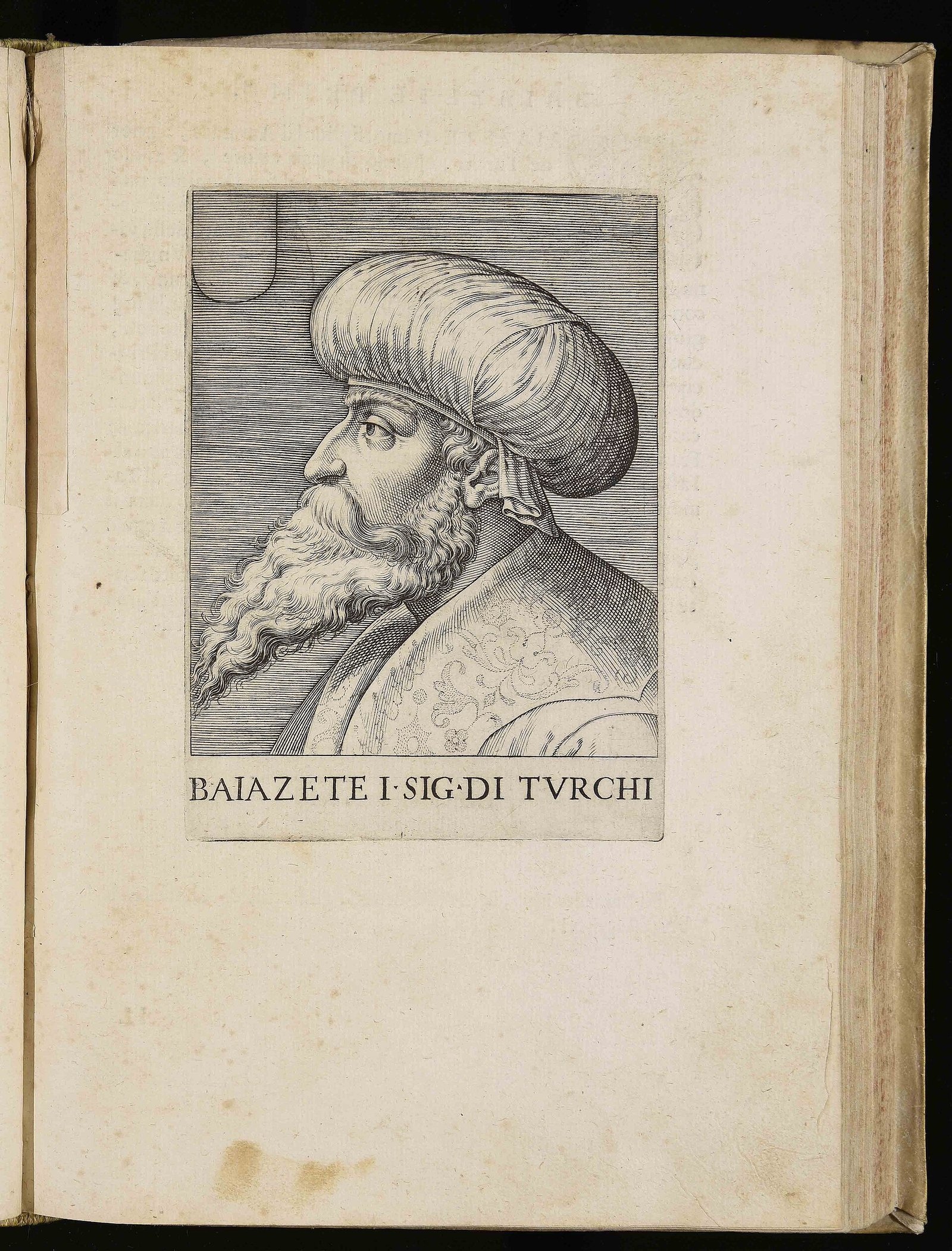
Image: Bayezid I, sultano.jpg — Aliprando Caprioli, CC0