Seven Years’ War summary: why was it fought?
The Seven Years’ War was fought because two major rivalries became connected. Britain and France competed for colonial territory and influence. Austria and Prussia struggled for power in Central Europe, especially over Silesia. Generally dated 1756–1763, the war involved fighting in Europe, the Americas, Africa, and Asia.
If you begin with those two disputes, the conflict becomes easier to follow. Britain and France confronted each other overseas. Austria wanted to recover Silesia from Prussia. Alliances brought these struggles together, linking territorial claims in the Ohio valley with armies fighting in Central Europe.
The opening dates matter. Fighting in North America began in 1754, before the wider European war of 1756. The conflict therefore cannot be explained as a European war that simply spread to America. Its North American struggle was already underway when the European powers entered their larger confrontation.
Seven Years’ War definition: what connected the conflicts?
The Seven Years’ War was a global conflict involving several connected fronts. Its principal alliances formed around Britain, Prussia, and Hanover on one side. France, Austria, Russia, Sweden, and Saxony stood on the other. Spain joined France in 1762, while Portugal entered on Britain’s side.
These alliances connected powers with different immediate aims. Britain’s rivalry with France concerned colonial competition. Austria’s central objective included regaining Silesia. You can follow the same war across continents without assuming that every participant fought for the same territory or expected the same reward.
Why did Britain and France fight in North America?
The upper Ohio River valley was one immediate source of conflict. The boundary between French and British territory there was unclear. French claims overlapped with British colonial attempts to expand westward. Control of this disputed area became a concrete expression of their broader colonial rivalry.
France built forts in the Ohio valley to strengthen its territorial claims. Those positions conflicted with the westward ambitions of Britain’s colonies. The dispute involved both the location of a boundary and the ability to establish control on the ground. Fortifications made competing claims harder to leave unresolved.
On 28 May 1754, forces commanded by George Washington attacked a French party at Jumonville Glen. This was among the opening clashes of the conflict that developed into global war. Both the French and British sides fought with Indigenous allies in North America.
Why did Austria and Prussia fight over Silesia?
Austria wanted to recover Silesia, which it had lost to Prussia. This territorial objective lay within a broader struggle for supremacy in Central Europe. The European conflict therefore had its own causes, alongside the colonial competition between Britain and France.
The diplomatic arrangements of 1756 linked these rivalries. Britain and Prussia signed the Convention of Westminster on 16 January. France and Austria followed with the Treaty of Versailles on 1 May. Their rapprochement formed part of the Diplomatic Revolution, which changed traditional alliances.
Britain formally declared war on France on 17 May 1756. On 29 August, Prussia’s King Frederick II entered Saxony with his army, opening the European land war. These events explain why 1756 marks the conventional beginning of the Seven Years’ War despite the earlier North American fighting.
Seven Years’ War map: where did it take place?
To understand a Seven Years’ War map, you need to look beyond Europe. By 1759, fighting was taking place in Africa, Asia, Europe, North America, and the Caribbean. A map limited to Austria and Prussia captures only part of the conflict.
In Central Europe, Silesia and Saxony help explain the territorial struggle. In North America, the upper Ohio valley marks an early disputed region. Louisbourg, Québec, and Montréal show the later course of Britain’s campaign against French power in Canada. In India, Plassey marks another major battlefield.
On 23 June 1757, Robert Clive’s East India Company forces won the Battle of Plassey. They defeated the Nawab of Bengal, Siraj ud-Daulah, and his French allies. The battle places India within the conflict’s wider geography and shows why a purely European account is incomplete.
Seven Years’ War in Canada: why did Québec matter?
Britain captured Louisbourg Fortress in 1758. That success made an advance toward Québec along the Saint Lawrence River easier. Québec was a strategic target because it controlled the passage of supplies and reinforcements sent from France to Canada through the river.
The everyday connection is a delivery route. Controlling Québec meant controlling a passage used to move supplies and reinforcements. If you picture goods depending on a particular route to reach their destination, you can understand why the Saint Lawrence mattered alongside the battlefield itself.
Britain won the Battle of the Plains of Abraham on 13 September 1759. Québec surrendered five days later. Montréal then surrendered to Britain in September 1760, a major development in ending French resistance in Canada. These events preceded France’s formal cession of Canada in the peace settlement.
Seven Years’ War vs. French and Indian War
The French and Indian War is the name for the North American conflict of 1754–1763. It is treated as part of the wider Seven Years’ War of 1756–1763. The names overlap, but their geographical scope and starting dates differ.
The name French and Indian War should not suggest that Indigenous peoples fought on only one side. Both France and Britain had Indigenous allies. Keeping that fact in view gives you a more accurate understanding of the North American fighting than the name alone provides.
Timeline
- 28 May 1754: Forces commanded by George Washington attacked a French party at Jumonville Glen, among the opening clashes of the conflict.
- 16 January 1756: Britain and Prussia signed the Convention of Westminster.
- 1 May 1756: France and Austria signed the Treaty of Versailles.
- 17 May 1756: Britain declared war on France.
- 29 August 1756: Frederick II entered Saxony.
- 23 June 1757: East India Company forces won at Plassey.
- 1758: Britain captured Louisbourg Fortress.
- 13 September 1759: Britain won the Battle of the Plains of Abraham.
- September 1760: Montréal surrendered to Britain.
- 1762: Spain and Portugal entered on opposing sides.
- 10 February 1763: The Treaty of Paris was signed.
- 15 February 1763: The Treaty of Hubertusburg was signed.
Details you won’t find in guidebooks
The fighting at Québec involved sharply different measures of time. A siege lasting roughly three months preceded the Battle of the Plains of Abraham. According to the Canadian War Museum’s account, the field battle on 13 September 1759 lasted about thirty minutes.
Both opposing commanders suffered fatal wounds at Québec. The British commander was James Wolfe. The French commander was Louis-Joseph de Montcalm. Britain’s victory therefore came with the loss of its commander as well as the fatal wounding of his opponent.
Seven Years’ War uniforms also resist simple assumptions about national colours. In 1757, French regular infantry generally wore white. Swiss and Irish regiments serving France could be distinguished by red coats. A red uniform alone therefore does not establish that a soldier served Britain.
The French Béarn Regiment offers an even smaller detail. Its vertical pocket flaps served as identifying features. The actual pocket openings were in the coat’s side folds. What appeared to be a practical opening on the uniform could instead help identify the regiment.
French negotiator Choiseul preferred retaining Martinique, Guadeloupe, and Saint Lucia to keeping Canada’s extensive territory. Their profitable sugar production shaped that preference. The settlement shows why the size of a territory alone cannot explain the choices made during peace negotiations.
How did the Seven Years’ War end?
France’s King Louis XV formally called for peace negotiations in March 1762. Britain, France, and Spain signed the Treaty of Paris on 10 February 1763. France ceded Canada to Britain. Spain transferred Florida to Britain in exchange for the return of Havana.
A separate agreement settled the Central European struggle. Austria, Prussia, and Saxony signed the Treaty of Hubertusburg on 15 February 1763. It confirmed that Silesia would remain Prussian. Austria’s attempt to recover the territory had failed.
Victory also left Britain facing disputes with its colonies. Arguments concerned payment of war expenses and the management of North American frontiers. Those disagreements fed the discontent that led toward the American Revolution. The settlement of the colonial war thus helped create further colonial tensions.
FAQ
Why was the Seven Years’ War fought?
Its main causes were colonial rivalry between Britain and France and the struggle between Austria and Prussia for power in Central Europe. Austria wanted to recover Silesia from Prussia, while British and French territorial claims clashed in North America.
What were the Seven Years’ War dates?
The wider war is generally dated 1756–1763. Its North American fighting began in 1754. The Treaty of Paris was signed on 10 February 1763, followed by the Treaty of Hubertusburg on 15 February.
Was the French and Indian War the same as the Seven Years’ War?
The French and Indian War names the North American conflict of 1754–1763. It formed part of the wider Seven Years’ War, which also included fighting in Europe, Africa, Asia, and the Caribbean.
What happened to Canada after the Seven Years’ War?
France ceded Canada to Britain in the 1763 peace settlement. British victories at Louisbourg and Québec, followed by Montréal’s surrender in September 1760, had weakened and then ended French resistance in Canada.
Sources
- Vikipedi — Yedi Yıl Savaşı tr.wikipedia.org
- Canadian War Museum — The Seven Years’ War warmuseum.ca
- U.S. Department of State, Office of the Historian — French and Indian War/Seven Years’ War, 1754–63 history.state.gov
- Wikipedia — Seven Years’ War en.wikipedia.org
- National Army Museum — Seven Years War nam.ac.uk
- Canadian War Museum — The Battle of the Plains of Abraham, 1759 warmuseum.ca
- National Army Museum — Battle of Plassey nam.ac.uk
- Yale Law School, Avalon Project — Treaty of Paris 1763 avalon.law.yale.edu
- U.S. Department of State, Office of the Historian — Treaty of Paris, 1763 history.state.gov
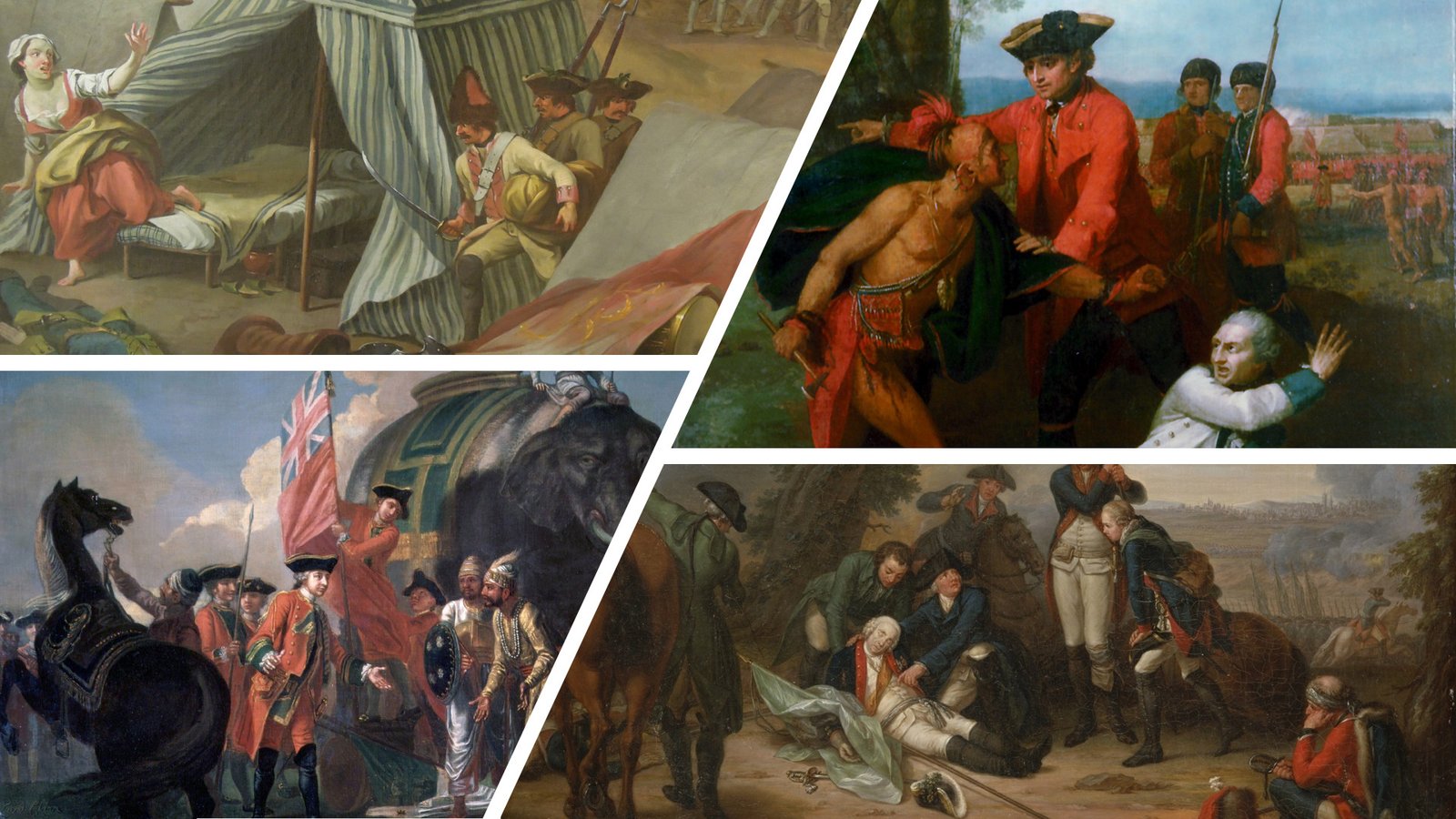
Image: Seven Years’ War Collage 2.0.jpg — CAvB, CC BY-SA 4.0