Why is Tallinn Old Town famous?
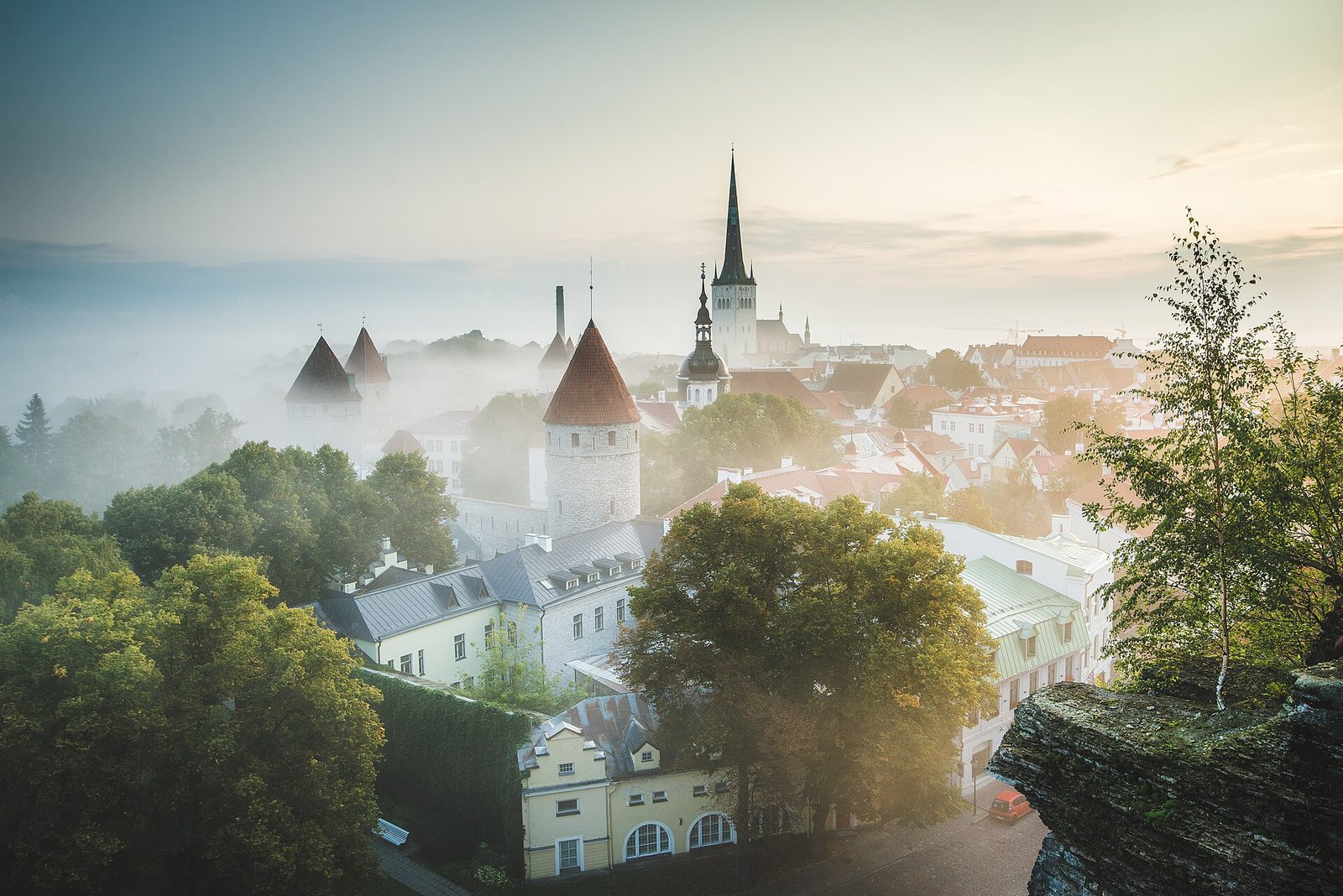
Tallinn Old Town is famous because it preserves a medieval trading town as a connected whole. UNESCO identifies it as a Northern European settlement that retains the character of a Hanseatic town from the 13th–16th centuries with exceptional completeness. Streets, property boundaries, merchant houses and public buildings remain part of the same historical setting.
The surviving defences make that history easy to see. About 1.85 kilometres of wall and 26 defensive towers remain. Town Hall Square adds another part of the story: a market and meeting place beside the building where the city council worked. You can read Tallinn’s history through these relationships between trade, defence and government.
Tallinn, Estonia: where is it?
Tallinn is Estonia’s capital, on the Gulf of Finland along the Baltic Sea in the country’s north. Historical sources also call it Reval. In 1285, the city joined the Hanseatic League, placing its medieval development within the history of Hanseatic commerce.
The historic settlement had two distinct centres. Toompea stood on a limestone hill, with its castle and cathedral forming an administrative centre. Below it, the lower town developed around merchant houses, guilds and the market. This division helps explain why Tallinn’s history needs both the hill and the commercial streets below.
The lower town’s property layout took shape in the 13th and 14th centuries. It survives almost entirely. When you look along these streets, the historical evidence includes the boundaries between plots as well as the buildings occupying them. The town’s medieval organisation extends beyond its most prominent monuments.
Who built Tallinn’s medieval walls?
In 1265, the Danish queen Margaret Sambiria ordered Tallinn’s first town wall. Known as the Margaret Wall, this early defence stood less than five metres high. Its base was about 1.5 metres thick. Those measurements describe the first wall, rather than every surviving section of the later defensive system.
The walls expanded during the 14th century. Residents were required to undertake guard duty wearing their armour. Defence therefore involved the town’s inhabitants as well as its masonry. The wall was a structure that people had to watch and serve.
Today, the surviving system includes about 1.85 kilometres of wall, 26 defensive towers, two intermediate gates and parts of two outer gates. Some preserved wall sections rise above 15 metres. These remains show the scale reached by a system that began with the lower Margaret Wall.
The contrast between the first wall and the surviving higher sections matters. Tallinn’s defences developed over time. The order of 1265 marks a beginning, while the 14th-century expansion and later artillery tower reveal further stages in the town’s military history.
How did Kiek in de Kök respond to firearms?
The first form of Kiek in de Kök was built between 1475 and 1483. This artillery tower answered the growing use of firearms in sieges. Its construction adds a later military chapter to the story of walls first ordered more than two centuries earlier.
The tower’s defensive arrangement included 27 openings for cannon and 30 for handheld firearms. Those figures show how its design accommodated different weapons. Kiek in de Kök was a working defensive building, with firing positions built into its structure.
Its military history also includes the siege of January–March 1577. Forces of Ivan IV fired on the tower during that siege. Stone cannonballs on its southern face preserve a direct connection with the attack, although their present positions resulted from later repairs.
What was Tallinn’s Town Hall Square used for?
Raekoja plats, or Town Hall Square, originally served as a market and meeting place. Its history brings buying, gathering and civic government into the same setting. The adjacent Town Hall gives the square an administrative dimension alongside its commercial role.
The legal basis for the council’s work came from the Lübeck town law charter granted by the Danish king Erik IV in 1248. Council members were chosen from Hanseatic merchants. Trade and municipal authority were therefore closely connected through the people who governed the town.
Tallinn’s Town Hall first appears in a property record from 1322. That reference mentions a meeting hall and a large municipal storehouse. Both functions matter: the building’s recorded history includes space for civic meetings and storage.
Reconstruction in 1402–1404 gave it its two-storey medieval appearance, with ceremonial halls, service rooms and offices. These spaces show that the building supported several kinds of municipal work.
Tallinn Town Hall is the only surviving Gothic town hall in Northern Europe. Its importance rests partly on that survival and partly on its place beside the former market. You can connect the building’s ceremonial rooms and offices with the square where people gathered and traded.
What does the Town Hall Pharmacy tell you about everyday life?
Raeapteek, the pharmacy on Town Hall Square, has its earliest known dated record on 8 April 1422. That date provides a firm documentary point in the square’s history. It establishes that the pharmacy was recorded then, without establishing the exact year it opened.
Suggested opening dates include 1248, 1392, 1415 and 1420. These remain theories. The distinction is useful when reading claims about the pharmacy’s age: a first surviving record and an opening date answer different questions.
Between 1582 and 1911, Raeapteek remained in the hands of ten generations of the Burchart family. This long family association adds another kind of continuity to the square. Alongside council meetings and market activity, the pharmacy links the place to an everyday need you recognise: obtaining medicine.
Details you won’t find in guidebooks
A form of the name Kiek in de Kök was first recorded in 1577. Its Low German meaning is “peek into the kitchen.” The name gives the artillery tower a domestic reference, even though its firing openings and siege history belong to the town’s military defences.
Fireplaces on every floor of Kiek in de Kök provided easy access to fire for using firearms. Their purpose connects an ordinary building feature with the practical demands of defence. A fireplace here formed part of the tower’s working equipment.
The stone cannonballs on the tower’s southern face are actual ammunition fired by Ivan IV’s forces during the January–March 1577 siege. They were placed in the wall as mementoes during repairs. Their authenticity and their later placement are both parts of the story.
Inside the Town Hall, Gothic benches survive from 1371–1374. The side supports of the longer bench depict Tristan and Isolde, together with Samson fighting the lion. These carvings add named narrative subjects to furniture preserved from the building’s medieval history.
On Town Hall Square, a round stone marked with a compass rose offers a precise viewing exercise. By adjusting your viewing position from that stone, you can see the tops of five Old Town towers. It connects a small marker underfoot with the town’s larger skyline.
Timeline
- 1248: Erik IV grants Tallinn its Lübeck town law charter.
- 1265: Margaret Sambiria orders the first town wall.
- 1285: Tallinn joins the Hanseatic League.
- 1322: A property record mentions the Town Hall.
- 1371–1374: Gothic benches survive in the Town Hall from this period.
- 1402–1404: Reconstruction gives the Town Hall its two-storey medieval appearance.
- 8 April 1422: Raeapteek receives its earliest known dated mention.
- 1475–1483: The first form of Kiek in de Kök is built.
- January–March 1577: Ivan IV’s forces bombard the tower during a siege.
- 1582–1911: Ten generations of the Burchart family hold Raeapteek.
- 1966: The Old Town conservation area is established.
- 1997: Tallinn Old Town enters the UNESCO World Heritage List.
- 2008: The World Heritage property expands to 113 hectares.
How was Tallinn Old Town protected?
Tallinn’s Old Town conservation area was established in 1966. According to UNESCO, it was the first conservation area created in the former Soviet Union. Protection thus became a formal part of the town’s history before its World Heritage inscription in 1997.
In 2008, the World Heritage boundary changed. The property expanded from 60 to 113 hectares and incorporated 17th-century fortifications. The protected area therefore includes evidence of defensive development beyond the medieval walls and towers.
FAQ
Why is Tallinn Old Town famous?
It preserves the streets, property boundaries and buildings of a Hanseatic trading town from the 13th–16th centuries. Its surviving walls and Gothic Town Hall make that history visible.
How much of Tallinn’s medieval wall survives?
About 1.85 kilometres of wall and 26 defensive towers survive, together with two intermediate gates and parts of two outer gates.
What was Town Hall Square originally used for?
Raekoja plats originally served as a market and meeting place. The Town Hall connected the square with the work of the city council.
When did the Town Hall Pharmacy open?
Its exact opening date remains uncertain. The earliest known dated record of Raeapteek is 8 April 1422; earlier proposed opening dates are theories.
Sources
- Turkish Wikipedia — Tallinn tr.wikipedia.org
- English Wikipedia — Tallinn en.wikipedia.org
- UNESCO — Historic Centre (Old Town) of Tallinn whc.unesco.org
- Tallinn Town Hall — The building raekoda.tallinn.ee
- English Wikipedia — Walls of Tallinn en.wikipedia.org
- Visit Tallinn — Nun’s Tower and City Wall Platform visittallinn.ee
- Tallinn City Museum — History of the Kiek in de Kök tower linnamuuseum.ee
- Tallinn City Museum — Permanent exhibition in the tower Kiek in de Kök linnamuuseum.ee
- Tallinn Tourism — Explore Tallinn visittallinn.ee
- Pharmazie — 600 Years of Town Hall Pharmacy (Raeapteek) in Tallinn, Estonia pubmed.ncbi.nlm.nih.gov
- Visit Tallinn — Town Hall Pharmacy visittallinn.ee
Image: Tallinna vanalinn päikesetõusu ajal.jpg — Hendrik Mändla, CC BY-SA 4.0