On the night of 3 June 1989, tanks and soldiers with live ammunition moved against protesters in Beijing. The day after the military action, one man with shopping bags stood in front of a tank column. Both scenes are tied to one name: Tiananmen Square.
This guide explains how the protests began, what happened, how many people died and who Tank Man was. It also says clearly what is still unknown.
What Happened at Tiananmen Square in 1989?
The 1989 Tiananmen protests ran from 15 April to 4 June. They were centered in Beijing. Students led them, but workers and intellectuals joined too.
The spark was a death. Hu Yaobang, a reform-minded former party leader, died on 15 April 1989. Mourning for him turned into protest in Tiananmen Square, according to the US State Department’s Office of the Historian.
The movement grew over seven weeks. It ended with a military assault on the night linking 3 June to 4 June.
Why Did the Protests Start? The Purpose and Demands
The protesters wanted several things at once. Their demands included an end to corruption, freedom of the press and of expression, democracy and social equality.
Students were not the only ones with complaints. Urban workers who joined the movement had their own. Among them were inflation and unemployment linked to the economic reforms.
So the protests were about more than politics. You can think of it this way. If prices rise faster than wages and your job feels unsafe, you start to care about who makes decisions and who answers for them. That everyday pressure sat beside the calls for democracy.
Timeline
- 15 April 1989: Mourning for Hu Yaobang turns into protest.
- 26 April 1989: The People’s Daily publishes an editorial condemning the movement.
- 13 May 1989: Students begin a hunger strike in Tiananmen Square.
- 15 May 1989: Mikhail Gorbachev’s visit to China begins. Foreign press interest in the protests grows.
- 19 May 1989: Zhao Ziyang visits the square and urges the protesters to end the hunger strike.
- 20 May 1989: Martial law is declared in Beijing.
- 30 May 1989: The Goddess of Democracy statue is erected in the square.
- 3–4 June 1989: The army suppresses the protests with tanks and live ammunition.
- 5 June 1989: Tank Man steps in front of a tank column on Chang’an Avenue.
- 19 June 1989: Li Ximing’s report gives an official death toll of 241.
- 1990: Charlie Cole’s Tank Man photograph wins the World Press Photo of the Year.
A Divided Leadership
China’s leaders did not agree on how to respond. Zhao Ziyang favored dialogue. Premier Li Peng argued for a harder line.
The hard line gained ground on 26 April 1989. The People’s Daily editorial of that date described the student movement as a revolt against the party and the government.
The hunger strike followed on 13 May. Students began it in the square two days before Gorbachev’s visit, which started on 15 May. Foreign journalists arrived to cover the visit, and they also covered the protests. This raised the international profile of the movement.
Zhao Ziyang went to the square on 19 May. He visited the protesters and asked them to end the hunger strike. The next day, 20 May, Beijing was placed under martial law. The protests continued anyway.
The Night of 3–4 June: The Tanks and the Crackdown
The People’s Liberation Army put down the protests on the night connecting 3 June to 4 June 1989. Soldiers used tanks and live ammunition, according to the Associated Press.
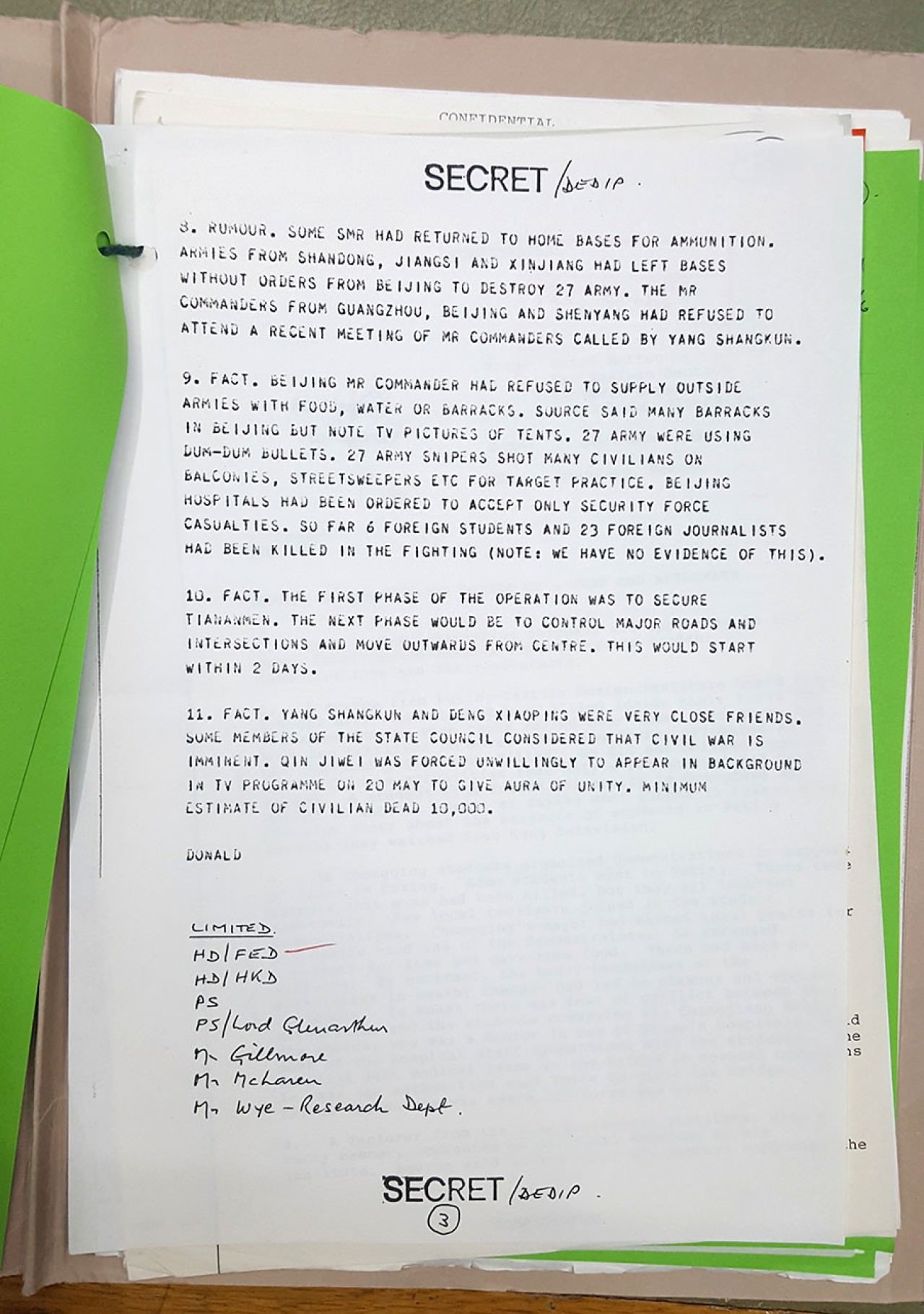
The violence was not one-sided in every account. A US intelligence summary dated 4 June, published by the National Security Archive, says that some civilians attacked military vehicles. They used stones, bottles and Molotov cocktails.
After the crackdown, the party changed its leadership. Jiang Zemin replaced Zhao Ziyang as general secretary of the Chinese Communist Party. US President George H. W. Bush suspended military sales to China and high-level official contacts.
How Many People Died at Tiananmen Square?
This is the hardest question, and the honest answer is that the exact total is unknown. Official Chinese statements reported a few hundred dead. Independent estimates range from hundreds to thousands.
Two documents show the gap.
- The official figure. A report by Beijing Party Secretary Li Ximing, dated 19 June 1989, listed 241 deaths. These were 218 civilians, 10 soldiers and 13 armed police.
- The alternative estimate. A US Embassy cable of 22 June 1989 found a figure of 2,600 dead soldiers and civilians plausible. The figure was attributed at the time to the Chinese Red Cross. The cable did not present it as a confirmed total.
So if you read a single number online, treat it with care. It is one estimate, not a settled count.
Did the deaths happen inside the square?
Many people picture a massacre inside the square itself. The same US Embassy assessment of 22 June 1989 disagreed. It said most of the deaths happened on Chang’an Avenue and the surrounding streets.
This matters when you read about the events. The square is the symbol, but much of the killing, according to this assessment, took place on the roads leading to it.
Who Was Tank Man?
On 5 June 1989, the day after the military action, an unarmed man stepped in front of a tank convoy on Chang’an Avenue in Beijing. He became known as Tank Man.
Two details are easy to miss. According to the PBS chronology, he carried shopping bags. As the lead tank tried to go around him, he kept stepping back in front of it. He looked like someone interrupted on an ordinary errand. Many of us carry bags like that on a normal day. That is part of why the image still hits so hard.
He also did more than block the column. According to the June 4th Memory & Human Rights Museum, he climbed onto the lead tank and spoke with one of the crew.
Is his name known?
The name Wang Weilin is often used for him. It comes from a report in Britain’s Sunday Express. The museum’s assessment is that his real name, his identity and his fate have not been established.
So any claim that he was found, named or sentenced should be treated with caution. The record does not support a confirmed answer.
The photograph
Charlie Cole, working for Newsweek, took a photograph of Tank Man on 5 June 1989. It won the 1990 World Press Photo of the Year.
What Does 六四事件 Mean?
In Chinese, the events are called 六四事件. In pinyin this is liùsì shìjiàn. It means the June Fourth Incident.
The name uses the date, not the place. If you search in Chinese, this is the term to use.
Details You Won’t Find in Guidebooks
The ceremony that moved. Gorbachev’s welcome was planned for Tiananmen Square. The protesters did not leave the square, so the welcome ceremony was held at the airport instead.
A statue made of foam. On 30 May 1989, protesters put up a Goddess of Democracy statue in the square. It was about 10 meters tall. It was made of foam and papier-mâché.
A man on a tank. Most people remember Tank Man standing in the road. Fewer know that he climbed onto the lead tank and talked to a crew member.
A photograph that won a prize. Cole’s image of Tank Man took the top World Press Photo award in 1990. The man in it remains unidentified.
Documentary: The Tank Man
Antony Thomas made it, and PBS FRONTLINE broadcast it on 11 April 2006.
How Is Tiananmen Remembered Today?
In mainland China, public remembrance of the crackdown is restricted. The Associated Press reported on 4 June 2025 that commemoration was blocked and that online content about the events was removed.
Elsewhere, you can read the declassified documents, the museum’s material and the PBS reporting listed below.
FAQ
When did the Tiananmen Square protests start and end?
They ran from 15 April to 4 June 1989. They began with mourning for Hu Yaobang and ended when the army cleared the protests on the night of 3–4 June.
How many people died at Tiananmen Square in 1989?
Nobody knows the exact total. A 19 June 1989 report by Beijing Party Secretary Li Ximing gave 241 deaths: 218 civilians, 10 soldiers and 13 armed police. A US Embassy cable of 22 June found a figure of 2,600 attributed to the Chinese Red Cross plausible, but it was not a confirmed total.
Who was Tank Man?
He was an unarmed man who stood in front of a tank convoy on Chang’an Avenue on 5 June 1989. The name Wang Weilin comes from a British newspaper report, but his real name, identity and fate have not been established.
What does 六四事件 mean?
It is pronounced liùsì shìjiàn and means the June Fourth Incident. It is the usual Chinese name for these events.
Can people in mainland China commemorate Tiananmen today?
According to an Associated Press report of 4 June 2025, public commemoration is blocked in mainland China and online content about the crackdown is removed.
Sources
- Wikipedia — 1989 Tiananmen Square protests and massacre en.wikipedia.org
- Vikipedi — 1989 Tiananmen Meydanı protestoları tr.wikipedia.org
- US Department of State, Office of the Historian — Tiananmen Square, 1989 history.state.gov
- National Security Archive — Tiananmen Square, 1989: The Declassified History nsarchive2.gwu.edu
- Associated Press — A quiet Tiananmen Square anniversary shows China’s ability to suppress history apnews.com
- PBS FRONTLINE — Remembering the Tiananmen Square Crackdown, and the Tank Man pbs.org
- PBS FRONTLINE — The Memory of Tiananmen (chronology) cgi.pbs.org
- PBS FRONTLINE — The Tank Man pbs.org
- June 4th Memory & Human Rights Museum — The Tank Man 8964museum.com
- World Press Photo — 1990 Charlie Cole worldpressphoto.org
Image: UK cable on Tiananmen Square Massacre – 1 3.jpg — Alan Ewen Donald, Public domain