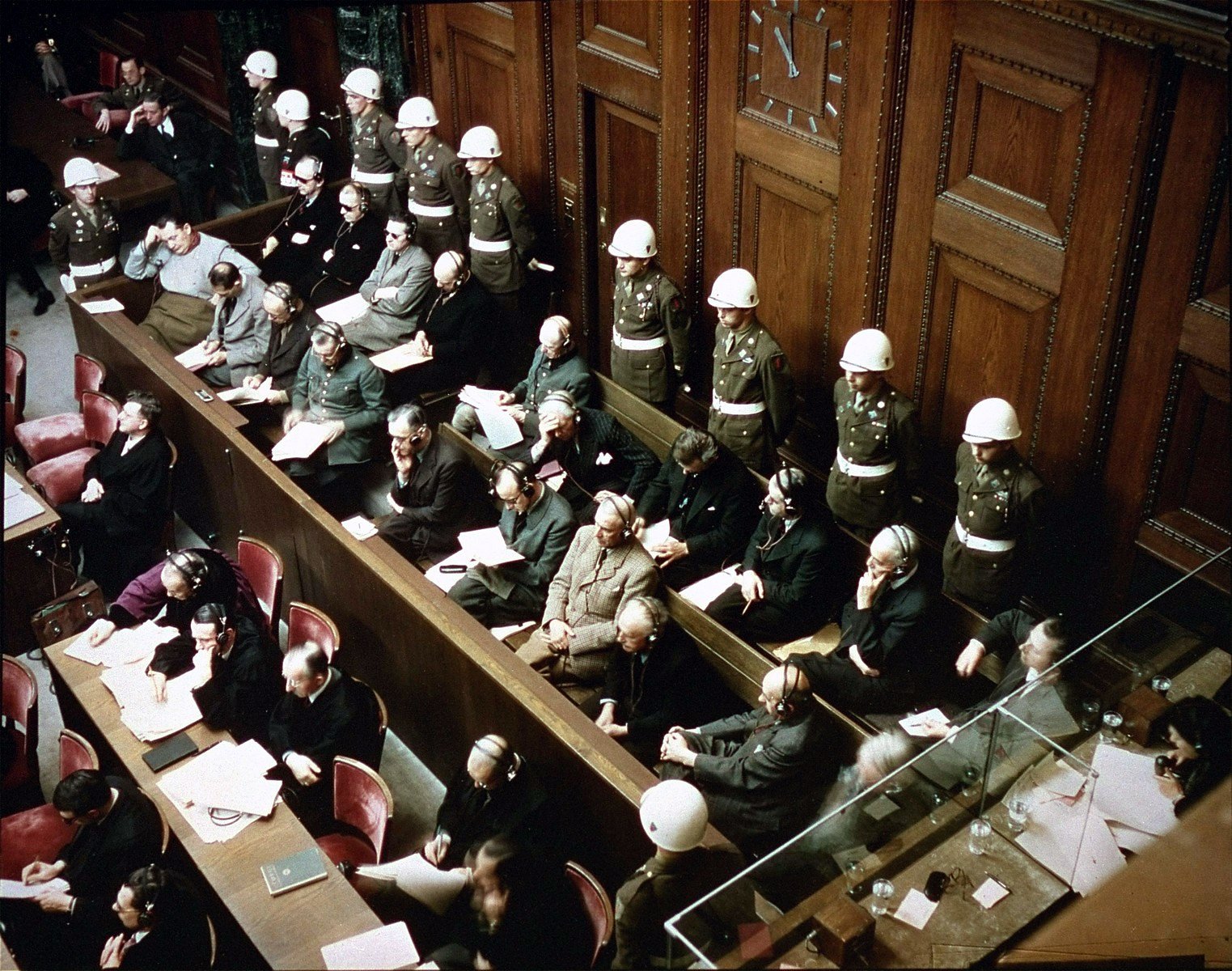
The Nuremberg Trials brought Nazi leaders before judges to answer for their actions. The main trial ran from 20 November 1945 to 1 October 1946. Its four charges covered conspiracy, crimes against peace, war crimes, and crimes against humanity. Twelve defendants received death sentences, seven received prison terms, and three were acquitted.
If you want to understand how Nazi leaders were brought to justice, start with the tribunal’s rules. Government office did not remove criminal responsibility. Acting under orders did not automatically excuse a defendant. The accused also had rights to lawyers, evidence, cross-examination, and proceedings they could understand.
Where were the Nuremberg Trials held?
The main trial took place in Courtroom 600 of Nuremberg’s Palace of Justice. The building had suffered relatively little damage. It offered enough space for the proceedings, with a prison beside it. These practical conditions were decisive in choosing the venue.
Nuremberg’s association with Nazi rallies gave the location additional symbolic meaning. Yet the tribunal’s official permanent seat was Berlin. When you distinguish the institution’s designated seat from its courtroom, the two city names become easier to place.
How did the International Military Tribunal work?
The United States, the United Kingdom, the Soviet Union, and France agreed in London on 8 August 1945 to establish the International Military Tribunal. Each state appointed a principal judge and an alternate. British judge Geoffrey Lawrence presided. A conviction and sentence required affirmative votes from at least three of the four judges.
The chief prosecutors represented the same four states. Robert H. Jackson acted for the United States, Hartley Shawcross for the United Kingdom, and Roman Rudenko for the Soviet Union. France’s chief prosecutor was initially François de Menthon. Auguste Champetier de Ribes replaced him in January 1946.
The indictment named 24 people. Robert Ley killed himself before proceedings began. Gustav Krupp was too ill to stand trial. The case therefore proceeded against 22 defendants, including Martin Bormann, who was tried in absentia. Adolf Hitler, Heinrich Himmler, and Joseph Goebbels were not tried at Nuremberg because they had killed themselves in 1945.
What crimes did the prosecution charge?
The four headings were conspiracy, crimes against peace, war crimes, and crimes against humanity. Article 6 of the tribunal’s Charter defined crimes against peace to include planning, preparing, initiating, or waging a war of aggression. It placed decisions about starting war within the tribunal’s criminal framework.
Article 7 addressed official position. Being a head of state or holding a government post could neither free a defendant from responsibility nor reduce the punishment. Article 8 addressed orders from a government or superior. Such orders did not remove responsibility, although the tribunal could consider them when reducing a sentence.
The Charter also set out defence rights in Article 16. Defendants could have legal representation, present evidence, and cross-examine prosecution witnesses. They were entitled to proceedings in a language they understood, or to translation. You can see both individual accountability and procedural rights in these provisions.
How did evidence reach the courtroom?
Prosecutors presented tens of thousands of documents produced by the Nazi regime itself. Photographs and film footage accompanied this written evidence. The prosecution therefore placed the regime’s own records before the judges alongside visual material.
On 29 November 1945, prosecutors screened the approximately hour-long film The Nazi Concentration Camps, assembled from footage recorded during the liberation of concentration camps. This screening formed part of the courtroom presentation of evidence.
Who was executed after the Nuremberg Trials?
The tribunal announced its judgments on 30 September and 1 October 1946. Twelve defendants received death sentences. Three received life imprisonment, four received fixed prison terms, and three were acquitted. The distinction between death sentences and executions explains why the final execution count was ten.
Hans Frank, Wilhelm Frick, Alfred Jodl, Ernst Kaltenbrunner, and Wilhelm Keitel were hanged on 16 October 1946. Joachim von Ribbentrop, Alfred Rosenberg, Fritz Sauckel, Arthur Seyss-Inquart, and Julius Streicher were also hanged that day.
Hermann Göring had received a death sentence but killed himself a few hours before his execution. Martin Bormann had been convicted in absentia. Their cases account for the difference between the twelve death sentences and the ten executions.
Rudolf Hess, Walther Funk, and Erich Raeder received life sentences. Karl Dönitz received ten years, and Konstantin von Neurath received fifteen. Baldur von Schirach and Albert Speer each received twenty years. Hjalmar Schacht, Franz von Papen, and Hans Fritzsche were acquitted in the main trial.
What happened at the Nuremberg Trials in 1947?
The main international trial ended in 1946, but proceedings at Nuremberg continued. Between 1946 and 1949, twelve subsequent trials took place before American military tribunals alone. These cases tried 177 defendants drawn from doctors, legal professionals, industrialists, and other leadership groups.
The first was the Doctors’ Trial. It opened on 9 December 1946 against 23 German physicians and administrators. Judgment followed in August 1947. This places the Doctors’ Trial within the later American proceedings, separate from the four-power tribunal that had tried the principal defendants.
The Nuremberg Code emerged during the Doctors’ Trial in 1947. Its ten principles made voluntary consent a fundamental condition for experiments on human beings. For an everyday-life connection, think about what it means when someone asks your permission: the Code placed voluntary consent at the foundation of human experimentation.
Timeline
- 8 August 1945: The four Allied states agreed in London to establish the International Military Tribunal.
- 20 November 1945: The main trial opened in Courtroom 600 in Nuremberg.
- 29 November 1945: Concentration camp footage was presented in court.
- 30 September–1 October 1946: The tribunal announced its judgments.
- 16 October 1946: Ten defendants were executed.
- 9 December 1946: The Doctors’ Trial began.
- August 1947: The Doctors’ Trial reached judgment.
- 1946–1949: Twelve subsequent trials took place before American military tribunals.
- 21 November 2010: The Memorium Nuremberg Trials museum opened.
- March 2020: Courtroom 600 ceased to be used for court hearings.
Details you won’t find in guidebooks
A wooden connecting passage linked Nuremberg’s prison with the east building of the Palace of Justice. It was built so defendants could be moved securely between the two buildings. The adjoining prison was therefore part of the practical arrangement behind the proceedings.
The 1945–1946 trial used simultaneous interpretation between English, French, Russian, and German. This supported communication across four languages. It also gave practical effect to the Charter’s requirement that defendants understand the proceedings or receive translation.
After the executions on 16 October 1946, the bodies were taken to the Ostfriedhof crematorium in Munich. They were cremated, and the ashes were scattered in a tributary of the Isar River.
Where is the Nuremberg Trials museum?
The Memorium Nuremberg Trials museum opened on 21 November 2010 inside the Palace of Justice where the main trial had taken place. Courtroom 600 stopped being used for court hearings in March 2020. It then became part of the museum’s permanent exhibition.
If you are connecting the trial’s history to its physical setting, Courtroom 600 is the central location. The main proceedings ran there from November 1945 to October 1946. The museum occupies the same Palace of Justice, linking the exhibition to the building used for the trial.
Which Nuremberg Trials book contains the official record?
Trial of the Major War Criminals before the International Military Tribunal is the official English publication of the main trial’s transcripts and documents. It comprises 42 volumes. For students following the proceedings in detail, this collection provides the official published record of the case.
FAQ
Where were the Nuremberg Trials held?
The main trial took place in Courtroom 600 of Nuremberg’s Palace of Justice from 20 November 1945 to 1 October 1946.
How many defendants were executed after the main trial?
Ten defendants were hanged on 16 October 1946. Twelve received death sentences, but Hermann Göring killed himself before his execution, and Martin Bormann had been convicted in absentia.
What happened at Nuremberg in 1947?
The Doctors’ Trial reached judgment in August 1947. The Nuremberg Code emerged during that proceeding, setting out ten principles for human experiments, including voluntary consent.
What book contains the official trial record?
Trial of the Major War Criminals before the International Military Tribunal contains the official English transcripts and documents in 42 volumes.
Sources
- Memorium Nuremberg Trials — The International Military Tribunal museums.nuernberg.de
- Memorium Nuremberg Trials — Courtroom 600 museums.nuernberg.de
- Wikipedia — Nuremberg trials en.wikipedia.org
- Memorium Nuremberg Trials — Judges and Prosecutors of the IMT museums.nuernberg.de
- United States Holocaust Memorial Museum — Nuremberg Trials encyclopedia.ushmm.org
- Yale Law School, Avalon Project — Charter of the International Military Tribunal avalon.law.yale.edu
- United States Holocaust Memorial Museum — What Were the Nuremberg Trials? ushmm.org
- United States Holocaust Memorial Museum — Film at the Nuremberg Trial encyclopedia.ushmm.org
- Memorium Nuremberg Trials — Verdicts museums.nuernberg.de
- Memorium Nuremberg Trials — Choice of Nuremberg as the Venue for the Trials museums.nuernberg.de
- Memorium Nuremberg Trials — The Subsequent Nuremberg Trials museums.nuernberg.de
- United States Holocaust Memorial Museum — The Doctors’ Trial encyclopedia.ushmm.org
- United States Holocaust Memorial Museum — The Nuremberg Code encyclopedia.ushmm.org
- US National Archives — National Archives Collection of World War II War Crimes Records archives.gov
- Wikipedia — Memorium Nuremberg Trials en.wikipedia.org
Image: Defendants in the dock at nuremberg trials.jpg — Raymond D’Addario, Public domain