Antalya is a modern port city with a very old core. Its name points back to a king who founded a town on this coast more than two thousand years ago. This guide follows that story from a cave near the city to the Italian occupation of 1919, and it shows you where the evidence still stands.
Where does the name Antalya come from?
The name comes from Attaleia. King Attalos II of Pergamon (Bergama) founded this city in the 2nd century BC, and it carried his name.
Over the centuries the name changed with the language of whoever wrote it down. Historical sources give Atalia and Adalia. Medieval Western texts use Satalia. Arab and Turkish sources use Antâliyye and Adalya. If you read an old map or a travel account, these are all the same city.
Antalya history: from Karain Cave to Attaleia
People lived here long before any king. Karain Cave lies about 30 kilometers north-northwest of Antalya, near Yağca. Kılıç Kökten identified it in 1946, and excavations began the same year.
In the cave’s B chamber, researchers recorded 13 archaeological levels. The finds run from the Middle Paleolithic to the Early Bronze Age. A small number of Roman-period remains sit in the upper levels.
The region was never one single country. Today’s Antalya Province covers land that ancient geographers split into three areas. Lycia lay in the west and Pamphylia in the east. Part of Pisidia lay to the north. When you travel the province, you cross these old borders without noticing.
In 333 BC, Alexander the Great besieged Termessos on Mount Güllük. The city resisted and did not surrender. Attaleia came later, in the 2nd century BC. In 67 BC, Pompey’s fleet used it as a base.
Antalya historical center: Kaleiçi and Hadrian’s Gate
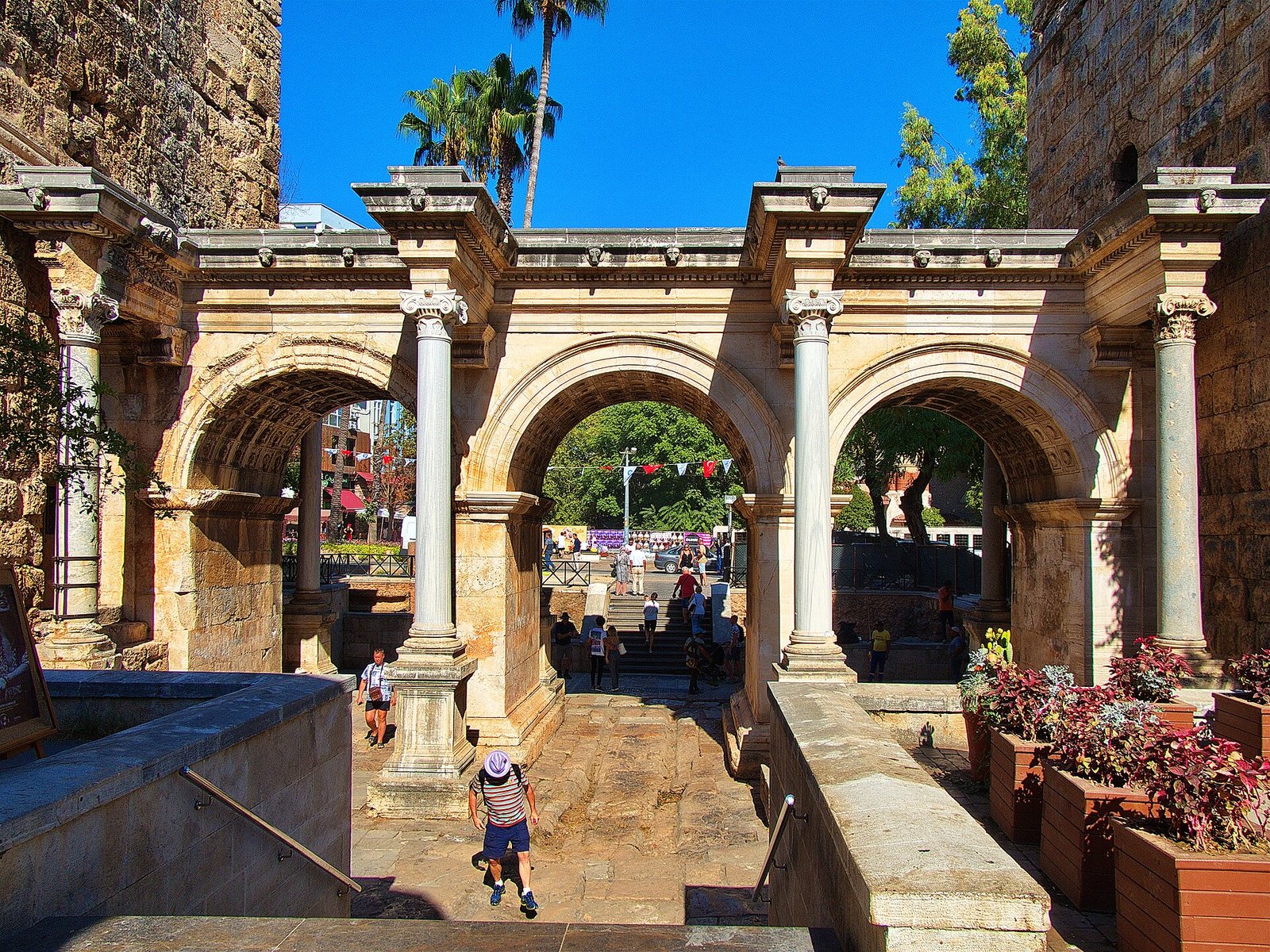
The historical center is Kaleiçi, around the inner harbor. Its best-known monument is Hadrian’s Gate, with three openings. It was built in AD 130 in the name of the Roman emperor Hadrian.
The gate was not always in view. The city walls closed off its outer side, and it went unused for a long time. In 1882, the wall remains in front of it were demolished, and the gate came back into sight.
The quarter has been protected for decades. In 1972 the inner harbor and Kaleiçi were declared a conservation site, to preserve their original texture. That is why you can still walk streets that follow the old layout.
Antalya history and culture: Seljuks, Cypriots and Ottomans
The city changed hands several times between 1207 and 1423.
- 1207: Sultan Gıyâseddin Keyhusrev I conquered Antalya on 5 March. He appointed Mübârizüddin Ertokuş as governor and subaşı.
- 1216: İzzeddin Keykâvus took the city again on 22 January. The harbor’s quays and breakwaters were then repaired, and a shipyard was set up.
- 1361: King Pierre of Cyprus seized Antalya on 24 August.
- 1373: Mübârizüddin Mehmed Bey took it back on 14 May.
- 1423: After Tekeoğlu Osman Çelebi was killed in January, Ottoman rule in Antalya and the Teke region became firm.
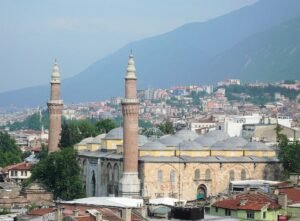
The Yivli Minare (Fluted Minaret) is the best-known Seljuk landmark. Its inscription dates the structure to the reign of Alâeddin Keykubad I, between 1220 and 1237. The minaret is about 30 meters high, and its shaft has eight flutes.
The mosque beside it has a separate date. According to its inscription, Emir Mübârizüddin Mehmed Bey had architect Balaban et-Tavâşî build the present Yivli Minare Mosque in 1373. That is the same year he recaptured the city.
The Ottoman period is visible too. The Murad Paşa Mosque stands outside the city walls. Murad Pasha, the Beylerbeyi of Karaman, had it built in 978 on the Islamic calendar, which is 1570–1571.
Antalya history museum: how the collection began
The Antalya Museum has a story of its own. It began as a local effort to keep finds in the city. The teacher Süleyman Fikri Erten started the effort to found a museum. On 15 October 1919, he was appointed honorary antiquities officer, after the Italians tried to take artifacts to their consulate.
The collection first moved into the Yivli Minare Mosque in 1937. In 1972 it moved to its present building on Konyaaltı Street. If you visit, you are seeing a museum that grew out of an occupation-era rescue effort.
Antalya historical places beyond the city
The city center is only part of the story. The province holds several ancient sites. Together they show that the region’s history is much wider than the founding of Attaleia.
- Aspendos: The theater near Serik was built between AD 161 and 180, under Emperor Marcus Aurelius. The architect was Zeno, son of Theodoros. The city’s water system also had an aqueduct bridge of about one kilometer, running north to south. It had pressure towers at both ends.
- Termessos: This city on Mount Güllük resisted Alexander in 333 BC.
- Phaselis: Near Kemer, this ancient city sits on a small peninsula. It had three harbors: the North Harbor, the Military Harbor and the South Harbor.
- Xanthos: Together with Letoon in Muğla, Xanthos is a Lycian site on the UNESCO World Heritage List since 1988. It was listed for the architecture and inscriptions of Lycian civilization.
- Perge: At Aksu, the first archaeological excavations began in 1946 by Istanbul University.
A simple plan for an Antalya history tour is to match each site to a period. Start with Karain for the earliest traces. Continue with Termessos and Perge for the ancient world. Then see Aspendos for Rome, and finish in Kaleiçi for the Seljuk and Ottoman layers.
Antalya history facts: the twentieth century
The modern chapter starts with occupation. Italian forces occupied Antalya on 28 March 1919. The occupation ended on 5 July 1921.
The city’s recent heritage work follows from there. The old quarter was protected in 1972, and the museum moved to its present building the same year. The Xanthos-Letoon listing came in 1988.
Timeline
- 333 BC Termessos resisted Alexander the Great’s siege.
- 2nd century BC: Attalos II founded Attaleia, which carried his name.
- 67 BC Attaleia served as a base for Pompey’s fleet.
- AD 130 Hadrian’s Gate was built in the name of Emperor Hadrian.
- AD 161–180 Aspendos Theater was built under Marcus Aurelius.
- 5 March 1207 Gıyâseddin Keyhusrev I conquered Antalya.
- 22 January 1216 İzzeddin Keykâvus retook the city.
- 1220–1237 The Yivli Minare dates to the reign of Alâeddin Keykubad I.
- 24 August 1361 King Pierre of Cyprus seized Antalya.
- 14 May 1373 Mübârizüddin Mehmed Bey recaptured it.
- 1373 The present Yivli Minare Mosque was built.
- 1423 Ottoman rule in Antalya and the Teke region became firm.
- 1570–1571 The Murad Paşa Mosque was built.
- 1882 Hadrian’s Gate was uncovered when wall remains in front of it were removed.
- 28 March 1919 Italian forces occupied Antalya.
- 15 October 1919 Süleyman Fikri Erten became honorary antiquities officer.
- 5 July 1921 The Italian occupation ended.
- 1946 Excavations began at Karain and Perge.
- 1972 Kaleiçi and the inner harbor were protected, and the museum moved to Konyaaltı Street.
- 1988 Xanthos-Letoon joined the UNESCO World Heritage List.
Details you won’t find in guidebooks
- A lake on the plain. The UNESCO nomination text for Karain lists hippopotamus bones and invertebrate shells found in the cave. It cites them as evidence of a lake on the Antalya plain in the Pleistocene.
- A missing upper floor. Hadrian’s Gate was originally two stories tall. The second story has not survived.
- A theater turned palace. Part of the Aspendos Theater was used as a palace in the Seljuk period.
- A poem for a dog. A sarcophagus from Termessos, known as the Dog Sarcophagus, carries an inscription. Its owner, Rhodope, wrote a poetic text for her dog Stefanos.
FAQ
Where does the name Antalya come from?
It comes from Attaleia, a city founded in the 2nd century BC by King Attalos II of Pergamon. The city carried his name.
When did the Seljuks take Antalya?
Sultan Gıyâseddin Keyhusrev I conquered it on 5 March 1207. İzzeddin Keykâvus retook it on 22 January 1216.
When did Antalya’s old quarter become a protected site?
The inner harbor and Kaleiçi were put under protection as a conservation site in 1972, to preserve their original texture.
How old is Hadrian’s Gate?
It was built in AD 130 in the name of the Roman emperor Hadrian. It has three openings and stands in Kaleiçi.
Which ancient sites in the province should I know?
Karain Cave, Perge, Aspendos, Termessos, Phaselis and Xanthos are the main ones covered here. Each shows a different period of the region’s past.
Sources
- Antalya Governorship — Antalya History antalya.gov.tr
- TDV Islamic Encyclopedia — Antalya islamansiklopedisi.org.tr
- Wikipedia — Antalya Province en.wikipedia.org
- Belleten — Karain Cave Middle Chalcolithic Pottery belleten.gov.tr
- UNESCO World Heritage Centre — Karain Cave whc.unesco.org
- Turkey Culture Portal — Hadrian’s Gate kulturportali.gov.tr
- TDV Islamic Encyclopedia — Yivli Minare Complex islamansiklopedisi.org.tr
- TDV Islamic Encyclopedia — Murad Paşa Mosque islamansiklopedisi.org.tr
- Vikipedi — Antalya tr.wikipedia.org
- Muratpaşa Municipality — Introduction muratpasa-bld.gov.tr
- Ministry of Culture and Tourism DÖSİMM — Antalya dosim.ktb.gov.tr
- Muratpaşa District Governorship — Tourist Places muratpasa.gov.tr
- Antalya Provincial Directorate of Culture and Tourism — Aspendos antalya.ktb.gov.tr
- Antalya Provincial Directorate of Culture and Tourism — Termessos antalya.ktb.gov.tr
- Antalya Provincial Directorate of Culture and Tourism — Phaselis antalya.ktb.gov.tr
- UNESCO World Heritage Centre — Xanthos-Letoon whc.unesco.org
- Antalya Provincial Directorate of Culture and Tourism — Museums and Ancient Sites antalya.ktb.gov.tr
Image: P9271456 Hadrians Gate, Antalya.jpg — Joe Wallace, CC BY-SA 2.0