Where did the Dyatlov Pass incident happen?
The nine members of the Dyatlov group died on the night of 1–2 February 1959. They were on the eastern slope of Kholat Syakhl, in the Northern Urals of the Soviet Union.
The group began as ten people: eight men and two women. Their goal was Otorten Mountain. The leader was Igor Dyatlov, a 23-year-old radio engineering student at the Ural Polytechnic Institute.
On 28 January 1959, Yuri Yudin left the trip because of health problems. He did not share the fate of the nine friends who died.
What kind of trip was it?
This was not a casual weekend walk. The ski expedition was planned to last about 14 days. Its route fell into category III, the hardest level in the Soviet classification of the time.
The group was prepared for hard terrain. That matters when you read the later theories. These were not beginners who wandered into the snow by accident.
One historical photograph, published by EPFL, shows the group advancing toward Kholat Syakhl on 1 February 1959. If you search for Dyatlov Pass photos, that is a good place to start. It is one of the last records of the group together.
Timeline
- 28 January 1959: Yuri Yudin turned back because of health problems.
- 1–2 February 1959: Nine people camping on the Kholat Syakhl slope died.
- 26 February 1959: Search teams found the abandoned tent.
- 4 May 1959: The last four bodies were found in a ravine under snow.
- May 1959: The first investigation closed with a “natural force” explanation.
- February 2019: Russian authorities reopened the case.
- 11 July 2020: Prosecutors announced an explanation based on an avalanche, cold and snow-pressure injuries.
- 28 January 2021: Gaume and Puzrin’s slab avalanche model was published.
- Summer 2021: A drone survey documented slopes steeper than 30 degrees in places.
- 29 January 2022: Traces of two slab avalanches were photographed nearby.
- 2022: A follow-up paper assessing the field findings was published.
What did the search teams find?
Search teams reached the tent on 26 February 1959. It was torn apart. The group’s shoes and many of their belongings were still inside.
The tent examination showed that the fabric had been cut from the inside. Someone left in a hurry.
Tracks led away from the tent. Some were made by people in socks. Some were made by a person in a single shoe. Some were made by bare feet.
The first two bodies were those of Yuri Krivonishenko and Yuri Doroshenko. They lay beside a tree at the forest edge, about 1.5 kilometres from the tent.
The last four bodies were found on 4 May 1959. They lay in a ravine about 75 metres beyond the tree, under four metres of snow.
How did the nine hikers die?
The autopsy results were mixed. Six people died of hypothermia. Two died of chest trauma. One died of a skull injury.
The injuries fed years of speculation. Dubinina’s missing tongue and other losses of facial tissue seemed sinister. The forensic expert Vozrozhdenny judged them to be changes after death. He linked them to the position of the bodies in the stream.
In May 1959 the investigation closed. It blamed an irresistible natural force. That wording left readers with more questions than answers.
What are the main Dyatlov Pass theories?
Two explanations get the most attention today.
The first is the avalanche. In February 2019, Russian authorities reopened the case. They looked at avalanches, slab avalanches and hurricanes.
On 11 July 2020, prosecutor’s representative Andrey Kuryakov gave the conclusion. The group left the tent because of an avalanche. They died from cold and from injuries caused by snow pressure.
The prosecutors also released a reconstruction. Visibility fell to 6–16 metres. The group moved about 50 metres away from the tent. They could not find it again.
The second is the infrasound theory. Donnie Eichar popularised it in his 2013 book Dead Mountain. It proposes panic caused by infrasound. This is a different hypothesis from the avalanche explanation that was physically modelled in 2021.
If you searched Reddit, you probably met both. This article follows the peer-reviewed work.
Dyatlov Pass incident solved: what did the 2021 study show?
On 28 January 2021, Johan Gaume and Alexander Puzrin published a peer-reviewed study. It examined, with physical models, whether a small slab avalanche could occur and produce severe injuries.
Their idea is specific. The group cut into the slope to pitch the tent. Wind piled snow above it. That cut and that snow could let the slab break away hours later.
The study did not stop at the mechanism. The injuries mattered too. The authors tested how snow affects a human chest. They used chest impact data from car safety research.
Think of crash-test dummies. The same data that helps design seat belts was used to ask whether snow could have hurt the hikers this way.
The 2021 expeditions for RSI’s documentary The Dyatlov Mystery, directed by Matteo Born, supplied field data to the avalanche research.
What were the objections, and how were they answered?
The avalanche idea met strong objections. These were the main ones:
- The slope looked too gentle.
- There were no clear avalanche traces.
- The trigger came with a delay.
- The injuries were unusual.
The summer 2021 drone measurements answered the slope objection. The average slope is about 20 degrees. But local steps in the terrain can exceed 30 degrees.
Then came the winter of 2022. On 29 January 2022, Oleg Demyanenko and Dmitriy Borisov photographed traces of two slab avalanches. They were on an eastern slope less than three kilometres from the old tent site.
That answered the “no avalanches here” objection. Avalanches do form in this area.
So, has science solved it?
Not completely. This is the honest answer to “Dyatlov Pass incident solved 2026”.
Gaume and Puzrin’s 2022 assessment confirmed that avalanches form in the area. It also noted that earlier investigations of the 1959 event were not fully conclusive.
The authors of the 2021 study were open about limits. Their models do not cover what the hikers did after leaving the tent. They do not explain every position where bodies were found.
So the avalanche explains why people may have fled. It does not explain every step afterward. Saying the case is fully and finally solved goes beyond the evidence.
Details you won’t find in guidebooks
- Two heights for one mountain. Kholat Syakhl appears on old maps as a hill of 1079 metres. Modern maps show 1,096.7 metres.
- A very fine terrain model. The 3D model the researchers built from the 2021 drone survey had a resolution of nine centimetres.
- A phone call started it. Gaume’s turn to the Dyatlov case began in October 2019. A journalist from New York phoned him.
- Crash data in a mountain case. Car safety chest-impact data helped test the effect of snow on a human chest.
- A photograph from the last day. EPFL’s historical photo shows the group moving toward Kholat Syakhl on 1 February 1959.
FAQ
Where did the Dyatlov Pass incident happen?
It happened on the eastern slope of Kholat Syakhl in the Northern Urals, then part of the Soviet Union. The group’s goal was Otorten Mountain.
Has the Dyatlov Pass incident been solved?
Not completely. In 2020 Russian prosecutors announced an avalanche explanation, and the 2021 and 2022 studies support it. But those authors say their models do not explain what the hikers did after leaving the tent, or where every body was found.
How did the nine hikers die?
Autopsies found that six died of hypothermia, two of chest trauma and one of a skull injury.
Is there a documentary about the incident?
Yes. The Swiss broadcaster RSI made The Dyatlov Mystery, directed by Matteo Born. Its 2021 expeditions gave the avalanche researchers field data.
Is the infrasound theory the same as the avalanche theory?
No. Donnie Eichar’s 2013 book Dead Mountain popularised an infrasound panic theory. The avalanche explanation modelled physically in 2021 is a different hypothesis.
Sources
- Wikipedia — Dyatlov Pass incident en.wikipedia.org
- Türkçe Vikipedi — Dyatlov Geçidi Vakası tr.wikipedia.org
- EPFL — Using science to explore a 60-year-old Russian mystery actu.epfl.ch
- EPFL — Intense press coverage prompts new expeditions to Dyatlov Pass actu.epfl.ch
- ABC News — The Dyatlov Pass incident sparked terror and conspiracy theories abc.net.au
- Interfax — Генпрокуратура окончательно определила причину гибели группы Дятлова interfax.ru
- Communications Earth & Environment — Mechanisms of slab avalanche release and impact in the Dyatlov Pass incident in 1959 nature.com
- Communications Earth & Environment — Post-publication careers: follow-up expeditions reveal avalanches at Dyatlov Pass nature.com
- ETH Zürich — Mechanisms of slab avalanche release and impact in the Dyatlov Pass incident in 1959 geomechanics.ethz.ch
- Wikipedia — Kholat Syakhl en.wikipedia.org
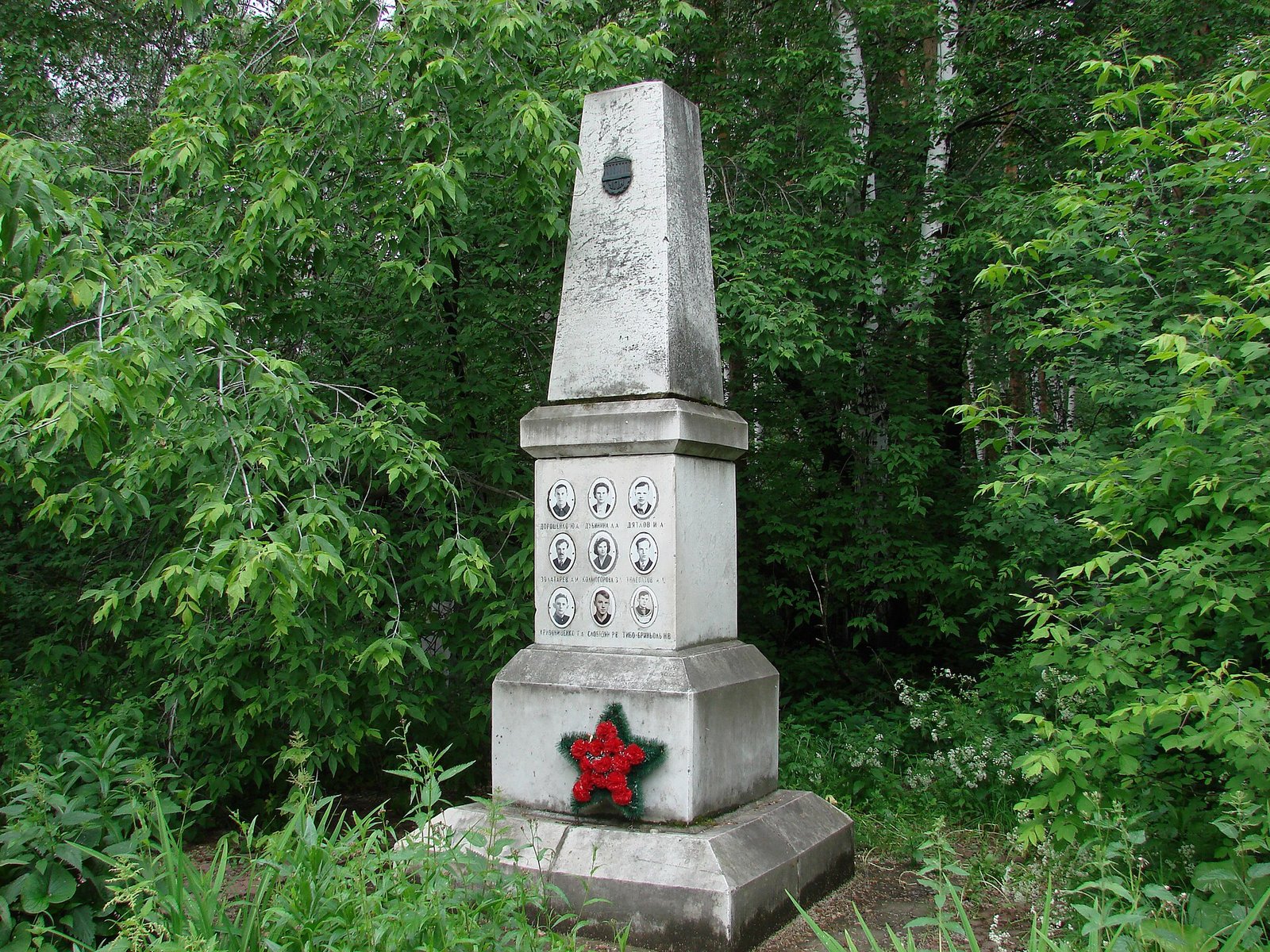
Image: Памятник дятловцам на Михайловском кладбище.jpg — Дмитрий Никишин.
The original uploader was Futball80 at Rus, Public domain