Korean War dates and years: when did it start and end?
The Korean War started on 25 June 1950. Major fighting stopped with the armistice of 27 July 1953. So the war ran from 1950 to 1953.
The direct trigger was simple. The North Korean army crossed the 38th parallel and invaded South Korea on 25 June 1950.
The roots go back a few years. In 1945 Japanese rule in Korea ended. The peninsula was split along the 38th parallel into two occupation zones. The Soviet Union ran the north. The United States ran the south.
In 1948 each zone formed its own government. North Korea’s leader Kim Il-sung and South Korea’s leader Syngman Rhee each claimed to be the legitimate ruler of all Korea. Neither side accepted the line on the map.
Korean War where? The place of the fighting
The war took place on the Korean Peninsula. It began at the 38th parallel and then moved up and down the peninsula.
The fighting also pulled in other states. China and the Soviet Union backed North Korea. A United Nations force led by the United States stood with South Korea.
The United Nations Security Council acted fast. On 27 June 1950 it called on member states to give South Korea military help. That call is why a brigade from Anatolia ended up in northern Korea.
Korean War timeline
- 1945: After Japanese rule ended, Korea was split along the 38th parallel into two occupation zones.
- 1948: North and South Korea formed separate governments.
- 25 June 1950: North Korea invaded South Korea. The war began.
- 27 June 1950: The UN Security Council called for military aid to South Korea.
- 25 July 1950: Türkiye decided to send troops to Korea.
- 15 September 1950: UN forces landed at Incheon.
- 17 September 1950: The first Turkish Brigade, under Brigadier General Tahsin Yazıcı, left İskenderun.
- 19 October 1950: The Chinese People’s Volunteer Army crossed the Yalu River.
- Late November 1950: The Turkish Brigade fought around Kunu-ri as UN forces pulled back.
- 18 February 1952: Türkiye joined NATO.
- 27 July 1953: The Korean Armistice Agreement was signed at Panmunjom.
- 27 July 1995: The Korean War Veterans Memorial opened in Washington.
- 2010: Eunja Kim and Süleyman Dilbirliği met again.
Korean War 1950: the year the war turned twice
Most of the big swings came in 1950. The year is worth a closer look.
On 15 September UN forces landed at Incheon. The landing cut the supply lines of the North Korean army. It opened the first major counterattack of the war.
Then the picture flipped. On 19 October the Chinese People’s Volunteer Army crossed the Yalu River and entered the war on North Korea’s side. A month later UN troops were falling back. That retreat is the setting of the Kunu-ri story.
How did Türkiye get involved?
Türkiye made its decision on 25 July 1950. Celal Bayar was president at the time. His term ran from 22 May 1950 to 27 May 1960, so he held the office through the entire war.
The first Turkish Brigade sailed on 17 September 1950 from İskenderun Port. Brigadier General Tahsin Yazıcı commanded it. Under United Nations command the unit became known as the Northern Star, or Polar Star.
The Korean commitment came just before a bigger step. On 18 February 1952, while the war was still going, Türkiye joined NATO together with Greece.
Kunu-ri: where the Turkish Brigade fought
Kunu-ri is in South Pyongan province in North Korea. Today the place is called Kunu-dong. The fighting there took place in November 1950.
The Turkish Brigade’s battles around Kunu-ri came at the end of that month. Chinese forces had launched an offensive. UN units were pulling back, and the Turks fought in the middle of that withdrawal.
TRT Haber’s account of Kunu-ri gives the brigade’s losses in these clashes as 218 martyrs, 455 wounded and 94 missing.
Why Kunu-ri mattered
Think of the train station on your daily commute. It is not just a building. It is where roads, schedules and people meet.
Kunu-ri was like that in 1950. It was not only a village. It had a railway station and served as a communications hub linking east–west movement. Whoever held the place affected how others could move.
One battle, two accounts
Not every detail is settled. A 2016 study by Mesut Uyar and Serhat Güvenç, titled One Battle and Two Accounts, looks at the disagreement.
Some American accounts say South Korean soldiers were shot at Wawon because they were mistaken for Chinese. The official Turkish account says the Turks fought Chinese forces at Wawon. It adds that the South Korean soldiers had been gathered the previous day.
If you read about Kunu-ri, expect both versions. Treat them as two accounts of the same battle, not as one agreed story.
Korean War casualties: what the numbers say
The human cost was huge. Britannica states that at least 2.5 million people died when soldiers and civilians are counted together.
Türkiye’s own figures need care. The United Nations Command page on Turkey records 741 combat deaths, 2,068 wounded and 163 missing. TRT Haber reports 721 martyrs for Türkiye. These two totals are not the same record, so do not merge them into one number.
The Foreign Ministry of Türkiye adds a place to the numbers. It says 462 Turkish soldiers lie in the UN Memorial Cemetery in Busan.
The true story of Ayla
Ayla is the name by which Eunja Kim is known. During the war she was a Korean child. Staff Sergeant Süleyman Dilbirliği of the Turkish Brigade took on her care.
We know much of this from Kim herself. In an Anadolu Agency interview dated 19 November 2017, she said she met Dilbirliği again in 2010. In the years after, they saw each other and wrote letters.
That is the core of the true story. A soldier looked after a child during a war. Decades later they found each other again.
Details you won’t find in guidebooks
Ayla’s school. After she was separated from Dilbirliği, Eunja Kim was placed in the Ankara School in Korea. She said she studied there until she came of age.
A father without a name. For years she searched for her spiritual father. She said she could not remember his name or his face. The only thing she knew about him was that he was Turkish.
The station, not just the village. Kunu-ri was a railway station and a communications hub in November 1950. That helps explain why the area mattered in a retreat.
Helicopters in the war. Sikorsky H-5 helicopters were used to rescue UN pilots shot down behind enemy lines. They also evacuated wounded men from the front.
A number hidden in the statues. The Washington memorial has 19 stainless steel soldiers. Their reflections in the granite wall make 38 figures. The number points to the 38th parallel.
How the war ended
The armistice was signed at Panmunjom on 27 July 1953. It created a demilitarized zone four kilometers wide between the sides.
The armistice did not end the division of Korea. It stopped the fighting but did not bring a peace treaty.
Korean War memorial in Washington, DC
The Korean War Veterans Memorial in Washington opened on 27 July 1995. That was the 42nd anniversary of the armistice.
If you visit, look at the soldiers and the wall together. The 19 figures and their reflections add up to 38, a quiet reference to the 38th parallel.
The memorial to the Turkish dead is in Busan, in the UN Memorial Cemetery, where 462 Turkish soldiers lie.
FAQ
What are the Korean War dates?
The Korean War began on 25 June 1950. Major fighting ended with the armistice of 27 July 1953.
Where did the Korean War take place?
It was fought on the Korean Peninsula. Kunu-ri, where the Turkish Brigade fought in November 1950, lies in South Pyongan province in North Korea.
How many Turkish soldiers died in the Korean War?
The United Nations Command lists 741 combat deaths, 2,068 wounded and 163 missing for Turkey. TRT Haber gives 721 martyrs for Türkiye, so the two totals are different records and should not be treated as the same count.
Who was Ayla in the Korean War?
Ayla is the name by which Eunja Kim is known. She was the Korean child cared for by Staff Sergeant Süleyman Dilbirliği of the Turkish Brigade. They met again in 2010.
When did the Korean War memorial in Washington open?
The Korean War Veterans Memorial in Washington opened on 27 July 1995, the 42nd anniversary of the armistice.
Sources
- Vikipedi — Kore Savaşı tr.wikipedia.org
- Wikipedia — Korean War en.wikipedia.org
- TRT Haber — Kunuri Çarpışması trthaber.com
- Anadolu Ajansı — Türkiye-Güney Kore kardeşliği 70 yaşında aa.com.tr
- Wikipedia — Turkish Brigade en.wikipedia.org
- Wikipedia — Kunu-dong en.wikipedia.org
- Mesut Uyar and Serhat Güvenç — One Battle and Two Accounts researchgate.net
- United Nations Command — Turkey unc.mil
- Encyclopaedia Britannica — Korean War (archived copy) cdn.ca9.uscourts.gov
- U.S. Army — Commemorating Korean War Armistice Day army.mil
- T.C. Dışişleri Bakanlığı — Türkiye–NATO 60 Yıldır Birlikte mfa.gov.tr
- T.C. Dışişleri Bakanlığı — Türkiye-Kore Cumhuriyeti Siyasi İlişkileri mfa.gov.tr
- Anadolu Ajansı — Ayla manevi babasına özlemini anlattı aa.com.tr
- National Park Service — Korean War Veterans Memorial nps.gov
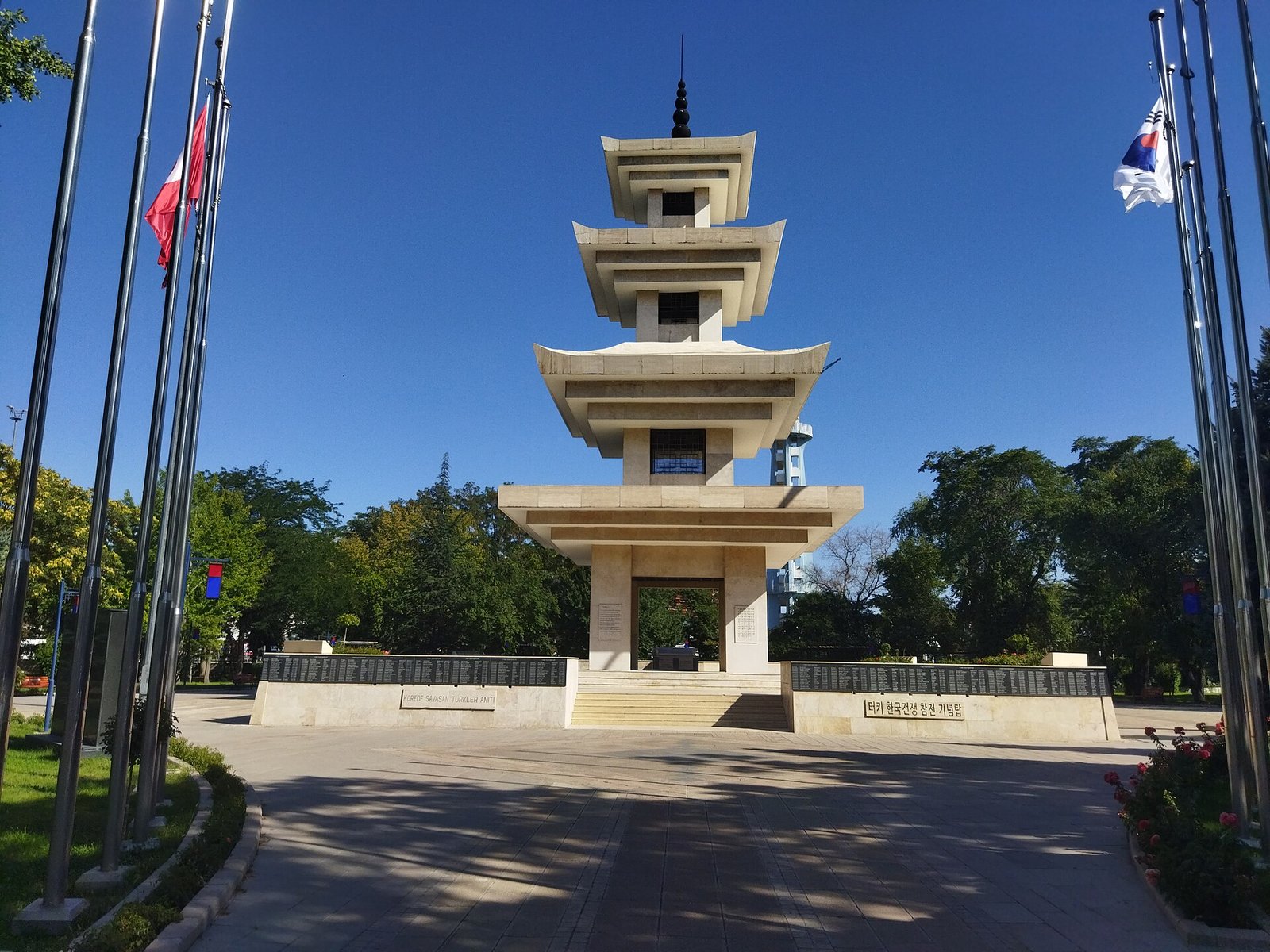
Image: Kore Savaşı Anıtı, Ankara.jpg — Modern primat, CC BY-SA 4.0