If you walk through Aksaray or Şehzadebaşı in Istanbul today, you are walking over ground once packed with soldiers. They were the Janissaries, the sultan’s own paid infantry. This guide explains who they were, how they fought, what they wore and how the corps ended in three days of June 1826.
Janissary meaning and definition
The word yeniçeri means “new soldier.” It names a member of the kapıkulu infantry, the troops tied directly to the Ottoman sultan.
The definition that matters is about pay and service. The Janissary corps, called the Yeniçeri Ocağı, was an infantry force paid from the centre. Its men served continuously. The Janissaries were a standing force.
This is why the corps is described as an elite unit of the Ottoman army. It belonged to the sultan, not to a local lord.
How the Janissary corps began
Nobody can give you a firm founding year. Many accounts link the corps to the reign of Murad I (1362–1389). Another view traces its formation to the time of Orhan Bey. The sources leave the exact date open.
A traditional account says an institution called the Acemi Ocağı was set up at Gelibolu (Gallipoli) in Murad I’s time. It trained new Janissaries. The names Kara Halil and Karamanlı Kara Rüstem appear in the story of its founding.
The first Janissary units drew on prisoners of war. A practice called pençik was tied to the sultan’s right to one fifth of war booty. In effect, the sultan’s share could include people.
You will also meet a popular tale that the saint Hacı Bektâş-ı Velî personally placed the cap on the first Janissaries. The Turkish Islamic Encyclopedia (TDV) points out a problem. He died before the Ottoman principality was founded. Treat the story as legend.
The devshirme: where the recruits came from
Later, the corps relied on the devshirme system. Christian boys, especially from the Balkans, were taken from their families. They were converted to Islam and raised for Ottoman military service.
The system changed in the sixteenth century. Janissaries then received permission to marry. Their sons were admitted to the corps under the name kuloğlu. The corps slowly became more of a hereditary body.
Janissary Ottoman organisation and pay
The corps was not a single mass of men. It was divided into 196 orta, or companies. These were grouped into three main branches: the cemaat, the sekban and the ağa companies.
The pay system has an everyday parallel. Think of a quarterly salary. Janissaries received their wages, called ulûfe, four times a year. Each payment covered a three-month period. A late payment could therefore leave a whole company short of money at once. That is one reason payday mattered so much in Ottoman politics.
Barracks: Edirne, Istanbul and the frontier
Before the conquest of Istanbul in 1453, the Janissary barracks stood in Edirne. After the conquest, the Eski Odalar (Old Rooms) and Yeni Odalar (New Rooms) barracks stood in Istanbul. Today those areas lie around Şehzadebaşı and Aksaray.
Not every Janissary lived in the capital. Many served in border garrisons. In the 1560s, about 3,400 Janissaries were stationed in the province of Buda (Budin).
Janissary battles and weapons
The best-known battle is the siege of Istanbul in 1453. Janissaries took part in it. In the Ottoman battle order they protected the centre, where the sultan himself was positioned.
Their weapons changed over time. They began using firearms in the reign of Murad II (1421–1444, 1446–1451). Even so, handguns became the main weapon of the majority only around the middle of the sixteenth century. So the image of a Janissary with a musket belongs mainly to the later period.
Their weapons were not only firearms. The Metropolitan Museum of Art holds a sixteenth-century Janissary hammer head made of iron and silver. It is 16.2 centimetres tall and weighs 428.1 grams.
Janissary uniform and hat
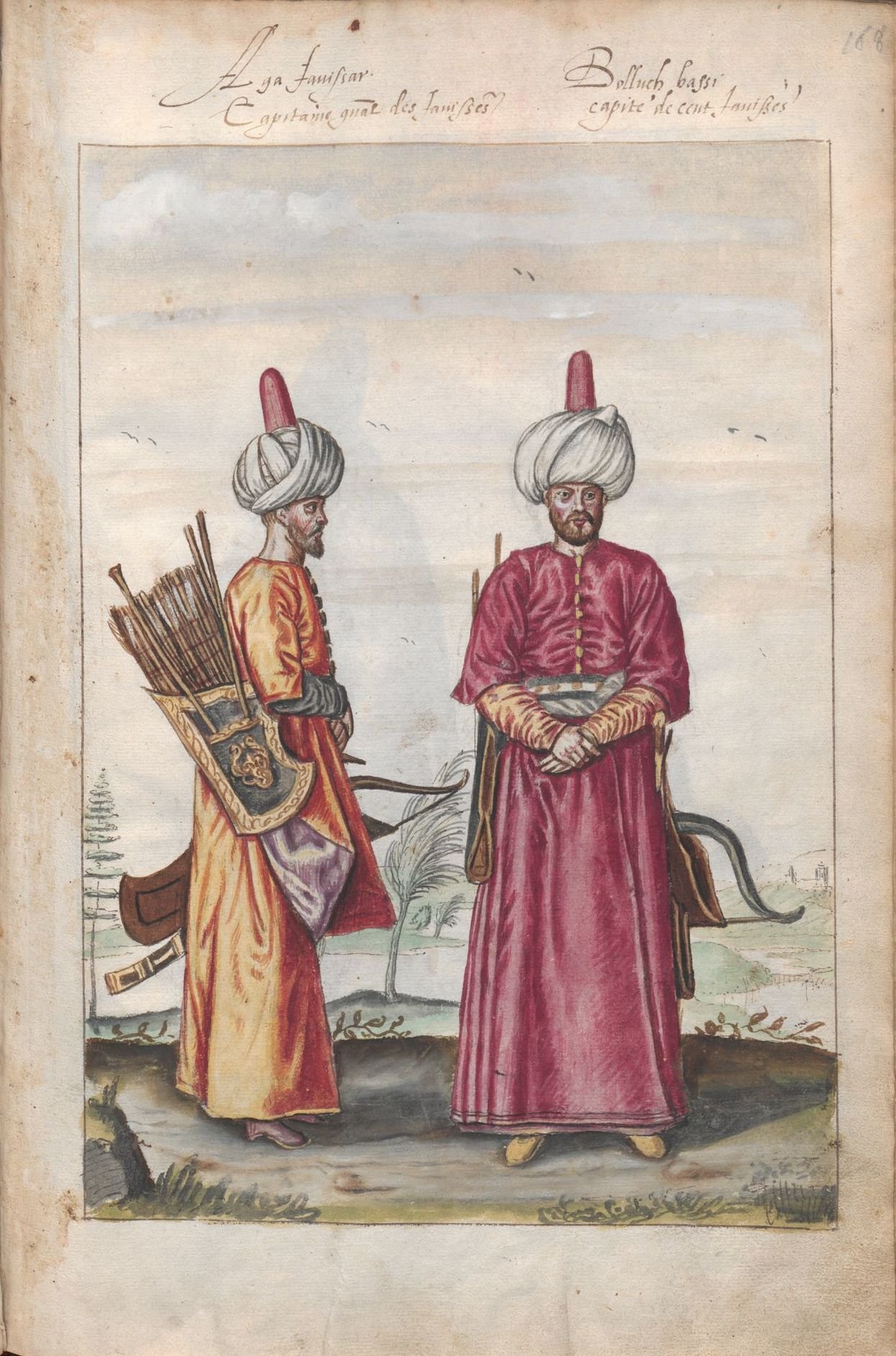
The uniform had several recognisable parts. A research article on Janissary clothing lists the felt börk (cap), the çakşır (trousers), the dolama (a coat of broadcloth) and the baranî, a rain cloak.
The same 2024 study notes that European eyewitnesses described different outer garments and headgear in wartime and in peacetime. So there was no single outfit worn the same way in every place and period.
You can see the hat at its most elaborate in Vienna. The Kunsthistorisches Museum holds a Janissary headdress dated to about 1550. It is 52 centimetres tall. It is made of felt, gold embroidery and gilded brass.
From soldiers to a political force
The corps also became a source of unrest. The first known Janissary revolt is the Buçuktepe Revolt of 1446 in Edirne.
The most dramatic case came in 1622. During an uprising, Osman II was removed from the throne and killed.
The soldiers had their own signal for trouble. When Janissaries brought out their company cauldrons (kazan), it signalled an intent to rebel. This act was known as kazan kaldırma (“lifting the cauldron”).
Timeline
- 14th century: The corps forms during the era of Orhan Bey and Murad I. The exact year is disputed.
- 1446: The Buçuktepe Revolt takes place in Edirne.
- 1453: Janissaries take part in the conquest of Istanbul.
- Mid-16th century: Firearms become the main weapon of most Janissaries.
- 1622: Osman II is deposed and killed during an uprising.
- 1807–1808: Revolts interrupt military reform efforts.
- 12 June 1826: Drills of the new Eşkinci troops start at Etmeydanı.
- 15 June 1826: The Janissary revolt begins. Troops loyal to the sultan fire cannon at the barracks.
- 17 June 1826: The decree abolishing the Janissaries takes effect. A new force replaces them.
The fall: reform and the revolt of 1826
Selim III began military reforms known as the Nizâm-ı Cedîd. Revolts in 1807 and 1808 interrupted them.
The final break came under Mahmud II. On 12 June 1826, Eşkinci drills began at Etmeydanı. These drills made the objections inside the Janissary ranks open. Three days later, on 15 June, a revolt broke out at the Etmeydanı barracks. Units loyal to the sultan answered by firing cannon and grenades at the barracks, and the revolt was crushed.
Mahmud II then abolished the corps. The decree took effect on 17 June 1826. Ottoman sources call the event Vak’a-i Hayriyye, the “Auspicious Incident.” A new force, the Asâkir-i Mansûre-i Muhammediyye, took the Janissaries’ place. Ağa Hüseyin Pasha became head of the new post of serasker (commander-in-chief).
Details you won’t find in guidebooks
- The decree went out by neighbourhood. More than 100 copies of the 1826 abolition decree were prepared. Local imams announced it in the neighbourhoods of Istanbul.
- A square lost its name. In the 1826 purge, when the barracks were torn down, Etmeydanı was renamed Ahmediye Meydanı.
- A cauldron could mean war. Bringing the company cauldrons out was a recognised sign that a revolt was coming.
- Even a hammer was decorated. A Janissary hammer head in the Metropolitan Museum combines iron with silver. It weighs just 428.1 grams.
FAQ
What does Janissary mean?
The Turkish word yeniçeri literally means “new soldier.” It names a member of the kapıkulu infantry, the troops who answered directly to the Ottoman sultan.
When was the Janissary corps abolished?
Sultan Mahmud II abolished it after the revolt of 15 June 1826. The decree took effect on 17 June 1826.
What did Janissaries wear on their heads?
A distinctive part of their dress was the felt börk, a cap. A gilded example in Vienna, dated to about 1550, stands 52 centimetres tall.
Were the Janissaries at the siege of Constantinople?
Yes. They took part in the 1453 siege of Istanbul. In the battle order they guarded the centre where the sultan stood.
Where can I see Janissary barracks sites in Istanbul?
The old barracks, the Eski Odalar and Yeni Odalar, stood in areas that today are around Şehzadebaşı and Aksaray. The main parade ground, Etmeydanı, was renamed Ahmediye Meydanı during the 1826 purge.
Sources
- Vikipedi — Yeniçeri tr.wikipedia.org
- TDV İslâm Ansiklopedisi — Yeniçeri islamansiklopedisi.org.tr
- TDV İslâm Ansiklopedisi — Vak’a-i Hayriyye islamansiklopedisi.org.tr
- TÜBİTAK Sosyal Bilimler Ansiklopedisi — Vak’a-i Hayriye ansiklopedi.tubitak.gov.tr
- Wikipedia — Janissary en.wikipedia.org
- Encyclopedia of the Ottoman Empire — Janissaries (Ágoston and Masters) psi424.cankaya.edu.tr
- ARIŞ — An Evaluation of the Janissary Clothes aris.gov.tr
- Museum With No Frontiers — Cap of a Janissary islamicart.museumwnf.org
- The Metropolitan Museum of Art — Head of a Janissary Hammer metmuseum.org
Image: Lambert Wyts – Agha of the Janissaries and a Bölük of the Janissaries.jpg — Lambert Wyts, CC0