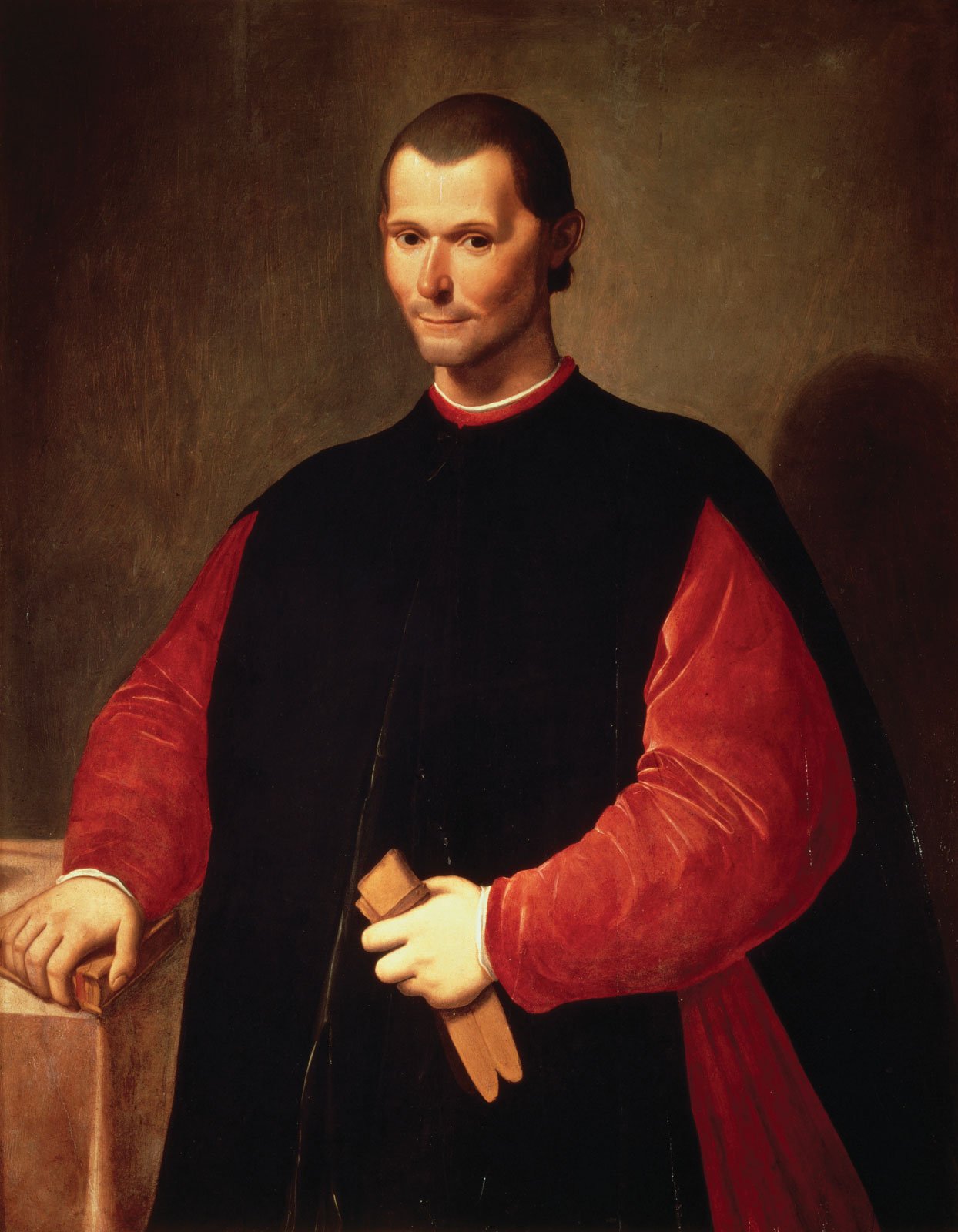
Niccolò Machiavelli was a Renaissance statesman, thinker, poet, and playwright born in Florence in 1469. His best-known political work, The Prince, examines how rulers acquire and preserve power. Yet his writing also includes arguments for republican government, military discussion, history, and comedy. If you know his name mainly through the word “Machiavellian,” those other works help explain why his legacy remains disputed.
Where was Niccolò Machiavelli from?
Niccolò di Bernardo dei Machiavelli was born in Florence on 3 May 1469. His political career developed within the Florentine Republic. In 1498, he received an appointment to its second chancery. He then spent about 14 years in diplomatic service, giving his later political writing a background in public affairs.
Machiavelli married Marietta Corsini in 1501. They had seven children: Primerana, Bernardo, Lodovico, Guido, Piero, Baccina, and Totto. This family history belongs alongside the familiar image of the political strategist. The author of The Prince was also a husband and father during his years of government service.
His career changed sharply in 1512. The Medici family returned to power in Florence, and Machiavelli lost his position. His writing of The Prince followed that removal from office. The sequence matters: the book emerged after a long period of diplomatic work and a sudden loss of political standing.
Niccolò Machiavelli: The Prince explained
Machiavelli wrote The Prince in late 1513 and probably into early 1514. It first appeared in print in 1532, after his death. Its 26 chapters examine different kinds of principalities, how they are acquired, and how they can be maintained. Power is the book’s central practical problem.
Chapter 17 contains the famous discussion of love and fear. Machiavelli argues that, when a ruler cannot combine both, being feared is safer than being loved. But the advice includes a limit: the ruler should avoid becoming hated. If you read only the claim about fear, you miss a qualification within the same discussion.
Chapter 18 develops another memorable image. A ruler should imitate the fox to recognize traps and the lion to frighten enemies. The two animals represent different political capacities. Recognizing danger and intimidating opponents are both necessary within this argument; strength alone does not supply the whole answer.
The final chapter changes the emphasis. Chapter 26 calls for Italy’s liberation from foreign rule. That ending gives the book a specific political destination. Its discussion of acquiring and preserving power concludes with an appeal directed toward Italy, rather than ending with a general maxim about personal success.
What does Machiavellianism mean?
Machiavellianism developed from Machiavelli’s name into an accusatory term. It describes an attitude that accepts any means in pursuit of political objectives. The word therefore carries a judgment about political conduct. Understanding that judgment is useful, but it does not settle how all of Machiavelli’s books should be interpreted.
The disagreement is clear in two contrasting readings. Leo Strauss regarded Machiavelli as a teacher of evil. Rousseau understood The Prince as a work that exposed rulers’ immoral methods to the public. These interpretations assign very different purposes to the same text: instruction for rulers in one reading, disclosure to their subjects in the other.
Machiavelli’s Discourses complicates the accusation further. There, he supports republican government and argues that conflict between the people and the nobles can produce laws that preserve liberty. His political thought therefore includes questions about public freedom alongside the ruler’s struggle to hold power.
Niccolò Machiavelli’s philosophy: virtù and fortuna
Machiavelli’s concept of virtù concerns the abilities that allow a ruler to preserve power. It includes skill and the capacity to adapt to circumstances. Within this political vocabulary, the important question is how effectively someone responds to the conditions they face. The concept belongs to his examination of political action.
In chapter 25 of The Prince, fortuna appears through the image of a flooding river. Its damage can be reduced by building barriers beforehand. The image connects unpredictable events with preparation. Circumstances may be disruptive, but Machiavelli’s comparison leaves room for action before the flood arrives.
You can connect that river image to everyday life through planning ahead. The link rests on the distinction in chapter 25: preparation can reduce the damage caused by events you cannot fully control. Read beside virtù, the comparison brings together changing circumstances and the ability to respond to them.
Niccolò Machiavelli quotes: what did he actually write?
“The ends justify the means” is frequently attributed to Machiavelli. An MIT teaching document on The Prince states that this exact wording does not occur in the text. It should therefore not be presented as a direct quotation from the book. A familiar summary and an author’s actual sentence are different things.
The discussions of fear, the fox and lion, and the flooding river have identifiable places in The Prince: chapters 17, 18, and 25. When you encounter a quotation attached to Machiavelli’s name, these chapter references offer useful context. They preserve the surrounding argument, including the warning against hatred in chapter 17.
Niccolò Machiavelli books: which should you read first?
The Prince is a starting point if your question concerns rulers and political survival. For republican government and liberty, turn to Discourses on the First Ten Books of Titus Livy. Its first edition appeared in Rome in 1531, followed by publication in Florence. Together, these works introduce different concerns within his political thought.
The Art of War, published in 1521, presents his military thinking. Florentine Histories grew from a commission given by Cardinal Giulio de’ Medici in 1520. Machiavelli completed it in 1525. These books extend a reading list beyond the concentrated discussion of rulership in The Prince.
His literary works include Andria, Mandragola, and Clizia. The Internet Encyclopedia of Philosophy dates Mandragola, his most famous play, probably to 1518. He also wrote The Life of Castruccio Castracani of Lucca in 1520. That biography alters its subject’s life and includes fictional elements, so it requires a different reading approach from a straightforward historical account.
Niccolò Machiavelli PDF searches and Hindi ebooks
For an English text of The Prince, Project Gutenberg provides W. K. Marriott’s translation free in HTML, EPUB, and plain text. You can read the HTML edition directly or choose one of the other listed formats. Its ebook record is number 1232, and the full text is linked in the Sources below.
Readers searching for Machiavelli books in Hindi can consult the digital catalogue of the Amir-ud-Daula Public Library in Lucknow. It lists an ebook called Shasak Machiavelli. Access to its content requires user registration. The catalogue entry provides a specific place to look when your reading preference is Hindi.
Niccolò Machiavelli pronunciation
The Italian pronunciation of Niccolò Machiavelli is [nikkoˈlɔ mmakjaˈvɛlli]. The stress marks identify the stressed syllables in Niccolò and Machiavelli. Keeping the spelling and pronunciation together helps connect the name on his books with the name you hear in discussion.
Details you won’t find in guidebooks
In February 1506, about 400 farmers took part in a parade of the militia Machiavelli had organized. They wore armor and carried pikes and small firearms. This episode gives a concrete setting for his military interests: he participated in organizing a force before publishing The Art of War.
Early in 1513, Machiavelli spent 22 days imprisoned and suffered strappado torture, which strained the shoulders. He was released in March. Later that year, he worked on The Prince. Its dedication also changed: initially intended for Giuliano de’ Medici, it was redirected to the younger Lorenzo de’ Medici.
Machiavelli personally directed the first performance of Clizia in January 1525. This theatrical work coincided with the year he completed Florentine Histories. Political history and stage production were both part of his activity during that period.
Niccolò Machiavelli’s death and tomb
Machiavelli died in Florence on 21 June 1527, aged 58. English Wikipedia connects his death with a stomach illness he had experienced since 1525. Both Discourses and The Prince received their first printed editions after his death, in 1531 and 1532 respectively.
He was buried in his family chapel at Santa Croce in 1527. The monumental tomb by Innocenzo Spinazzi was unveiled much later, in 1787. The burial and the monument therefore belong to different dates. For readers interested in his memorial, that distinction explains what the later tomb commemorates.
Timeline
- 1469: Born in Florence on 3 May.
- 1498: Entered the Florentine Republic’s second chancery.
- 1501: Married Marietta Corsini.
- 1506: About 400 members of his militia joined a parade.
- 1512: Lost office after the Medici returned.
- 1513: Imprisoned, tortured, and released; began The Prince late that year.
- 1520: Received the commission for Florentine Histories.
- 1521: The Art of War appeared.
- 1525: Directed Clizia and completed Florentine Histories.
- 1527: Died in Florence on 21 June.
- 1531: Discourses first appeared in print.
- 1532: The Prince first appeared in print.
- 1787: His Santa Croce monument was unveiled.
FAQ
Where was Niccolò Machiavelli born?
He was born in Florence on 3 May 1469. He later served the Florentine Republic and died in Florence on 21 June 1527.
What is The Prince about?
Its 26 chapters examine types of principalities and how rulers acquire and preserve them. The final chapter calls for Italy’s liberation from foreign rule.
Did Machiavelli write that the ends justify the means?
That exact wording does not appear in The Prince, as an MIT teaching document explains. It should not be presented as a direct quotation from the book.
Where can you read Machiavelli online?
Project Gutenberg offers W. K. Marriott’s English translation of The Prince free in HTML, EPUB, and plain text. Lucknow Digital Library also lists the Hindi ebook Shasak Machiavelli, with registration required for access.
Sources
- Stanford Encyclopedia of Philosophy — Niccolò Machiavelli plato.stanford.edu
- Internet Encyclopedia of Philosophy — Machiavelli iep.utm.edu
- Project Gutenberg — The Prince, full text gutenberg.org
- Project Gutenberg — The Prince, ebook record gutenberg.org
- MIT OpenCourseWare — Literature and Ethical Values, Second Paper Assignment ocw.mit.edu
- Opera di Santa Croce — Niccolò Machiavelli Monumental Tomb santacroceopera.it
- English Wikipedia — Niccolò Machiavelli en.wikipedia.org
- Lucknow Digital Library — Shasak Machiavelli lucknowdigitallibrary.com
Image: Portrait of Niccolò Machiavelli by Santi di Tito.jpg — Santi di Tito, Public domain