On 8 September 1941, the last land routes into Leningrad were cut. The city stayed cut off for 872 days. Germans and Finns surrounded it, starved it and shelled it, yet they never took it. This guide covers the dates, the map, the death toll and the people who kept the city alive.
The Siege of Leningrad: A Short Summary
The Siege of Leningrad was a military blockade on the Eastern Front of World War II. German and Finnish forces besieged what is now Saint Petersburg but could not capture it.
The city mattered for three reasons. It was an important base of the Baltic Fleet. It was a centre of arms production. It was also the symbolic city of the Russian Revolution. That is why it was one of the main targets of Operation Barbarossa.
The siege began on 8 September 1941 and ended completely on 27 January 1944. Many sources use the round figure of about 900 days. The exact count is 872.
The sources taken together point to three things that kept the city alive. The first was a military defence that held. The second was supply and evacuation across Lake Ladoga. The third was a land corridor opened in January 1943.
When Did the Siege of Leningrad Take Place?
The siege ran from 8 September 1941 to 27 January 1944. If you are searching for the date, those are the two that matter.
Do not confuse the end date with 18 January 1943. On that day the Red Army opened a narrow land corridor to Leningrad. It was a turning point, but the siege was not fully lifted until 27 January 1944.
Where Was Leningrad, and What Does the Map Look Like?
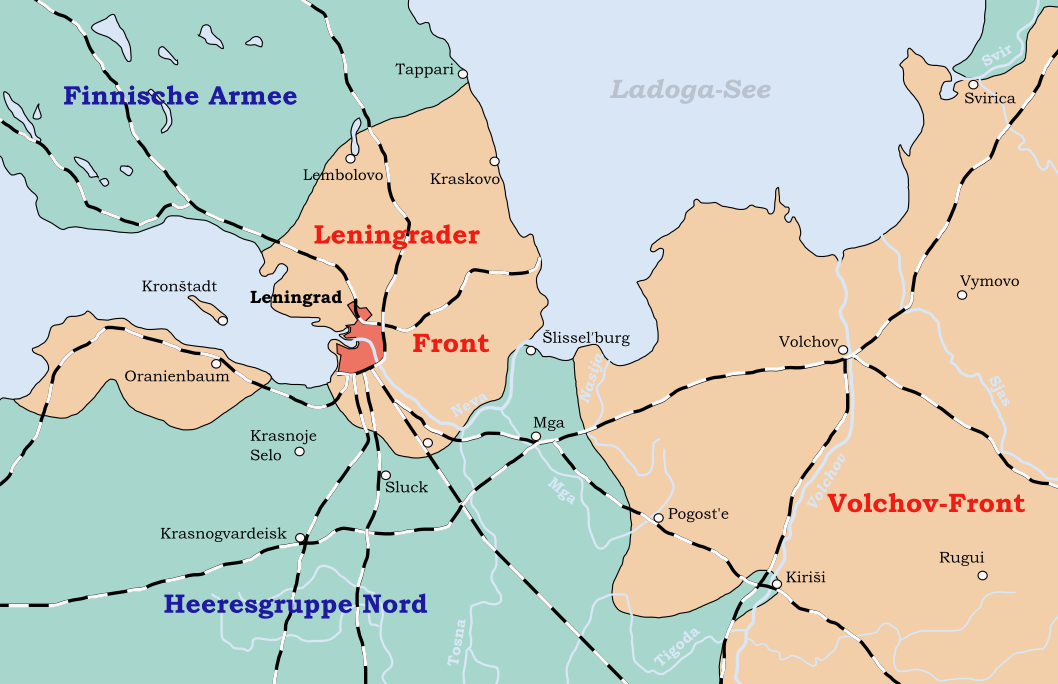
Leningrad is today’s Saint Petersburg. Picture the map in three parts.
- The south and east: German forces captured Shlisselburg on the shore of Lake Ladoga. That cut all of Leningrad’s land connections.
- The north: Finnish troops advanced from this direction.
- The lake: Lake Ladoga became the only way in and out, by ship in warm months and over the ice in winter.
In January 1943 the Red Army opened a corridor south of Lake Ladoga. It was between 4 and 11 kilometres wide. The road built along it, the Victory Road, reconnected Leningrad with the rest of the country.
Why Hitler Chose to Starve the City
Hitler did not want to fight for Leningrad street by street. That would have meant heavy losses. He chose to starve the population instead.
A German directive of 22 September 1941 spelled out the logic. Requests from Leningrad for surrender talks were to be rejected. Germany did not want responsibility for feeding the people.
The city entered this situation poorly prepared. When the siege began, Saint Petersburg’s encyclopaedia says, 2,887,000 people were in the city. Food reserves covered only 30 to 60 days. There was also a serious fuel shortage.
Timeline
- 8 September 1941: Leningrad’s land links are cut and the siege begins.
- 22 September 1941: A German directive orders that surrender talks requested by the city be rejected.
- Winter 1941–1942: Hunger, fuel shortages and failing infrastructure cause mass deaths.
- 2 July 1942: The score of Shostakovich’s Seventh Symphony is flown into the city.
- 9 August 1942: The Seventh Symphony is performed in the besieged city under Karl Eliasberg.
- 18 January 1943: Soviet troops open a land corridor south of Lake Ladoga.
- 27 January 1944: The 872-day siege ends completely.
How Did the City Defend Itself?
Civilians did much of the work. They helped build about 700 kilometres of anti-tank ditches and 635 kilometres of barbed-wire barriers.
Even the famous cruiser Aurora gave up its guns. They were removed and moved to defensive positions south of Leningrad.
The Winter of 1941–1942
The winter of 1941–1942 brought extreme hunger. Irina Zimneva, a survivor, told the Associated Press that each person in her family received only 125 grams of bread a day. Think of a few thin slices from the loaf in your kitchen. That was a whole day’s ration.
Hunger was not the only problem. Heating and electricity were insufficient. Water and sewage lines broke down. Public transport stopped. Each failure made the others harder to survive.
The Road of Life Across Lake Ladoga
In September 1941 the city organised the Road of Life over Lake Ladoga. In warm months, ships carried supplies. When the lake froze, vehicles drove across the ice.
The numbers show its scale. Between September 1941 and March 1943, more than 1.6 million tons of cargo reached Leningrad this way. About 1,376,000 people were evacuated along the same route.
Siege of Leningrad Death Toll and Casualties
There is no single agreed number. Two reputable sources give two ranges:
- The German Historical Museum puts the number of residents who died in siege conditions by the end of January 1944 at 800,000 to 1,000,000.
- The Saint Petersburg Encyclopaedia stresses that the exact figure is unknown. It gives 800,000 to 1,500,000 deaths from hunger or bombardment.
Because the estimates differ so much, quoting one precise figure would mislead you.
The city’s buildings also paid a price. The encyclopaedia says 840 industrial facilities and 3,200 residential buildings were completely destroyed.
Music in a Starving City
One of the best-known episodes is musical. On 2 July 1942, the score of Shostakovich’s Seventh Symphony was flown into the besieged city. On 9 August 1942, the Radio Committee Orchestra performed it under Karl Eliasberg.
The Philharmonic’s own records give exact figures for that evening. There were 1,046 listeners, and the box office took in 8,205 roubles.
Details You Won’t Find in Guidebooks
- Bread that was not only flour. A siege loaf recorded by the State Memorial Museum of the Defence and Siege of Leningrad lists flour, pressed oilcake and malt among its ingredients.
- A concert with a ledger. The Philharmonic’s concert book records the attendance and takings of the 9 August 1942 performance. It treats a historic night as a line in the accounts.
- The Aurora’s guns. The cruiser that symbolises the revolution lost its guns to the defence of the southern approaches.
- A leader’s family loss. According to research reported by The New York Times, Vladimir Putin’s older brother Viktor was born in 1940 and died in 1942 during the siege.
Siege of Leningrad Facts at a Glance
- Start: 8 September 1941. End: 27 January 1944. Length: 872 days.
- Population at the start: 2,887,000 people.
- Food reserves at the start: 30 to 60 days.
- Winter 1941–1942 ration in one family: 125 grams of bread per person per day.
- Road of Life: more than 1.6 million tons of cargo in, about 1,376,000 people out.
- Defences: about 700 km of anti-tank ditches, 635 km of barbed wire.
- Death toll: estimates from 800,000 to 1,500,000.
Books, Photos and Further Reading
If you want a serious book, start with The Leningrad Blockade, 1941–1944 by Richard Bidlack and Nikita Lomagin. It is built on previously secret Soviet archives and republishes 66 documents.
For a visual starting point, the museum’s online record of the siege bread is on Google Arts & Culture. The link is in the sources below.
If you are in Turkey and want to follow the story further, the sources below are good places to start.
FAQ
When did the Siege of Leningrad take place?
It began on 8 September 1941 and ended completely on 27 January 1944. That makes 872 days. A land corridor opened earlier, on 18 January 1943, but it did not lift the siege.
Where was the Siege of Leningrad?
It took place in Leningrad, today’s Saint Petersburg, on the Eastern Front of World War II. German forces closed in from the south. Finnish forces advanced from the north. Lake Ladoga stayed the city’s lifeline.
What was the death toll of the Siege of Leningrad?
No one knows the exact number. The German Historical Museum gives 800,000 to 1,000,000 residents who died in siege conditions by the end of January 1944. The Saint Petersburg Encyclopaedia gives a range of 800,000 to 1,500,000 deaths from hunger or bombardment.
Why did the Germans not simply capture Leningrad?
Hitler chose to starve the population rather than take the city in costly street fighting. A German directive of 22 September 1941 also ordered that any surrender talks requested by Leningrad be rejected, so Germany would not have to feed the people.
Is there a good book on the siege?
The Leningrad Blockade, 1941–1944 by Richard Bidlack and Nikita Lomagin draws on previously secret Soviet archives. It republishes 66 documents.
Sources
- Wikipedia — Siege of Leningrad en.wikipedia.org
- Saint Petersburg Encyclopaedia — Siege of 1941-44 encspb.ru
- Saint Petersburg Encyclopaedia — Road of Life encspb.ru
- Vikipedi — Leningrad Kuşatması tr.wikipedia.org
- Deutsches Historisches Museum — Die Belagerung von Leningrad dhm.de
- Associated Press — Russia marks 80 years since breaking the Nazi siege of Leningrad apnews.com
- St. Petersburg Academic Philharmonia — The Siege Book of the Philharmonic Hall philharmonia.spb.ru
- St. Petersburg Academic Philharmonia — Victory Day amidst the War philharmonia.spb.ru
- Leningrad Siege Museum / Google Arts & Culture — Bread baked during the siege artsandculture.google.com
- Yale University Press — The Leningrad Blockade, 1941-1944 yalebooks.yale.edu
- The New York Times / The Indian Express — Putin: Lost a brother in Leningrad siege indianexpress.com
Image: Leningrad Siege May 1942 – January 1943.png — Memnon335bc, CC BY-SA 3.0