Normandy landings date: why 6 June and not 5 June
The Normandy landings took place on 6 June 1944. Allied forces landed by sea and dropped from the air onto the coast of Normandy in German-occupied France. The plan had named 5 June as the day. Strong winds and heavy cloud over the Channel coast forced a postponement of one day.
If you have ever watched a departure board flip to “delayed” and felt a whole trip unravel, you have a small taste of that night. Thousands of ships and aircraft were already loaded. Everything now depended on a forecast.
Normandy landings WW2: why the Allies opened a second front
The main assault forces came from the United States, the United Kingdom and Canada. Facing them were the troops of Nazi Germany. The Allies judged that a second front in North-West Europe was necessary for two reasons. They wanted to defeat Nazi Germany. They also wanted to ease the pressure on the Soviet army.
The decision had a paper trail. In August 1943, at the Québec Conference, Roosevelt and Churchill reaffirmed the plan to cross the Channel. Its code name was Overlord. From 28 November to 1 December 1943, at the Tehran Conference, Roosevelt, Churchill and Stalin firmed up the commitment to launch Overlord in Northern France in May 1944. The weather would later push that date into June.
Normandy landings location: why Normandy and not Calais
Normandy was chosen over Calais for three reasons. It was less heavily fortified than Calais. It had beaches suited to a landing. It lay within range of Allied fighter aircraft.
General Dwight D. Eisenhower was supreme commander of all Allied land, sea and air forces taking part in the Normandy operation. The British General Bernard Montgomery commanded all Allied ground forces during the landings. The naval part of the wider Overlord operation carried its own code name, Neptune.
Normandy landings map: the five beaches from west to east
If you look at a map of the Normandy landings, read it from west to east. The landing coast ran for about 80 kilometres and was split into five sectors. In order they were Utah, Omaha, Gold, Juno and Sword.
Each sector had a nationality attached. American troops landed at Utah and Omaha. British troops landed at Gold and Sword. Canadian troops landed at Juno. When people ask “D-Day landings, where?”, this five-name line along the Normandy shore is the answer.
Normandy landings weather: the forecast that set the day
The meteorologist James Stagg reported that conditions on 6 June would be marginal but would allow the landings to go ahead. German forecasts told a different story. They predicted that the weather would stay unsuitable for an attack.
That gap between the two forecasts mattered. The Allies went in on a day the defenders did not expect an attack. How the Allied forecasters gained their edge is covered below in the section on details you will not find in guidebooks.
How D-Day unfolded, hour by hour
The operation began in the dark. Around 22:00 on 5 June, the first Allied transport aircraft and gliders took off to carry airborne troops to France. In the early hours of 6 June, before any boat touched sand, British airborne troops captured Pegasus Bridge.
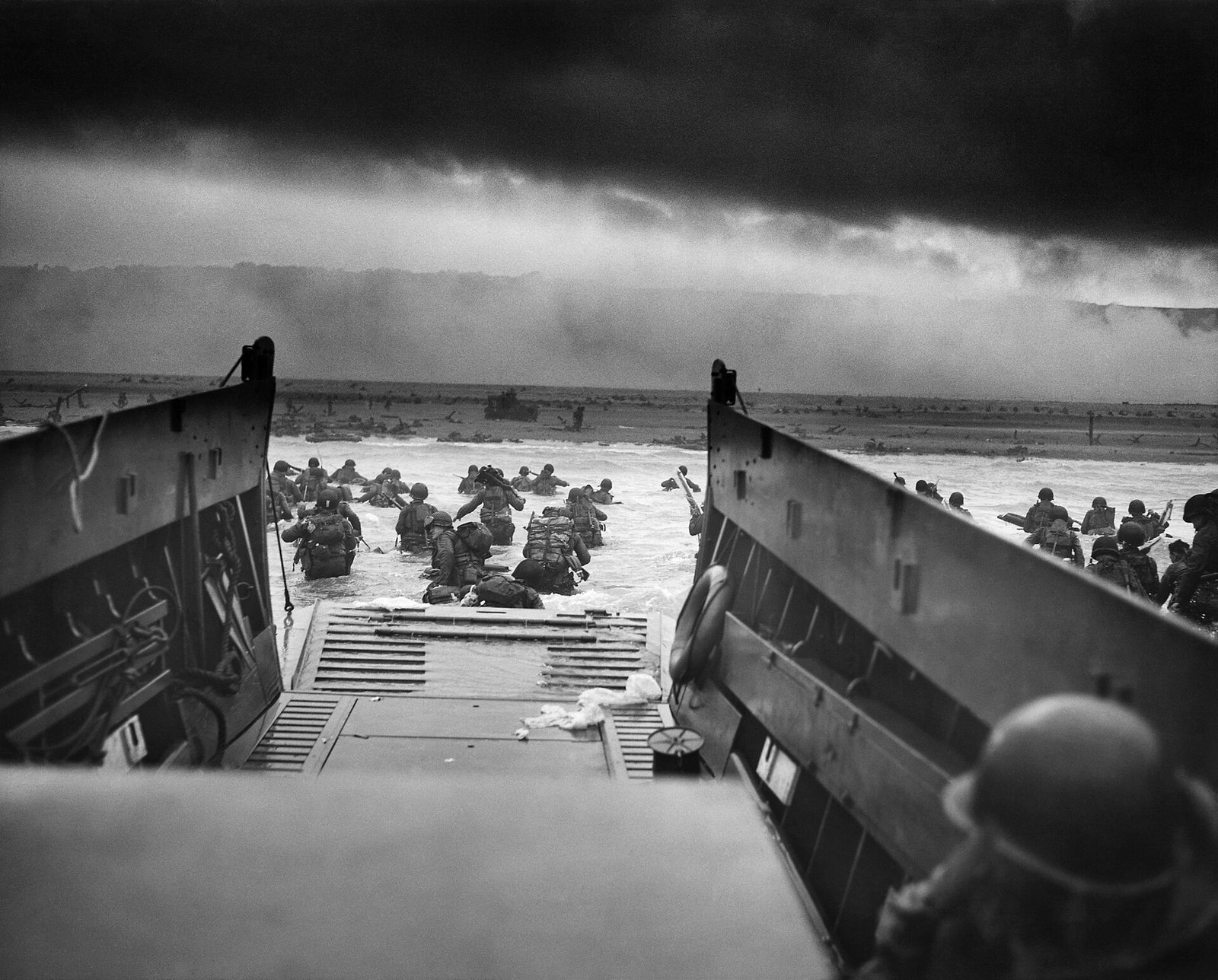
The seaborne assault followed at dawn. At 06:30 on 6 June, the first American waves reached the shore at Utah and Omaha. The British and Canadian landings on the other beaches began about an hour later.
Omaha needed help from the sea. From around 08:00, American destroyers off Omaha brought German positions under fire. That support helped the troops on the beach move forward.
By the end of the day, about 156,000 Allied soldiers had reached Normandy by sea and air. The Allies had set up beachheads in all five landing sectors. That made the first day of the operation a success.
The front was not yet one line. On 6 June only the Gold and Juno beachheads joined up. The link between all five landing areas was completed on 12 June.
Normandy landings casualties: what the numbers say
The cost was heavy. The current page of the National D-Day Memorial records 4,436 Allied soldiers killed on 6 June 1944. Total Allied casualties that day were at least 10,000. That figure covers the wounded and the missing as well as the dead.
German losses on 6 June are not known with precision. Estimates put the German total of killed, wounded, missing and captured at between 4,000 and 9,000.
Timeline
- August 1943: Roosevelt and Churchill reaffirm the Overlord plan at the Québec Conference.
- 28 November to 1 December 1943: At the Tehran Conference the commitment to land in Northern France in May 1944 is made firm.
- 5 June 1944: The landings are postponed by one day because of bad weather.
- 5 June 1944, around 22:00: The first airborne aircraft and gliders leave for France.
- 6 June 1944, early hours: British airborne troops capture Pegasus Bridge before the seaborne landings.
- 6 June 1944, 06:30: American troops begin landing at Utah and Omaha.
- 6 June 1944, about an hour after the American landings: British and Canadian troops begin reaching the other landing beaches.
- 6 June 1944, around 08:00: American destroyers open heavy supporting fire on German positions at Omaha.
- 6 June 1944, end of day: Beachheads hold on all five beaches. Gold and Juno are linked.
- 8 June 1944: The temporary American Saint-Laurent Cemetery is established.
- 12 June 1944: All five beachheads are joined into one front.
Details you won’t find in guidebooks
The German weather reports helped the Allies. Breaking the Enigma ciphers let Allied meteorologists use German weather observations alongside their own. Stagg’s forecast rested on more data than the German side knew it was sharing.
Utah was hit in the wrong place. The first American landing craft at Utah were pushed by strong currents about 1,800 metres south of the intended zone. The landing went on from there.
One destroyer nearly emptied its magazines. The USS Carmick had brought 1,500 five-inch shells to Normandy. It fired 1,127 of them in under an hour while supporting the troops at Omaha.
Fake paratroopers fell from the sky. On the night of the landings the Allies dropped 450 dummy parachutists stuffed with sand and straw. The dummies were nicknamed Rupert. Their job was to confuse the Germans about where the real drops were.
The guns at Pointe du Hoc were wooden. The Germans had moved the real 155-millimetre guns inland and replaced them with wooden fakes. American Rangers found the real guns on the morning of 6 June and put them out of action.
Normandy landings tours and museums: what you can see today
The five-beach line still shapes most visits. The names from the map, Utah, Omaha, Gold, Juno and Sword, mark the stops. Pegasus Bridge and Pointe du Hoc are the two sites from the first hours of the day.
Two places anchor the memory of the dead and the Canadian story. The Normandy American Cemetery at Colleville-sur-Mer lies on the ground where the US First Army set up the temporary Saint-Laurent Cemetery on 8 June 1944. The Juno Beach Centre at Courseulles-sur-Mer opened on 6 June 2003 to present Canada’s Second World War heritage.
Normandy landings movies
The 1962 film The Longest Day is based on Cornelius Ryan’s 1959 book and follows the landings from the evening of 5 June to the evening of 6 June.
FAQ
What is the date of the Normandy landings?
The landings took place on 6 June 1944. They had been planned for 5 June but were postponed by one day because of strong winds and heavy cloud over the Channel coast.
Where exactly did the D-Day landings happen?
On the coast of Normandy in German-occupied Northern France, along roughly 80 kilometres of shore divided into five sectors: Utah, Omaha, Gold, Juno and Sword.
How many soldiers died in the Normandy landings on 6 June 1944?
The National D-Day Memorial records 4,436 Allied dead for 6 June 1944. Total Allied casualties, including wounded and missing, were at least 10,000. German losses are estimated at 4,000 to 9,000 killed, wounded, missing and captured.
Which Normandy landings museums can you visit?
The Normandy American Cemetery at Colleville-sur-Mer stands where the US First Army set up the temporary Saint-Laurent Cemetery on 8 June 1944. The Juno Beach Centre at Courseulles-sur-Mer opened on 6 June 2003 and tells Canada’s Second World War story.
Sources
- Wikipedia — Normandy landings en.wikipedia.org
- Vikipedi — Normandiya Çıkarması tr.wikipedia.org
- National Army Museum — D-Day nam.ac.uk
- US National Archives — General Dwight D. Eisenhower’s Order of the Day archives.gov
- US Department of State, Office of the Historian — The Tehran Conference, 1943 history.state.gov
- US Naval History and Heritage Command — Operation Neptune history.navy.mil
- Met Office — D-Day 6 June 1944 (weather factsheet) metoffice.gov.uk
- Met Office — D-Day: the most important weather forecast in history metoffice.gov.uk
- RAF Museum — D-Day Through the RAF Museum’s Collection cms.rafmuseum.org.uk
- American Battle Monuments Commission — Pointe du Hoc brochure abmc.gov
- National D-Day Memorial dday.org
- American Battle Monuments Commission — About Normandy American Cemetery abmc.gov
- Air University — Operation Overlord after 70 years airuniversity.af.edu
Image: Into the Jaws of Death 23-0455M edit.jpg — Chief Photographer’s Mate (CPHoM) Robert F. Sargent, Public domain