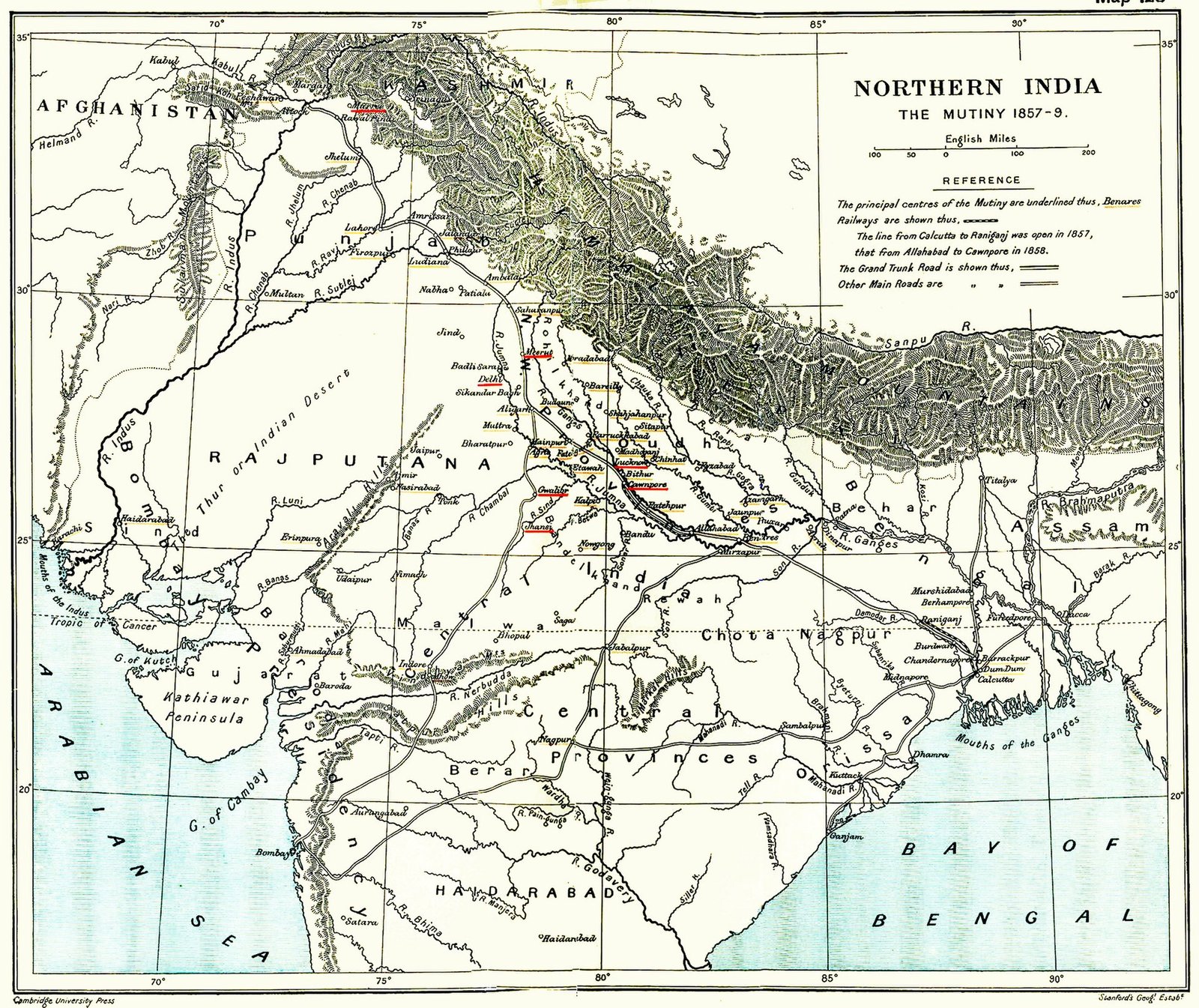
If you stand in front of a map of India and point to Delhi, Kanpur, Lucknow, Jhansi and Gwalior, you have found the heart of the Indian Rebellion of 1857. It began as a revolt of soldiers. It grew into a major challenge to British rule in India. This guide gives you the short version, the key names, the debates and a few objects you can still see in museums.
The Indian Rebellion of 1857: a short summary
On 10 May 1857, soldiers of the East India Company rose at Meerut. Their uprising spread across northern and central India. Civilians and local rulers joined the soldiers.
Three strands came together:
- Religious fears about new cartridges.
- Unequal conditions inside the Company’s army.
- Anger at annexations and at colonial rule in general.
The British won. In 1858 the Company’s rule gave way to rule by the Crown. Historians still argue about what to call the event and how many people died.
When did the Indian Rebellion of 1857 start?
The general uprising started on 10 May 1857 at Meerut. Company soldiers there rebelled. They freed 85 soldiers of the 3rd Bengal Light Cavalry. Those men had been imprisoned because they refused to use cartridges that they believed went against their religion.
There was an earlier spark. On 29 March 1857, Mangal Pandey attacked British officers at Barrackpore, near Calcutta. He was executed on 8 April 1857. That was about a month before Meerut.
The rebels from Meerut then reached Delhi. They sought the support and leadership of the Mughal ruler Bahadur Shah II.
Why did the rebellion happen?
The famous trigger was the cartridge. A rumour spread that cartridges for the Pattern 1853 Enfield rifle were greased with pig and cow fat. The National Army Museum presents this as a rumour that fed the religious worries of Muslim and Hindu soldiers.
The same museum does not treat the cartridge as the only cause. It also points to conditions in the Bengal Army:
- Low pay.
- Blocked promotion.
- Poor service conditions.
Politics mattered too. In 1856 the British removed the ruler of Awadh, saying he was unfit to govern. This increased the resentment of local rulers.
Think of a workplace where pay is low, promotions never come and a new rule offends your beliefs. One more order can make people walk out. In 1857 the cartridge was that last order.
Revolt against the Company was not new, either. According to a source collection of the National Archives of India, the 1806 sepoy mutiny at Vellore was a major earlier rebellion against the East India Company.
Where was the Indian Rebellion of 1857? A map in words
On a map, the rebellion’s main centres sit in northern and central India. Look for these five cities:
- Delhi. The rebels from Meerut arrived here and turned to Bahadur Shah II.
- Kanpur. In June 1857, rebels led by Nana Sahib besieged the British garrison.
- Lucknow. The British Residency here was besieged and later relieved.
- Jhansi. This was the state of its ruler, Lakshmibai.
- Gwalior. The rebel forces were defeated here, but Tatya Tope kept fighting.
Not all of India joined. Some Indian groups backed the British, as you will see below.
Leaders of the rebellion
The best-known names include:
- Lakshmibai, ruler of Jhansi.
- Tatya Tope.
- Begum Hazrat Mahal.
- Bakht Khan.
- Kunwar Singh.
- Nana Sahib, leader of the rebels who besieged Kanpur.
- Bahadur Shah II, the Mughal ruler whose support the Delhi rebels sought.
- Mangal Pandey, who attacked his officers before the general uprising.
Tatya Tope kept fighting after the defeat at Gwalior. He was caught in April 1859 and hanged.
How the British won
The British took Delhi back after an assault that began on 14 September 1857. It was followed by about a week of street fighting.
On 22 November 1857, forces under Colin Campbell evacuated the people besieged in the Lucknow Residency.
The rebels also lost Gwalior. Fighting did not formally end until 8 July 1859, when British authorities declared the conflict over.
Death toll of the Indian Rebellion of 1857
No one number is accepted. Two estimates show the range:
- The Royal Hampshire Regiment Museum says more than 100,000 Indians were killed in the 1857–1859 rebellion.
- A broader estimate includes famine and epidemics caused by the conflict. It speaks of about 800,000 Indian deaths. Its basis, however, is pre-1857 population data with reliability problems.
If you read a single confident figure, check what it counts. Combat deaths and famine deaths are very different totals.
Mutiny, rebellion or war of independence?
The name you choose is an argument.
- ‘Sepoy Mutiny’ stresses the military beginning of the event.
- ‘First War of Independence’ stresses that Indian civilians also fought colonial rule.
The Bodmin Keep museum warns against the idea that all of India fought one united war. In 1857 there was no political unity. Some Indian groups, such as the Sikh forces in Punjab, supported the British.
Timeline
- 1806: Soldiers mutiny against the East India Company at Vellore.
- 1856: The British remove the ruler of Awadh.
- 29 March 1857: Mangal Pandey attacks officers at Barrackpore.
- 8 April 1857: Mangal Pandey is executed.
- 10 May 1857: The general uprising begins at Meerut.
- September 1857: The British retake Delhi.
- 22 November 1857: The besieged at the Lucknow Residency are evacuated.
- 1858: Authority over India passes from the Company to the Crown.
- 1 November 1858: Queen Victoria’s proclamation to the people of India is issued.
- April 1859: Tatya Tope is caught and hanged.
- 8 July 1859: British authorities declare the fighting officially over.
What changed afterwards
The 1858 Government of India Act handed the East India Company’s powers in India to the British Crown. Company rule was over.
On 1 November 1858, Queen Victoria issued a proclamation. It promised the people of India rights similar to those of other British subjects.
The rebellion in painting and film
One well-known painting is Henry Nelson O’Neil’s Home Again, 1858, dated 1859. It shows wounded soldiers returning from the war in India and meeting their families in England. You see the war from the home front, not the battlefield.
On screen, Ketan Mehta’s 2005 Hindi film Mangal Pandey: The Rising tells the story of one of the rebellion’s early figures.
Details you won’t find in guidebooks
- Some rebels simply went home. The National Army Museum notes that part of the rebelling soldiers returned to their homes instead of fighting the British. They helped neither side.
- A silver fly whisk. The same museum displays a silver fly whisk looted from Bahadur Shah II’s palace in Delhi in 1857.
- A lock of hair in a snuffbox. Its collection includes a snuffbox holding a lock of Tatya Tope’s hair, cut after his execution in 1859.
- Months at sea. British troops sent to India to crush the rebellion spent months on troopships on the voyage round the Cape of Good Hope.
FAQ
When did the Indian Rebellion of 1857 start?
The general uprising began on 10 May 1857 at Meerut, when East India Company soldiers rose against their officers. Mangal Pandey had attacked British officers earlier, on 29 March 1857, at Barrackpore near Calcutta.
Where was the Indian Rebellion of 1857 fought?
The main centres were in northern and central India: Delhi, Kanpur, Lucknow, Jhansi and Gwalior.
How many people died in the Indian Rebellion of 1857?
No single figure is agreed. The Royal Hampshire Regiment Museum says more than 100,000 Indians were killed in 1857–1859. A wider estimate that includes famine and disease reaches about 800,000, but the pre-1857 population data behind it is unreliable.
Was the 1857 rebellion a war of independence?
Historians disagree. The label ‘First War of Independence’ stresses that Indian civilians fought colonial rule. Critics note there was no political unity in 1857 and that groups such as the Sikh forces in Punjab supported the British.
What changed after the rebellion?
The 1858 Government of India Act moved the East India Company’s powers in India to the British Crown. On 1 November 1858 Queen Victoria issued a proclamation promising Indians rights similar to those of other British subjects.
Sources
- National Army Museum — Why did the Indian Rebellion happen? nam.ac.uk
- National Army Museum — Decisive events of the Indian Rebellion nam.ac.uk
- National Army Museum — Home Again, 1858 nam.ac.uk
- Wikipedia — Indian Rebellion of 1857 en.wikipedia.org
- Bodmin Keep — Mutiny, Rebellion or War of Independence? bodminkeep.org.uk
- National Archives of India — Sources on Indian History nationalarchives.nic.in
- Royal Hampshire Regiment Museum — The 37th and the Indian Mutiny royalhampshireregiment.org
- London Museum — Home Again, 1858 londonmuseum.org.uk
Image: Indian Rebellion of 1857.jpg — Unknown authorUnknown author Cambridge University Press; Sta, Public domain