The short answer
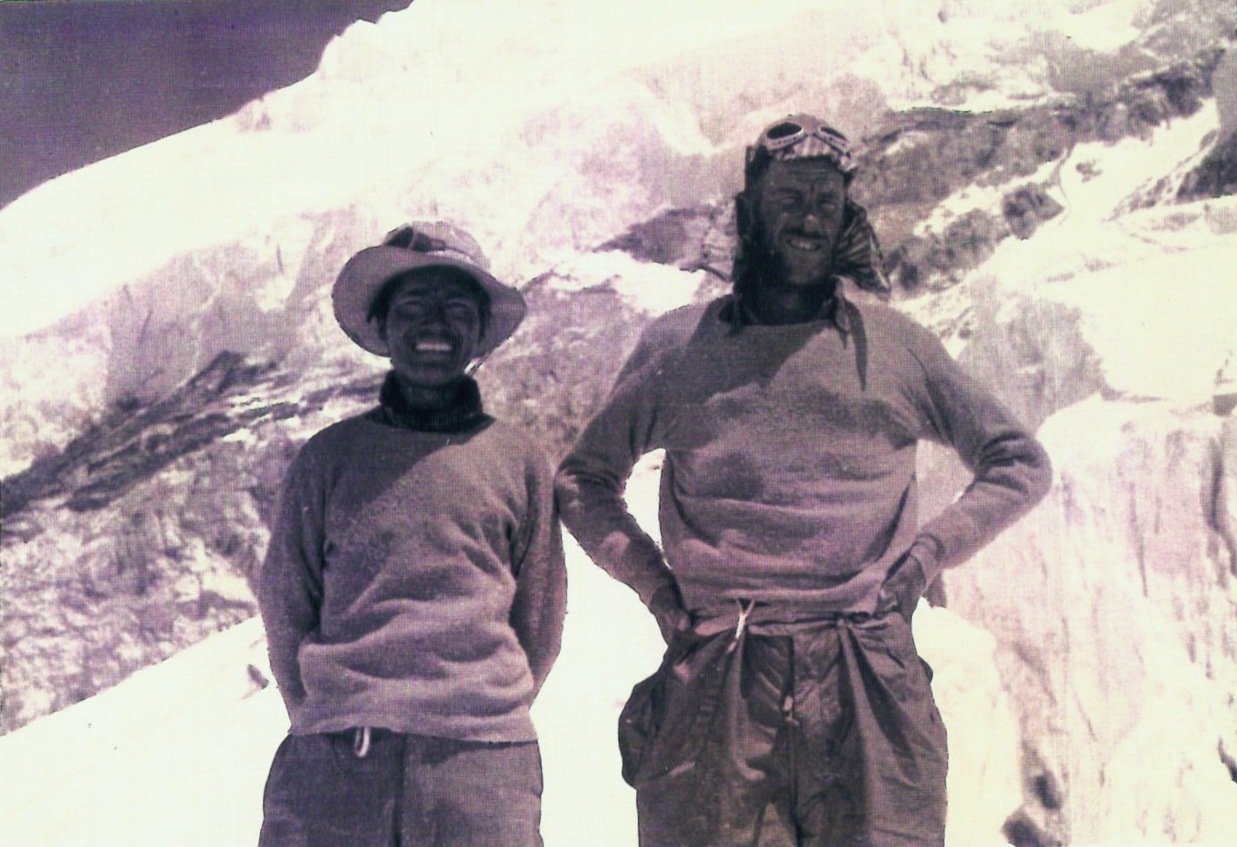
On 29 May 1953, at 11.30, Edmund Hillary and Tenzing Norgay stood on top of Everest. It was the first documented successful ascent of the mountain. They climbed from the Nepal side and followed the southeast ridge. The climb was part of a British expedition led by John Hunt.
Norgay was a Sherpa climber. Hillary was a New Zealander. Two men from very different places shared one rope.
The mountain
Everest sits in the Mahalangur Himal section of the Himalayas in Asia. It lies on the border between Nepal and China’s Tibet region. In Nepali it is called Sagarmatha. In Tibetan it is called Chomolungma.
Nepal and China jointly announced a new height in 2020: 8,848.86 metres above sea level. That makes Everest the highest mountain on Earth when measured from sea level to the summit.
The Royal Geographical Society says the average temperature on the summit in July, the warmest month, is about −18 °C. Think of waiting at a bus stop on the coldest morning of your winter, with your fingers aching. Now imagine that being the warm season, at a height where you need bottled oxygen to keep moving.
Who was Edmund Hillary?
Edmund Percival Hillary was born on 20 July 1919 in Auckland, New Zealand. Before Everest he was a mountaineer who also worked in his family’s beekeeping business. He was not a professional explorer. He was a beekeeper who climbed.
Tenzing Norgay: Sherpa, climber, veteran
Tenzing Norgay was a Sherpa climber born in May 1914. He is associated with both Nepal and India.
By 1953 he was no beginner. He had joined the Everest expeditions of 1935, 1936 and 1938 as a high-altitude porter. In spring 1952 he went up with the Swiss expedition. He and Raymond Lambert reached about 28,200 feet. The 1953 success was his seventh expedition to Everest.
Where was Tenzing Norgay born?
Nobody can say for certain. Norgay said in his own account that he was born in the Tengboche area of Nepal. Some later accounts name Tse Chu in the Kama Valley of Tibet. One of those accounts is a book co-written by his son Jamling.
He did not know his exact birthday either. After the Everest success he chose 29 May, the day of the summit, as the day to celebrate it. So his birth date in the books is a month, May 1914, and nothing more precise.
The 1953 expedition
The successful 1953 climb was a British expedition led by John Hunt. It was a team effort. Several pairs had a chance at the summit, and the first pair did not make it.
On 26 May 1953, Tom Bourdillon and Charles Evans reached the South Summit of Everest. They could not continue to the main summit and turned back. That left the second attempt to Hillary and Norgay.
The final push
On 28 May 1953, Hillary and Norgay set up Camp IX at about 8,503 metres. They were supported by George Lowe, Alfred Gregory and Ang Nyima.
On the morning of 29 May, at 06.30, the two men began the final climb. They used open-circuit oxygen equipment. Five hours later, at 11.30, they were on the summit.
They stayed there about 15 minutes. Hillary took the now-famous photograph of Norgay posing with his ice axe.
Who stepped first?
This question followed them for years. John Hunt stressed that the success belonged to both men. Norgay settled it in his 1955 autobiography. He wrote that Hillary took the first step onto the summit.
Was Everest climbed before 1953?
George Mallory and Andrew Irvine disappeared in 1924 while attempting the summit. Some people argue they may have reached the top first. A 1999 search expedition could not prove that they did. So the 1953 climb remains the first documented successful ascent.
Timeline
- May 1914: Tenzing Norgay is born. His exact birthday and birthplace are uncertain.
- 20 July 1919: Edmund Hillary is born in Auckland.
- 1924: George Mallory and Andrew Irvine disappear during their summit attempt.
- 1935: Norgay joins an Everest expedition as a high-altitude porter.
- Spring 1952: Norgay and Raymond Lambert reach about 28,200 feet on the Swiss expedition.
- 26 May 1953: Bourdillon and Evans reach the South Summit and turn back.
- 28 May 1953: Hillary and Norgay set up their last high camp.
- 29 May 1953: Hillary and Norgay reach the summit at 11.30.
- 4 November 1954: The Himalayan Mountaineering Institute is founded in Darjeeling.
- 1961: Hillary oversees the building of a school in Khumjung.
- 9 May 1986: Norgay dies in Darjeeling.
- 11 January 2008: Hillary dies in Auckland.
- 2020: Nepal and China announce Everest’s height as 8,848.86 metres.
Details you won’t find in guidebooks
- A rope that saved a life. During the 1953 expedition Hillary fell into a crevasse. Norgay held the rope with his ice axe and stopped the fall.
- A thermometer at −27 °C. In Hillary’s own published account, the camp thermometer read −27 °C just before the final climb.
- Ice in the oxygen set. On the way up, the outlet tube on Norgay’s oxygen equipment became blocked with ice. Hillary cleared it and fixed the problem.
- Tent ropes tied to oxygen cylinders. At Camp IX, the two men could not find suitable rocks to anchor the tent. They tied the tent ropes to oxygen cylinders instead.
- A birthday chosen by the climber. Norgay did not know his birth date, so he picked the day of the summit, 29 May.
After Everest
Both men received honours. Hillary was knighted. Norgay received the George Medal.
Norgay’s later work stayed with the mountains. The Everest success helped inspire the Himalayan Mountaineering Institute, founded in Darjeeling on 4 November 1954. Norgay became its first field training director.
Hillary turned to Nepal’s communities. In 1961 he oversaw the construction of a school in the village of Khumjung.
Norgay died in Darjeeling on 9 May 1986. Hillary died in Auckland on 11 January 2008.
Why Everest remains hard
The mountain is still dangerous. When climbers die on Everest, bringing their bodies down is difficult and expensive. It takes many people working on icy slopes. That gives you a sense of the effort the 1953 team put in.
FAQ
Who made the first ascent of Everest?
Edmund Hillary of New Zealand and Tenzing Norgay, a Sherpa climber, reached the summit at 11.30 on 29 May 1953. It was the first documented successful ascent.
Was Tenzing Norgay a Sherpa?
Yes. He was a Sherpa climber associated with Nepal and India. He worked as a high-altitude porter on Everest expeditions in 1935, 1936 and 1938 before 1953.
Where was Tenzing Norgay born?
It is disputed. In his own account he said he was born in the Tengboche area of Nepal. Some later accounts, including a book co-written by his son Jamling, name Tse Chu in Tibet’s Kama Valley. He did not know his exact birthday, so he chose to celebrate it on 29 May.
Sources
- Wikipedia — Tenzing Norgay en.wikipedia.org
- Royal Geographical Society — Everest 1953 rgs.org
- NZ History — Hillary and Tenzing reach summit of Everest nzhistory.govt.nz
- NZ History — The early years nzhistory.govt.nz
- Te Ara — Hillary, Edmund Percival teara.govt.nz
- Himalayan Mountaineering Institute — Legendary Mountaineers of HMI hmidarjeeling.com
- Himalayan Mountaineering Institute — Origin and Growth hmidarjeeling.com
- The Alpine Journal — Edmund Hillary, Everest, 1953: The Last Lap alpinejournal.org.uk
- Christchurch City Libraries — Sir Edmund Hillary my.christchurchcitylibraries.com
- Royal Geographical Society — Sir Edmund Hillary obituary rgs.org
- Wikipedia (Turkish) — Everest Dağı tr.wikipedia.org
- Royal Geographical Society — Mount Everest rgs.org
Image: Tenzing and Hillary.jpg — Dirk Pons, CC BY-SA 3.0