You have probably heard the name before. Fewer people know how different the stories behind it are. The Queen of Sheba appears in the Bible, in the Quran and in an Ethiopian national epic. Each one tells her story in its own way.
This guide sets the three versions side by side. It also tells you what archaeology can and cannot confirm.
Queen of Sheba meaning: a title, not a name
“Queen of Sheba” is a title. It means “Queen of Saba”. In Turkish she is also called Belkıs.
Her personal name is never given in the Bible or the Quran. Later traditions filled the gap. Belkıs is the name used in Arab-Islamic tradition. Makeda is the name used in Ethiopian tradition.
So when someone says “Belkıs” or “Makeda”, they mean the same figure seen through different traditions.
Queen of Sheba in the Bible
The visit to Solomon is told in two Old Testament passages. They are 1 Kings 10:1–13 and 2 Chronicles 9:1–12.
In 1 Kings 10:1–3 the queen travels to Jerusalem with a caravan of camels. They carry spices, gold and precious stones. She comes to test Solomon’s wisdom with hard questions.
The text says Solomon answered all of them. It does not record what she asked. That is a gap you will not see in most retellings.
Verse 10 gives one precise number. The queen gives Solomon 120 talents of gold.
Verse 13 ends the visit. Solomon gives the queen gifts, and she returns to her own land with her attendants.
Notice what is missing. The passage mentions no marriage. It mentions no child born to the two of them.
The New Testament refers to her too. In Matthew 12:42 and Luke 11:31, the ruler who came to hear Solomon’s wisdom is called the “Queen of the South”.
The Quran version: the hoopoe, the throne and the glass floor
In the Quran the queen appears in Surah An-Naml, verses 22–44. Her name is not given there either.
The story begins with a bird. A hoopoe (hüdhüd) tells Solomon that a woman rules the land of Saba. It adds that the ruler and her people worship the sun.
Solomon sends a letter. It opens with the basmala, the phrase “In the name of God”. The queen does not answer alone. She asks the leading men of her country for advice.
She then sends gifts. Solomon rejects them and sends the envoy back.
The throne scene comes next. In An-Naml 27:39–40 an ifrit offers to bring the queen’s throne. Then a person with knowledge of the Book says he can bring it in the blink of an eye. Solomon sees the throne beside him.
The verses speak of a throne. They do not mention a sword belonging to the queen.
The last scene is the glass floor. In An-Naml 27:44 the queen mistakes the crystal floor for water and lifts her skirt. Solomon explains that the floor is glass. She then declares that she submits, together with Solomon, to God, the Lord of the worlds.
Queen of Sheba and Ethiopia: Makeda and the Kebra Nagast
Ethiopia’s version is told in the Kebra Nagast. It is a 14th-century work written in Ge’ez.
In it the queen is Makeda. Her son with Solomon is Menelik I. According to the legend, he starts the line of rulers whom Ethiopian kings traced back to Solomon.
The legend goes on. The adult Menelik visits his father in Jerusalem. When he returns, his party carries the Ark of the Covenant to Ethiopia.
Here you should keep the labels straight. This is legend, not documented history. The 1 Kings account has no son and no marriage.
The story was still being retold in the 20th century. Paintings shown in the Ethiopia at the Crossroads exhibition tell Makeda and Solomon’s story in arrangements of 44 separate scenes. Think of it as a comic strip on canvas.
Queen of Sheba: where is Sheba, and where is she from?
Sheba is the Saba Kingdom of South Arabia, in what is now Yemen. Its administrative, cultural and economic capital was Marib. Archaeological remains and inscriptions survive there.
UNESCO says Saba was an important political and cultural power in South Arabia. It held that position between the 8th century BCE and the 3rd century CE. Its position on the incense trade routes made this possible.
In 2023 seven archaeological sites representing the Saba heritage at Marib were added to two UNESCO lists. They are the World Heritage List and the List of World Heritage in Danger.
So the answer depends on which tradition you ask. The Bible and the Quran point toward Saba. The Ethiopian tradition gives the queen an Ethiopian story as Makeda.
Two temples at Marib carry her name in popular use. The Awwam temple is called Mahram Belkıs. The Bar’an temple is called Arş Belkıs. Archaeology has not confirmed any link between these names and the queen.
Was she real? The debate
The traditional date for Solomon’s contemporary queen is the 10th century BCE. That date does not come from an inscription made by the queen herself.
Jillian Stinchcomb of Brandeis University says there is no archaeological evidence that the Queen of Sheba lived.
The TDV İslâm Ansiklopedisi answers from the other side. It says the absence of concrete documents does not, by itself, prove she never lived.
Both statements can be true at once. The kingdom is documented. The woman and the visit are not.
Timeline
- 10th century BCE: The period where tradition places the queen’s visit to Solomon. The exact date and the historicity of the visit are not confirmed.
- 8th century BCE–3rd century CE: According to UNESCO, the Saba Kingdom stands out as a political and cultural power in South Arabia.
- 14th century: The Ge’ez Kebra Nagast forms the main written account of the Makeda–Solomon–Menelik legend.
- 2023: Seven Saba heritage sites at Marib are added to UNESCO’s World Heritage and World Heritage in Danger lists.
Details you won’t find in guidebooks
- The Bible does not say what the queen asked. It only says Solomon answered everything.
- The queen’s gift in 1 Kings 10:10 is counted exactly: 120 talents of gold.
- The glass floor scene is in the Quran. In An-Naml 27:44 the queen lifts her skirt because she thinks the floor is water.
- Evliya Çelebi records that ruins across the Near East and Anatolia were called the palace of Belkıs or Balkız. If you travel in Turkey, you may meet the name on a local ruin. It is a folk name.
- Twentieth-century Ethiopian paintings split her story into 44 scenes.
Why the story lasts
The core of it is simple. A ruler hears about a wise king, travels far, tests him with hard questions, and comes home with gifts.
You know this situation from daily life. Think of a job interview or a visit to a well-known expert. You bring your hardest question to see if the reputation holds up.
The traditions then pull the story in different directions. The Bible keeps it to a state visit. The Quran turns it into a story about belief and submission. The Kebra Nagast turns it into a founding story for a dynasty.
That is why the same woman has two personal names, Belkıs and Makeda. Each tradition kept the story that mattered to it.
FAQ
Was the Queen of Sheba a real person?
It is not settled. Jillian Stinchcomb of Brandeis University says there is no archaeological evidence that she lived. The Turkish encyclopedia TDV İslâm Ansiklopedisi replies that missing documents alone do not prove she never existed. The kingdom of Saba, by contrast, is well documented.
Where is Sheba?
The Saba Kingdom was in South Arabia, in today’s Yemen. Its capital was Marib, where archaeological remains and inscriptions survive. Ethiopian tradition tells the queen’s story differently and calls her Makeda.
What does the name Queen of Sheba mean?
It is a title meaning ‘Queen of Saba’. It is not a personal name. Neither the Bible nor the Quran gives her name. Arab-Islamic tradition calls her Belkıs, and Ethiopian tradition calls her Makeda.
Did the Queen of Sheba marry Solomon?
Not in the Bible. The visit story in 1 Kings 10:1–13 mentions no marriage and no shared child. The son Menelik comes from the Ethiopian Kebra Nagast, a 14th-century text.
Sources
- Wikipedia — Queen of Sheba en.wikipedia.org
- Vikipedi — Belkıs (Saba Melikesi) tr.wikipedia.org
- TDV İslâm Ansiklopedisi — Belkıs islamansiklopedisi.org.tr
- Bible Gateway — 1 Kings 10:1–13, NIV biblegateway.com
- Diyanet — Neml sûresi 36–40. ayetler kuran.diyanet.gov.tr
- Diyanet — Neml sûresi 41–44. ayetlerin tefsiri kuran.diyanet.gov.tr
- Peabody Essex Museum / Walters Art Museum — Ethiopia at the Crossroads exhibition text s3.us-east-1.amazonaws.com
- UNESCO — Landmarks of the Ancient Kingdom of Saba, Marib whc.unesco.org
- National Geographic — Where did the Queen of Sheba rule—Arabia or Africa? nationalgeographic.com
- Brandeis University — An Obscure Biblical Figure, a Black Feminist Pop Icon brandeis.edu
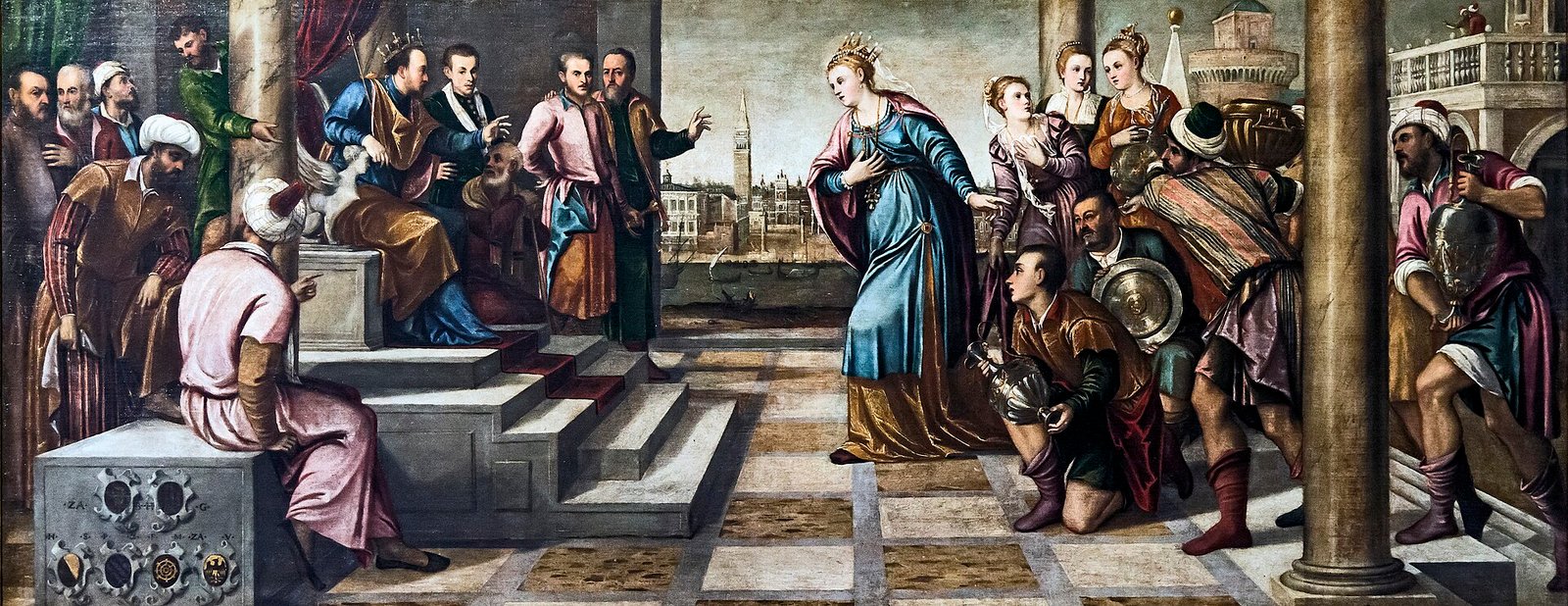
Image: Frari (Venice) – Sacristy – Visit of the Queen of Sheba to Solomon by Bonifacio de’Pitati.jpg — Bonifazio Veronese, CC BY-SA 4.0