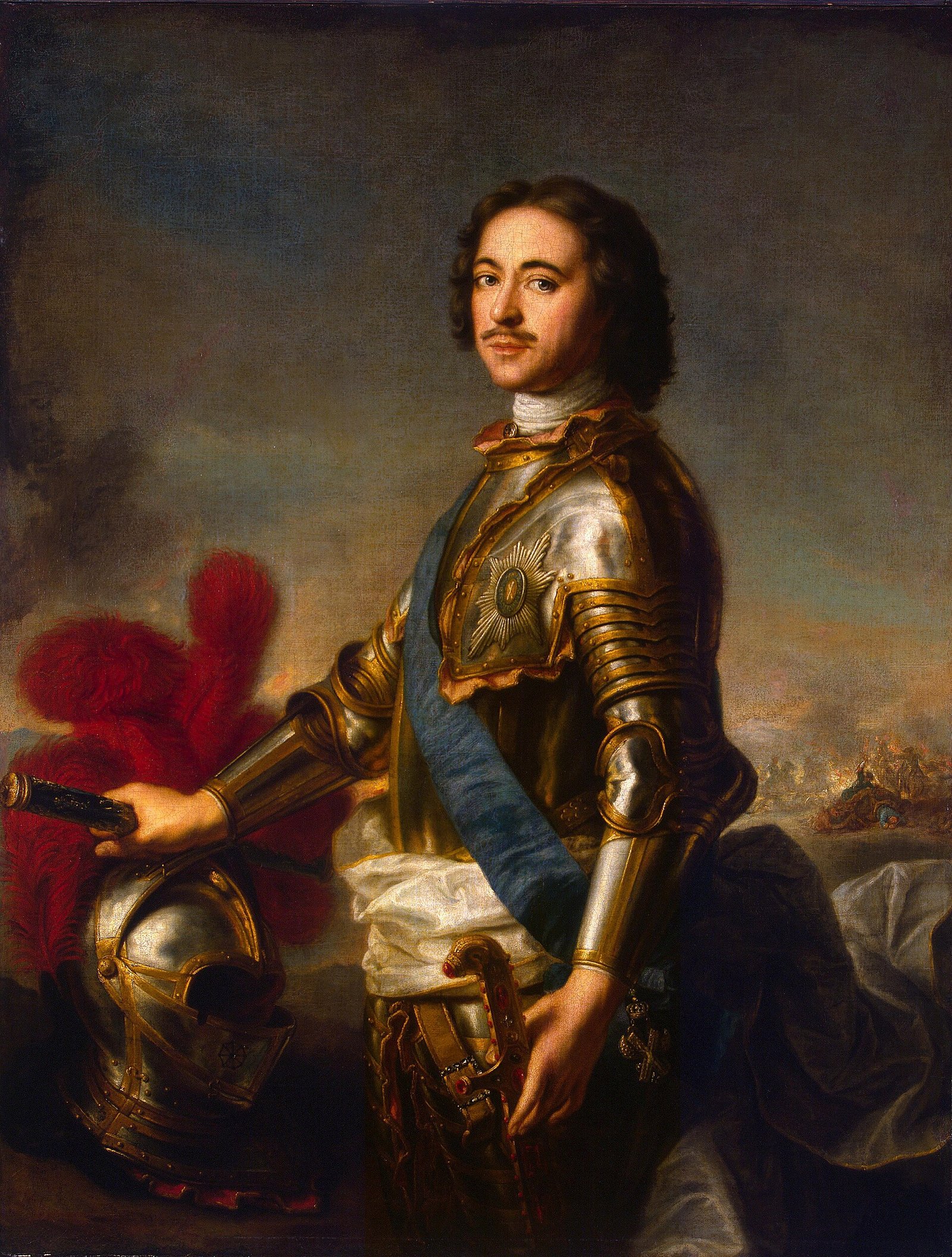
If you picture a tsar, you probably see a man on a throne. Peter the Great did something else. In 1697 he set out for Western Europe with his identity hidden, and he went to learn how to build ships. He came back and changed how Russians dressed, counted the years, governed and fought.
This guide covers who he was, how tall he stood, whom he married, what happened to his son and where you can see his monument. It also touches on why his Ottoman wars matter if you are visiting Turkey.
Peter the Great of Russia: who he was and where he ruled
Pyotr Alekseyevich of the Romanov dynasty was born in Moscow on 9 June 1672. His parents were Tsar Aleksey and Natalya Naryshkina.
He ruled Russia. From 1682 to 1696 he shared the throne with his elder brother Ivan V. After Ivan died, Peter ruled alone until 1725.
His seat of power moved during his reign. Moscow was the capital when he was born. In 1712 he moved the capital to Saint Petersburg, the city he had started building in 1703.
How tall was Peter the Great?
He is reported to have stood about 2.03 metres tall.
The height mattered on his journey. A man that tall in a crowd is easy to spot, so keeping his identity hidden was hard.
Why did the tsar travel through Europe in disguise?
In March 1697 the Grand Embassy began. It lasted about 18 months. Peter joined it with his identity concealed.
His goal was practical. He had just seen what a navy could do. In 1696, on his second campaign, his army captured the Ottoman fortress of Azov with the help of a newly built fleet. He wanted to learn more about shipbuilding from the people who did it best.
Zaandam and Amsterdam
He first went to Zaandam to learn ship carpentry. The Zaans Museum says he stayed eight days in 1697 in the modest wooden house of the blacksmith Gerrit Kist.
Then he moved to Amsterdam. There he worked at the shipyards of the Dutch East India Company.
England
In 1698 he studied the Deptford shipyards in England. At the Greenwich Observatory, John Flamsteed taught him how to use a telescope.
The Royal Collection holds a portrait of Peter from that year by Godfrey Kneller. It was made for William III, and ships manoeuvre in its background.
What happened when he came home?
The trip ended early. News reached him in 1698 of a new Streltsi uprising in Moscow. He cut short his journey and returned to Russia.
Then he started changing daily life. In 1698 he issued rules requiring Western clothing and the cutting of beards.
In 1699 he moved the start of the year from 1 September to 1 January. Years were now counted from the birth of Christ. If you toast the new year on 1 January, you are following the same calendar logic that Russia adopted by his order.
Timeline
- 1672 Peter is born in Moscow.
- 1682 He becomes co-tsar with Ivan V.
- 1689 He marries Yevdokiya Lopukhina.
- 1696 Ivan V dies, Peter rules alone, and Azov is captured.
- 1697–1698 On the Grand Embassy he studies shipbuilding in Holland and England.
- 1698 A Streltsi uprising calls him home; clothing and beard rules follow.
- 1699 The new year moves to 1 January and years are counted from the birth of Christ.
- 1700–1721 The Great Northern War against Sweden is fought.
- 1703 Saint Petersburg is founded.
- 1709 Russia wins at Poltava.
- 1711 The Governing Senate is created; after the Prut defeat, Peter agrees to return Azov.
- 1712 The capital moves to Saint Petersburg and Peter formally marries Catherine.
- 1718 Tsarevich Alexei is tried and dies in prison.
- 1721 The Treaty of Nystad is signed, the Holy Synod is created and Peter takes the title of emperor.
- 1722 The Table of Ranks is issued.
- 1725 Peter dies in Saint Petersburg.
- 1782 The equestrian monument is unveiled in Saint Petersburg.
Wars: from Azov to Poltava
The Great Northern War against Sweden ran from 1700 to 1721. Peter’s 1709 victory at Poltava raised Russia’s military weight in Europe.
The 1721 Treaty of Nystad ended the war. Russia received Estonia, Livonia, Ingria and a large part of Karelia from Sweden.
Not every campaign went his way, and this is where Turkey comes in. In 1711 Baltacı Mehmed Pasha’s army surrounded Peter on the Prut River. By the treaty that followed, Peter agreed to give Azov back to the Ottomans. The fortress he had won in 1696 was lost in 1711.
Saint Petersburg: a city built by order
Peter began the Saint Petersburg project in 1703. UNESCO describes it as a major urban planning effort, noted for its unity and the speed of its execution.
In 1712 he made it the capital. The country’s centre of government moved from Moscow to the new city.
How he rebuilt the state
Peter changed institutions as well as clothes.
- 1711: He set up the Governing Senate to organise central administration.
- 1721: He replaced the patriarchate with the Holy Synod, which was under state control. This strengthened the ruler’s hold over the Orthodox Church.
- 1721: He took the title of Emperor of All Russia.
- 1722: The Table of Ranks made service and achievement, rather than birth, the basis for promotion in state service.
That last point matters for ordinary people. A career in the state could now depend on what you did, not on your family name.
Peter the Great’s wife and children
Peter married Yevdokiya Lopukhina in 1689. The marriage ended in 1698. In 1712 he formally married his second wife, who later took the throne as Catherine I.
Many of his children did not survive. Only three reached adulthood: Alexei, Anna and Elizabeth, who later became empress.
Peter the Great’s son Alexei and the interrogation
Alexei was Peter’s son from his first marriage. In 1718 he was tried on a charge of treason, gave testimony under torture and died in prison.
The scene has inspired painters. Nikolay Ge painted Peter interrogating Alexei at Peterhof. The State Russian Museum dates its version of the painting to 1872.
The Peter the Great statue
Étienne Falconet made the equestrian monument on the orders of Catherine II. It was unveiled on 18 August 1782 on Senate Square in Saint Petersburg.
Details you won’t find in guidebooks
- A small wooden house. Peter’s eight days in Zaandam were spent in a blacksmith’s modest wooden house, not a palace.
- A tsar who pulled teeth. According to ITMO University’s museum guide, the Kunstkamera displays 32 teeth that Peter pulled himself.
- A plaster record of death. On the day Peter died in 1725, Carlo Bartolomeo Rastrelli was called to the palace to take casts of his face, hands and feet.
- A portrait for a king. Kneller’s 1698 portrait was made for William III, with ships in the background.
Did he modernise Russia or force it?
Historians disagree. One interpretation says his years of rule, 1682–1725, carried Russia into modern Europe. The opposing view stresses that his reforms relied on coercion and strengthened autocracy and serfdom.
Both views start from the same facts: a navy, a new capital, victories over Sweden and a state rebuilt from above. They differ on the price.
If you want a long read, Robert K. Massie’s biography Peter the Great: His Life and World won the 1981 Pulitzer Prize for Biography.
Death and burial
Peter died on 8 February 1725 in Saint Petersburg. He was buried in the Peter and Paul Cathedral.
FAQ
How tall was Peter the Great?
He is reported to have stood about 2.03 metres tall. That height made it hard for him to hide his identity on his European journey.
Where did Peter the Great rule?
He ruled Russia. He was born in Moscow in 1672, moved the capital to Saint Petersburg in 1712 and died there in 1725.
Who were Peter the Great’s wives and children?
He married Yevdokiya Lopukhina in 1689; the marriage ended in 1698. In 1712 he formally married the woman who later reigned as Catherine I. Only Alexei, Anna and Elizabeth, who later became empress, reached adulthood.
What happened to Peter the Great’s son Alexei?
Alexei was tried for treason in 1718, gave testimony under torture and died in prison.
Where is the Peter the Great statue?
Étienne Falconet’s equestrian monument stands on Senate Square in Saint Petersburg. It was unveiled on 18 August 1782 on the order of Catherine II.
Sources
- Vikipedi — I. Petro tr.wikipedia.org
- Wikipedia — Peter the Great en.wikipedia.org
- Zaans Museum — Czaar Peterhuisje zaansmuseum.nl
- State Russian Museum — Peter I and his Era rusmuseumvrm.ru
- Oxford Bibliographies — Peter the Great, Tsar of Russia doi.org
- UNESCO — Historic Centre of Saint Petersburg and Related Groups of Monuments whc.unesco.org
- Presidential Library — Unveiling of the Peter the Great Monument in Saint Petersburg prlib.ru
- ITMO University — Skeletons and Scientific Wonders: 5 Exhibits To See in the Kunstkamera news.itmo.ru
- Royal Collection Trust — Peter the Great, Tsar of Russia rct.uk
Image: Inconnu d’après J.-M. Nattier, Portrait de Pierre Ier (musée de l’Ermitage).jpg — Attributed to Jean-Marc Nattier, Public domain