Where is the Museum of Troy in Turkey?
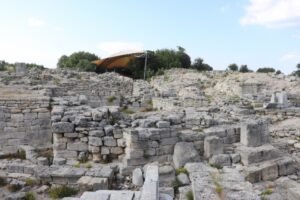
The Museum of Troy stands at the entrance to the Troy archaeological site in Tevfikiye village. The village belongs to Çanakkale’s central district. Here, you can connect objects from Troy and the surrounding Troas region with the archaeological site beside the museum. The building itself is also part of the visit: its weathering steel exterior was designed around the idea of an excavated artifact.
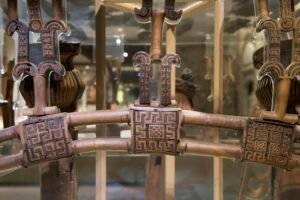
The collection gives you several ways into the subject. Bronze arrowheads come from Troy’s VI and VII settlement layers. Gold jewelry connects the displays with objects brought back to Turkey. The Polyksena Sarcophagus introduces a carved representation of a Trojan myth. Together, these exhibits extend the visit beyond a single type of object or a single period.
Museum of Troy history: when did it open?
The museum began receiving visitors on 10 October 2018. Its official opening followed on 18 March 2019, the date recorded by the Ministry of Culture and Tourism. These dates describe separate milestones. The first marks the start of public visits; the second marks the formal opening.
The building’s development took several years. A national architectural competition in 2011 attracted 132 projects. Construction began in 2013, stopped in 2015 and resumed in 2017. The museum that opened in 2018 therefore followed both a design competition and an interrupted construction process.
Inside, the exhibition follows seven thematic headings. Its scope runs from Troas archaeology through the Ottoman period and the history of excavation. That breadth matters when you look at the collection: the museum’s subject includes the region, its archaeological discoveries and the later history of investigating them.
Timeline
- 520–500 BCE: The period to which the Polyksena Sarcophagus is dated.
- 1994: A rescue excavation at Kızöldün Tumulus uncovered the sarcophagus.
- 2011: The national architectural competition attracted 132 projects.
- 1 September 2012: Twenty-four pieces of Early Bronze Age gold jewelry from the Penn Museum were brought to Turkey.
- 2013: Museum construction began.
- 2015: Construction stopped.
- 2017: Construction resumed.
- 10 October 2018: The Museum of Troy opened to visitors.
- 18 March 2019: The museum held its official opening.
- 2020: The museum received a national architecture award and a European Museum of the Year Special Commendation.
Museum of Troy: Yalin Architectural Design and the steel cube
Yalın Mimarlık designed the museum, with Ömer Selçuk Baz and Okan Bal among the team. Its main exhibition volume is a cube with a square plan measuring 32 by 32 metres. This clear geometric form gives the exhibition building a readily identifiable shape.
The exterior uses weathering steel, also called corten steel. Its surface rusts over time. The architects connected this material choice with the idea of an object recovered through excavation. The reference is therefore built into the cladding itself, rather than depending only on the artifacts displayed inside.
The cube does not contain every museum function above ground. Supporting functions are gathered in a single underground level. This arrangement reduces the amount of visible building around the exhibition volume. When you examine the design, the underground accommodation helps explain why the main cube carries so much of its visual identity.
The museum received the Building Category Award in the 2020 XVII National Architecture Exhibition and Awards. The award was made in Ömer Selçuk Baz’s name. A separate recognition came through the European Museum Forum, which lists Troy among the Special Commendation recipients in the 2020 European Museum of the Year Awards.
Which artifacts should you look for?
The bronze arrowheads include examples found in Troy VI and VII. Their recorded settlement layers make them useful objects for understanding how the displays connect individual finds with the archaeological sequence. Look at them alongside the museum’s broader account of Troas archaeology, one of its seven thematic subjects.
The gold displays have more than one collection history. Some objects came from the Istanbul Archaeological Museums. They are pieces remaining from the treasure that Schliemann took abroad. Their presence introduces another strand of the exhibition: the movement of archaeological objects after their discovery.
A separate group consists of 24 pieces of Early Bronze Age gold jewelry brought to Turkey from the Penn Museum on 1 September 2012. These pieces are displayed in the Museum of Troy. Keep that group distinct from the objects transferred from Istanbul; the two groups reached the museum through different routes.
Gold jewelry also offers an everyday-life connection. If you wear jewelry, use that familiar experience as a starting point when looking at the 24 Early Bronze Age pieces. Then return to their documented context: these are Early Bronze Age objects brought from the Penn Museum to Turkey in 2012.
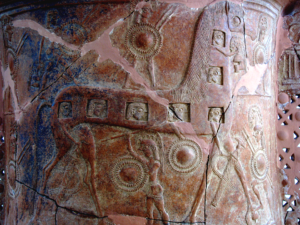
The Polyksena Sarcophagus dates to 520–500 BCE. It was discovered in 1994 during a rescue excavation at Kızöldün Tumulus in Gümüşçay, Biga. Its findspot is a useful reminder that the museum’s collection reaches beyond the settlement layers of Troy itself.
The sarcophagus takes its name from a scene on one of its long sides. That relief depicts the myth of the sacrifice of the Trojan princess Polyksena. The name identifies the represented story. Looking closely at the carving lets you connect the object’s familiar museum label with the scene that explains it.
On the second floor, another exhibit comes from Parion. The Triton/Kentauros statue was discovered there during excavations in 2012. Alongside the sarcophagus from Gümüşçay, it adds a specific regional findspot to the museum’s account of Troy and the surrounding Troas region.
Details you won’t find in guidebooks
The ramp connecting the exhibition floors has a total length of approximately 480 metres. This is a substantial part of the building’s internal route. As you move between displays, the ramp belongs to the architectural experience as much as the steel exterior does.
The Polyksena Sarcophagus carries 37 human figures across its reliefs. That number gives you a concrete reason to slow down at the carvings. The sacrifice scene explains the object’s name, while the full figure count directs attention to the relief decoration beyond that single scene.
A ship-shaped display case on the first floor was designed to explain Troy’s Bronze Age maritime trade. Its shape has an interpretive purpose. The case connects the objects on display with the exhibition’s account of trade by sea.
On the ground floor, an interactive screen allows visitors to explore the interior of Dardanos Tumulus digitally. This introduces another way to encounter an archaeological setting within the museum. You can use the screen as a separate stop alongside the physical objects.
On the second floor, a three-to-four-minute Trojan War animation draws inspiration from Attic vases and shadow theatre.
How do you get there, and what does a visit cost?
By road, turn towards Tevfikiye at the 25th kilometre of the Çanakkale–İzmir road. Continue for approximately five kilometres. Tevfikiye village minibuses also provide access from central Çanakkale, giving you a public transport option for reaching the museum.
The official museum page checked on 25 October 2026 lists opening hours of 08:30–17:30 every day. The ticket office closes at 17:00. Keep these two times separate when planning your arrival: the listed ticket-office closing time comes before the museum’s closing time.
The official tariff checked on 25 October 2026 gives a combined price of €27 for foreign visitors to the Museum of Troy and the Troy archaeological site. Turkish identity card holders can enter both places with Müzekart. The combined ticket therefore links the museum collection with the nearby archaeological visit.
According to the ministry’s combined-ticket description, a Troy archaeological site–Museum of Troy ticket purchased at the ticket office remains valid for 72 hours from its first purchase day. That validity period is useful when arranging the two parts of your visit across your stay.
Museum of Troy on ArchDaily and online
ArchDaily’s Museum of Troy project page presents the Yalın Architectural Design building through a gallery of 34 images. Photographs are credited to Emre Dörter and Murat Germen. For readers interested in the architecture, the gallery provides a visual companion to the cube’s dimensions and weathering steel design.
The Ministry of Culture and Tourism also provides a Museum of Troy virtual tour on its Sanal Müze platform. You can use it to explore the museum online before a visit or to return to its displays afterwards.
FAQ
Where is the Museum of Troy in Turkey?
The museum stands at the entrance to the Troy archaeological site in Tevfikiye village, in Çanakkale’s central district.
Who designed the Museum of Troy?
Yalın Mimarlık designed the museum. The team included Ömer Selçuk Baz and Okan Bal.
What artifacts can you see in the Museum of Troy?
Exhibits include bronze arrowheads from Troy VI and VII, Early Bronze Age gold jewelry, the Polyksena Sarcophagus and a Triton/Kentauros statue from Parion.
What awards has the Museum of Troy received?
In 2020, the museum received the Building Category Award in the National Architecture Exhibition and Awards, awarded in Ömer Selçuk Baz’s name. It also received a Special Commendation in the European Museum of the Year Awards.
What are the Museum of Troy’s opening hours and ticket arrangements?
The official information checked on 25 October 2026 lists daily opening hours of 08:30–17:30, with the ticket office closing at 17:00. The combined museum and archaeological site ticket costs €27 for foreign visitors; Turkish identity card holders can enter both with Müzekart.
Sources
- Ministry of Culture and Tourism — Museum of Troy muze.gov.tr
- Wikipedia — Troya Müzesi tr.wikipedia.org
- ArchDaily — Museum of Troy / Yalin Architectural Design archdaily.com
- Chamber of Architects, Istanbul Branch — 2020 National Architecture Awards mimarist.org
- European Museum Forum — Special Commendations europeanforum.museum
- Culture Portal — Museum of Troy kulturportali.gov.tr
- Culture Portal — Çanakkale Museum of Troy kulturportali.gov.tr
- General Directorate of Cultural Heritage and Museums — 24 Trojan Objects from the Penn Museum kvmgm.ktb.gov.tr
- DÖSİMM — Museum and Archaeological Site Fees dosim.ktb.gov.tr
- Ministry of Culture and Tourism — Museum of Troy Virtual Tour sanalmuze.gov.tr
Image: Museum of Troy (53022400001).jpg — Troya Müzesi from Çanakkale, Türkiye, CC BY-SA 2.0